
Fireworks raises $1.5B Series D for enterprise AI models, hits $1B ARR
Serge Bulaev
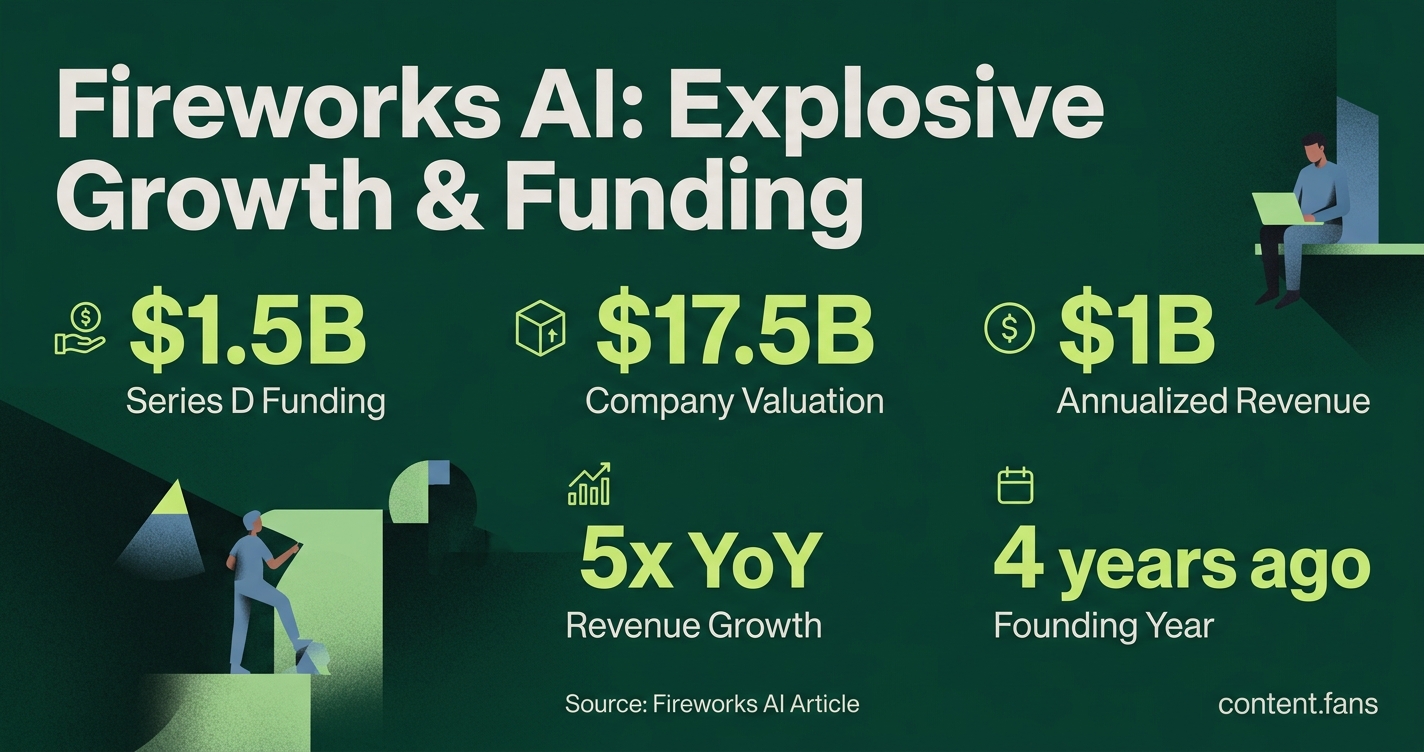
Fireworks, a San Mateo start-up, has raised $1.5 billion in Series D funding and now has a valuation of $17.5 billion. The company says it passed $1 billion in annual revenue, which may be linked to how much clients use its AI platform. Fireworks helps businesses customize and use AI models with their own data and appears to focus on being fast and affordable for enterprises. Investors and analysts suggest this funding might help Fireworks grow its engineering team and expand its computing power, although future success could depend on how quickly companies start using these AI tools in real operations.

Fireworks AI has secured $1.5B in a Series D round to advance its platform for enterprise AI models, hitting a $17.5B valuation. The San Mateo-based startup, founded four years ago, plans to use the new capital to deepen its focus on building specialized enterprise intelligence.
Investors see Fireworks as a foundational 'picks-and-shovels' provider for the era of open-source AI. This view is supported by the company's rapid growth, crossing $1 billion in annualized revenue - a fivefold year-over-year increase, as highlighted in a CNBC report. Company executives link this revenue directly to significant platform usage growth.
The new funding will accelerate Fireworks' core strategy: empowering enterprises to "own, customize, and improve" their own AI models instead of relying on closed, pre-trained systems. The platform achieves this by hosting open-weight models from developers like DeepSeek and MiniMax and offering tools to fine-tune them with private, client-specific data.
Series D Funding and Strategic Investors
Fireworks AI raised $1.5 billion to scale its AI infrastructure, which helps businesses build specialized models using their own data. The funding, co-led by major investors and including NVIDIA, validates its rapid growth and aims to expand its engineering team and secure more computing power for its clients.
The Series D round was co-led by Atreides Management, Index Ventures, and TCV, with strategic investments from NVIDIA and TIME Ventures. NVIDIA's involvement is tied to a supply agreement for GPUs, crucial for reducing latency and inference costs. Sacra confirms Fireworks uses specialized CUDA kernels and a proprietary batching engine but does not publish the specific margin, throughput, or cost reduction figures in the available summary.
Usage-based Business Model
Instead of traditional seat-based subscriptions, Fireworks operates on a usage-based business model, charging clients per unit of compute. This B2B managed runtime provides several pricing levers tailored to different AI workloads:
- Serverless inference - billed per generated token
- Fine-tuning - priced per training token
- Reinforcement fine-tuning - metered by GPU-hour
- Dedicated clusters - billed by GPU-second for latency-sensitive workloads
Additionally, the company negotiates contracts for reserved capacity on a case-by-case basis, offering scaling flexibility for large enterprise clients.
Enterprise Traction and Product Roadmap
The platform has already achieved significant enterprise traction, with a growing number of organizations, including industry leaders like Uber, Notion, and Vercel, building on its infrastructure. A strategic partnership announced in March integrates Fireworks' models into Microsoft Foundry on Azure, making its services accessible within established Windows and Office ecosystems.
The company's internal roadmap points to three key product launches in the near future:
- A voice agent platform targeting sub-500 ms latency in drive-thrus and contact centers.
- Agentic reinforcement fine-tuning that trains models for tool use and multi-step reasoning.
- Multi-LoRA support to run several lightweight adapters on a single GPU, which may improve utilization economics.
Industry analysts believe the Series D funding will be allocated to securing more compute resources and expanding the engineering team. If current demand trends continue, daily token throughput is projected to continue growing significantly, although Fireworks has not officially confirmed these targets.
Competitive Context
In a competitive landscape that includes hyperscalers like Microsoft Copilot Studio and open-source platforms such as ClearML, Fireworks carves out a unique position. As licensing for powerful models like Qwen 3 becomes more permissive with standards like Apache 2.0, enterprises gain more options for data sovereignty. Fireworks' strategy is to remain model-neutral, aiming to be the fastest and most cost-effective platform for running any leading open-source model.
Market analysts view this funding as a strong signal of investor confidence in usage-based AI infrastructure's potential to disrupt budgets traditionally allocated to RPA and contact center software. Ultimately, the company's long-term valuation will depend on the speed at which enterprises adopt these specialized AI tools in production environments.