
EU Lawmakers Ban Addictive Social Features for Minors
Serge Bulaev
EU lawmakers are working on a new law to protect children from addictive social media features. They suggest banning personalized content feeds and making non-personalized feeds the default for minors, along with turning off things like infinite scroll and autoplay videos. The plan may also require age checks and set a minimum digital access age. Researchers say these changes might help reduce mental health risks linked to social media algorithms, but tech companies warn the rules could be costly. The law is not final yet, and it appears that different rules in some countries could make agreement harder.

In a significant move to protect children online, EU lawmakers are advancing a proposal to ban addictive social media features for minors. The plan centers on creating a mandatory "youth mode" that disables algorithmic content feeds and engagement-driven designs by default, aiming to curb mental health risks associated with current platforms.
What Does the EU "Youth Mode" Actually Require?
The EU's proposed "youth mode" would require social media platforms to disable addictive features for minors by default. This includes turning off personalized algorithmic feeds in favor of chronological ones, removing infinite scroll and autoplay videos, and banning targeted advertising for all underage users.
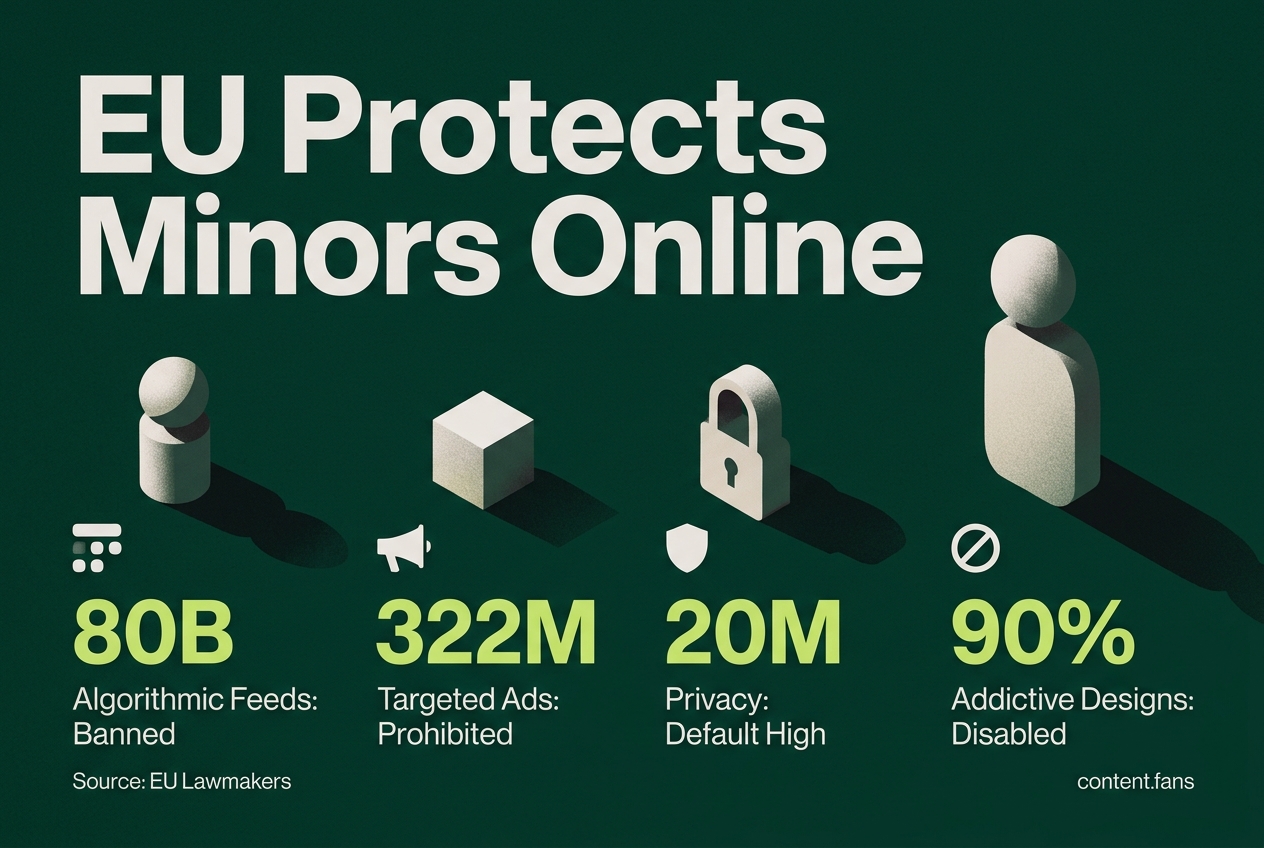
The proposed "youth mode" would fundamentally alter the user experience for minors by disabling algorithmic content feeds and addictive design features by default. Based on a report formally adopted by the European Parliament, key requirements include:
- Ban on Engagement-Based Algorithms: Minors would receive chronological or other non-personalized content feeds instead of feeds curated to maximize engagement.
- Removal of Addictive Designs: Features like infinite scroll, autoplay videos, and pull-to-refresh mechanics would be disabled.
- No Targeted Advertising: All targeted ads for users identified as minors would be prohibited.
- Privacy by Default: Accounts for minors would be required to have the highest privacy settings enabled automatically.
What Evidence Supports Banning Algorithmic Feeds for Children?
Regulators are citing a growing body of research that identifies algorithmic curation - more than screen time alone - as a primary driver of mental health risks for young people. Key evidence includes:
- Mental Health Links: Real systematic reviews confirm associations between problematic social media use and depression/anxiety, synthesizing evidence from recent years showing correlations with poor academic performance and mental health concerns.
- Harmful Content Escalation: The UK coroner's investigation into the death of Molly Russell found that algorithmic amplification of suicide-related content on platforms like Instagram and Pinterest was a contributing factor.
- Negative Community Clustering: Research indicates that algorithms can quickly escalate vulnerable youths into online communities that promote disordered eating, self-harm, and other dangerous behaviors.
- Stunted Emotional Development: Mental health experts have raised concerns that AI companionship features present on some platforms may hinder emotional growth by replacing real human connection with simulated empathy.
How Are Tech Companies Responding?
Industry reaction has been largely oppositional, focusing on the potential for significant economic disruption and high implementation costs. Major concerns include:
| Concern | Description |
|---|---|
| Economic Impact | Ad revenue and teen user metrics are threatened, while compliance would necessitate costly and complex age-assurance systems. |
| Product Redesign | Removing core features like infinite scroll and algorithmic feeds requires fundamental engineering changes that could impact business models. |
| Business Disruption | EU officials have stated that the goal is to force the creation of "new platforms with completely different business models." |
Some tech leaders have framed the regulations as a threat to free expression. Musk has opposed EU digital regulations broadly, though specific statements about these particular proposals remain a matter of ongoing debate.
When Will This Legislation Take Effect and What Age Limits Are Proposed?
The timeline for implementation remains tentative, as the proposal is not yet law. The European Parliament's vote produced a non-binding resolution, and the European Commission is expected to unveil a formal legislative draft as part of future digital legislation.
A major complication is the lack of consensus on age limits, which creates uncertainty for platforms. The current proposals include:
- European Parliament: A 16-year minimum for social media access, with parental consent allowed for users aged 13-15.
- Member State Initiatives: National governments are pursuing stricter rules. France's Senate has passed a bill banning under-15s entirely from certain platforms, and Italy is considering similar legislation.
This fragmentation means that achieving a single, harmonized standard across the EU will be a key challenge in the upcoming negotiations between the Parliament and member states.