
Bad Data Slows AI Agent Rollouts, Causes Millions in eCommerce Losses
Serge Bulaev
Bad data may slow down the rollout of AI agents in eCommerce and cause large financial losses. Experts warn that most data problems come from spreadsheets and missing checks, not from the AI models themselves. Studies suggest that fixing bad data can take up to 60 percent of project time, and errors may lead to lost sales or huge pricing mistakes. Clean data should be complete, consistent, current, and connected, and ongoing human checks and monitoring are needed to catch problems. If data is not cleaned, AI may make costly errors and damage customer trust.

Many operators overlook that The Most Expensive Mistake in Ecommerce Is Invisible - Data Quality Underneath AI Agents sits in their own spreadsheets, not in futuristic models. Jo Lambadjieva, CEO of Amazing Wave Digital, keeps warning audiences that automation without verification "removes the human process of insight generation" and blinds teams to stale or fabricated inputs.
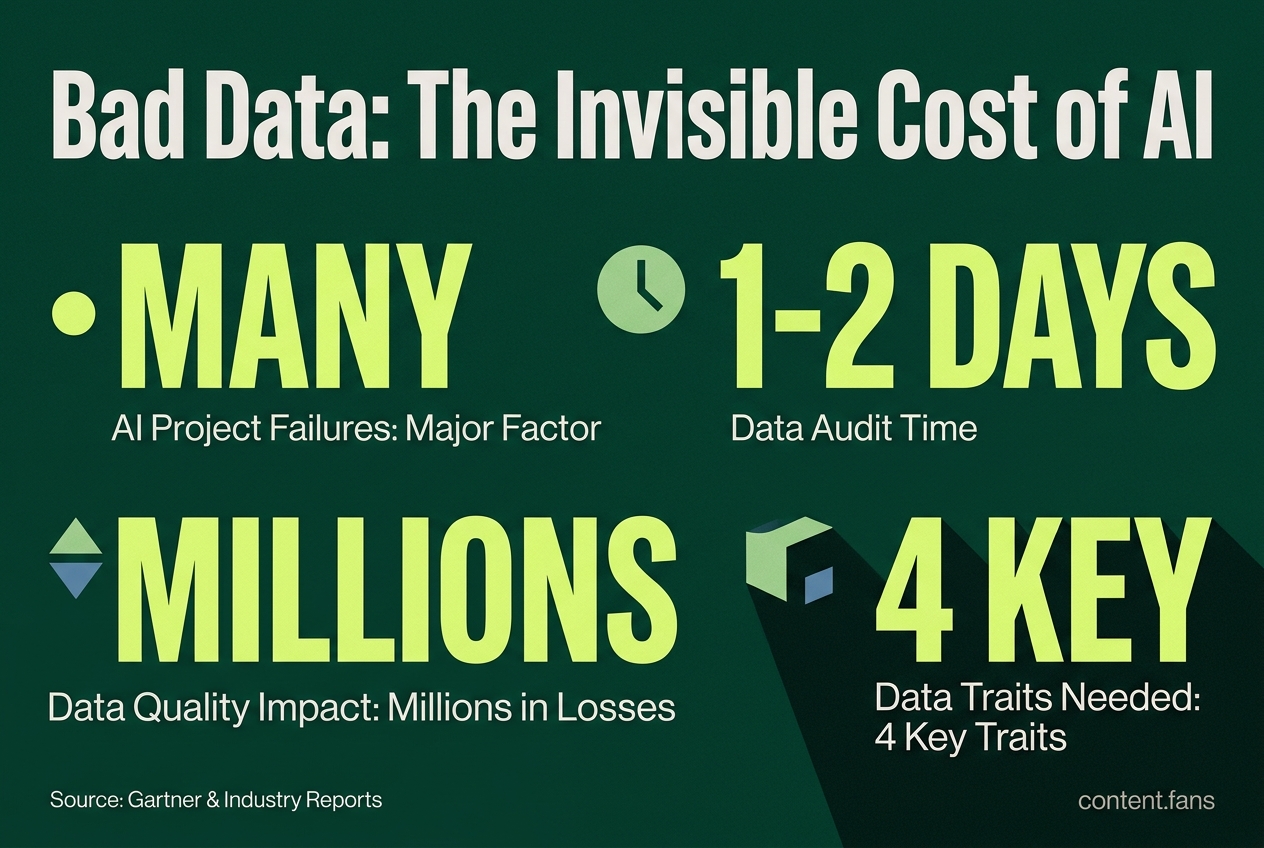
According to Gartner, poor data quality is a major factor in AI project failures, with data quality issues contributing significantly to implementation challenges across the industry. This suggests the real bottleneck is the catalog, not the code.
The Most Expensive Mistake in Ecommerce Is Invisible - Data Quality Underneath AI Agents
Bad inputs can trigger cascading losses. An agent trained on outdated unit costs may see room for a deep discount, automatically sync the new price to marketplaces, and boost bids on the now "high margin" item. Operators discover the error only after margins vanish. According to industry reports, pricing agents have caused substantial losses when upstream data corruption leads to severe pricing errors, with some incidents resulting in significant financial damage before operators could intervene.
Source data issues follow repeatable patterns:
- Incomplete product attributes (missing sizes, materials) mislead recommendation or ad agents
- Inconsistent inventory tables show items as both "in stock" and "reserved"
- Stale competitor price files sit untouched for weeks, yet drive hourly repricing jobs
- Hallucinated SKUs enter the catalog when generative assistants draft listings without guardrails
According to industry studies, merchants with empty collections or duplicate products often see shopping agents query competitors instead, resulting in lost sales opportunities.
Data properties every AI agent needs
Clean datasets share four traits. They are complete, consistent across systems, current in near real time, and connected so that the same customer ID appears in the CRM, PIM, and ad stack. Industry practitioners suggest that substantial historical data is typically required before training demand models. If a significant portion of fields need manual repair, teams often postpone deployment until data quality improves.
Auditing in hours, not months
Lambadjieva argues that solo sellers can audit core data in one or two days by exporting:
1. Product master file (attributes, cost, price)
2. Last 90 days of orders with timestamps
3. Current inventory snapshot
4. Advertising spend and conversion logs
Look for blanks, negative numbers, or impossible combinations. Mid-sized teams designate data owners per table and publish precedence rules - which column overrules when two sources differ. Larger brands embed checks into workflow tools and set drift alerts that flag sudden swings in fill-rate or attribute sparsity.
Human review stays in the loop
Both the E-commerce Will Never Be The Same After AI interview and Lambadjieva's later YouTube Q&A note that "the more you automate, the less you actually understand what's happening." Practitioners therefore start agents in suggestion mode. Price agents output draft changes; humans approve or reject. Copy agents propose bullet points; merchandisers verify materials and compliance labels. This guardrail may slow time to value, yet it prevents silent erosion of margin and trust.
Monitoring for drift
Once live, agents require telemetry. Teams track error rates such as mismatch between forecast and actual sales or frequency of backorders after automated reorders. A surge signals that the underlying feed slipped out of spec, not that the model "got dumber." Vendor lockouts, API version changes, or a new shipping surcharge can all degrade once-clean data.
Poor data does not only waste advertising budget; it erodes customer confidence. Shoppers who see phantom stock or randomized prices may not return. Cleaning the inputs is therefore a revenue exercise, not a housekeeping chore. Data maturity determines whether AI amplifies profit or multiplies mistakes.
Bad data slows AI agent rollouts, a vulnerability costing ecommerce merchants millions. While agents transform operations like repricing and forecasting, they blindly trust unverified data. Jo Lambadjieva, CEO of Amazing Wave Digital, warns the risk is not flawed AI but the stale inputs agents consume without human skepticism.
What specific ecommerce tasks are AI agents handling today?
Bad data causes AI agents to make costly errors because they cannot instinctively spot anomalies the way humans can. Flawed inputs, such as outdated prices or incorrect inventory levels, are accepted as fact, leading to automated decisions that erode profit margins and damage customer trust at scale.
AI agents now manage high-velocity, high-stakes workflows across the ecommerce stack: dynamic repricing, advertising optimization, inventory forecasting, listing generation, and demand prediction. These systems operate continuously, making thousands of micro-decisions that compound rapidly. Where a human might pause to verify a suspicious competitor price or inventory signal, agents proceed immediately - amplifying any data errors into cascading operational failures.
How does bad data actually cause financial damage?
The damage follows predictable failure cascades. Consider this documented pattern: a flawed demand forecast (based on stale conversion data) triggers excessive inventory orders; excess stock then forces aggressive price cuts; automated advertising agents scale spend on these discounted prices, acquiring unprofitable customers. According to industry reports, pricing agent incidents have caused substantial financial losses when upstream data corruption leads retailers to list items at severely discounted prices, with no magnitude safeguards to halt the cascade.
Why can't AI agents spot bad data the way humans do?
Historical ecommerce operations relied on an informal human data filter - experienced managers who instinctively flagged anomalies, questioned sudden competitor price drops, or recognized when inventory signals felt "off." Agents lack this intuition entirely. As Lambadjieva notes in a popular interview, over-automation creates "loss of business intuition" where operators stop verifying whether AI data is hallucinated or true. Failure rates for AI projects vary significantly by scope, with poor data quality consistently ranking as a top failure cause across enterprise implementations - not model sophistication, but the amplification of weaknesses in underlying datasets.
What are practical remediation steps for different organization sizes?
Solo sellers can execute corrective audits of core datasets - costs, fees, competitor lists, conversion data - typically achievable in one to two days. Many sellers operate with tools and spreadsheets unverified for months or years.
Mid-sized teams need designated data owners and clear precedence rules determining which system holds authoritative values when sources conflict.
Larger organizations require workflow-level oversight and drift monitoring - automated alerts when data patterns deviate from baselines, triggering human review before agents act on corrupted inputs.
Should businesses prioritize data volume or data curation?
Curation decisively outweighs volume. The most successful deployments emphasize relevance and currency over providing agents with every historical file. Industry best practices suggest that substantial amounts of clean, well-labeled data are typically sufficient for training - with many practitioners recommending that only a small portion of data should require manual cleaning before AI deployment. Schema compliance multiplies AI visibility: Product JSON-LD pages are cited 3.1x more frequently in AI-generated shopping results.
The strategic imperative is clear: data maturity, not tool sophistication, determines AI success. Before deploying agents, audit whether your data satisfies four properties - complete, consistent, current, and connected across systems. As Lambadjieva warns: "The more you automate, the less you actually understand what's happening in your own business. And that's about to cost you a lot of money."