
Anthropic Launches 3 Free Claude AI Certificates, Challenges Paid Courses
Serge Bulaev
Anthropic Academy now offers three official Claude AI certificates and 18 free courses, which may help learners show their skills without paying fees. These certificates can be easily shared on LinkedIn, and hiring managers may recognize them. This move appears to make Anthropic's courses the main choice for Claude learning, while paid courses are trying to add value to justify higher prices. Over 400,000 people reportedly completed Anthropic training, suggesting free options might be replacing many older paid tutorials. The free entry-level certificates may set a new standard for learning about AI models.
Anthropic now offers three official free Claude AI certificates and multiple courses via its Anthropic Academy, providing a no-cost way to validate Claude skills. The full catalog is available on Skilljar, and certificates can be posted directly to LinkedIn, creating a verifiable credential for hiring managers.
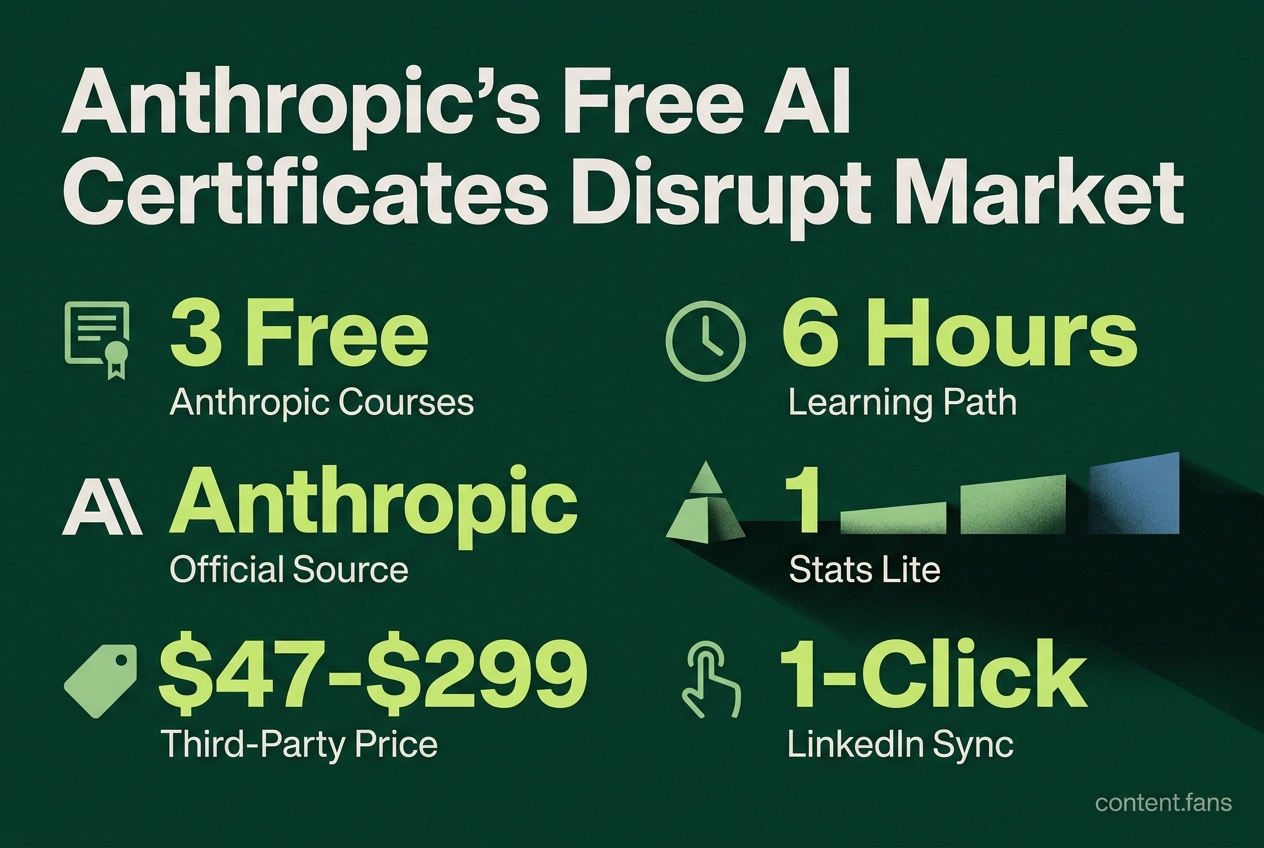
This strategic move establishes Anthropic's official training as the primary starting point for Claude education. Consequently, third-party course providers are under pressure to justify their pricing, which ranges from approximately $47 to $299 for unofficial training.
Inside the official credential path
Anthropic offers three official certificates: Claude 101, AI Fluency, and Introduction to Claude Cowork. Hosted on its Skilljar academy, these free courses provide a verifiable credential. After completing the six-hour path and passing quizzes, learners receive a shareable certificate for their LinkedIn profiles, validating their expertise.
Anthropic recommends a learning path that takes approximately six hours to complete. It includes:
- Claude 101 - overview of the model's interface and safety guardrails
- AI Fluency: Framework & Foundations - applies the 4D framework of Delegation, Description, Discernment, and Diligence
Upon passing a short quiz for each course, learners automatically receive a PDF certificate from Skilljar and can add it to their LinkedIn profile with one click, complete with official Anthropic Academy branding.
Competitive pressure on third-party providers
The introduction of free, official training fundamentally alters the market for entry-level Claude education. With a growing number of individuals completing Anthropic training, a significant shift away from paid tutorials is evident. In response, third-party providers are pivoting to offer value-added services like live coaching and exam prep for Anthropic's paid Pearson VUE exams to justify their fees, as seen with offerings from companies like Learning Tree.
Why Anthropic stresses AI fluency over prompt tricks
Early market signals to watch
While paid Claude certificates still exist, market pricing indicates significant pressure on their profit margins. The table below illustrates how third-party providers are attempting to differentiate themselves:
| Provider type | Typical price band (USD) | Differentiator |
|---|---|---|
| Download-only video course | 47-99 | Convenience bundles |
| Instructor-led bootcamp | 199-299 | Live coaching, mock exams |
| Anthropic Academy | 0 | Official source, LinkedIn sync |
The seamless social sharing of official certificates is a key factor driving adoption. The number of free courses on Skilljar is also growing, further cementing the platform's appeal.
By offering entry-level credentials for free and charging only for advanced, proctored exams, Anthropic is following a model proven in other major tech ecosystems. This strategy is poised to establish a new industry standard for what constitutes baseline AI literacy.
What certificates does Anthropic offer for free?
Anthropic provides three core certificates through its Skilljar-hosted academy, forming a structured credentialing path: Claude 101, AI Fluency: Framework & Foundations, and Introduction to Claude Cowork. These certificates are official, verifiable, and auto-post to LinkedIn with Anthropic Academy branding - distinguishing them from unofficial alternatives. The recommended completion order is Claude 101 first, then AI Fluency, followed by the Cowork course.
How long does it take to complete the certification path?
The total completion time is roughly six hours across all three courses. This represents a significant time investment relative to many paid alternatives, yet remains accessible for working professionals. The AI Fluency: Framework & Foundations course specifically emphasizes judgment and durable skills over simple tool memorization - a pedagogical approach that may extend learning time but builds transferable competency.
What is the 4D framework taught in the AI Fluency course?
The 4D framework - Delegation, Description, Discernment, and Diligence - serves as Anthropic's core model for AI competency. Rather than teaching "button-pushing," the framework develops four interconnected competencies to ensure AI interactions are effective, efficient, ethical, and safe. Anthropic has operationalized this into measurable behaviors, with 11 observable indicators tracked across Claude.ai conversations. The framework now underpins domain-specific courses for creators, builders, and educators.
How do these free certificates compare to paid third-party Claude courses?
Anthropic's official certificates create direct price competition for introductory Claude education. Third-party unaffiliated courses currently charge $47-$299 despite lacking official recognition. With many people completing Claude training through the free Anthropic Partner Academy, the official channel has substantial reach. Paid alternatives now typically differentiate through instructor-led preparation, hands-on labs, or advanced consulting rather than competing on basic credentialing.
Why does the LinkedIn integration matter for these certificates?
The auto-posting feature to LinkedIn transforms completion into immediately visible professional credibility. Each certificate carries official Anthropic Academy branding, creating a verifiable signal of Claude competency that employers can trust. This integration addresses a key friction point in professional development - the gap between learning and demonstrable credential - while competing directly with paid certification programs that often lack equivalent institutional backing.