
Eight AI Harnesses Reshape Enterprise Expectations in 2026
Serge Bulaev
Domain-specific AI harnesses may help companies cut repeated tasks and make work more auditable, especially in fields like law, design, healthcare, and customer service. The article lists eight harnesses that are being used in 2026, each focused on a specific use, such as legal research, design, or enterprise search. Research suggests these harnesses are moving towards systems that can adapt and swap parts more easily, and some tools may even fix themselves if they fail. It appears important for teams to keep human review, log all actions, use modular designs, and test tools on their own data. The main idea is that these domain-specific harnesses may turn general AI models into reliable and trackable helpers for different jobs.

Domain-specific AI harnesses are central to the current wave of AI tooling, enabling firms to enhance large language models with specialized prompts, tools, and guardrails. This approach significantly reduces repetitive tasks and boosts auditability in both creative and regulated fields. This article profiles leading AI harnesses and explores how emerging research into adaptive orchestration is redefining enterprise expectations.
Legal research and drafting
The Harvey AI harness equips a large language model with specialized templates for legal workflows like due diligence, contract analysis, and motion drafting. Following a June 2025 partnership reported by LawNext, Harvey integrates LexisNexis content and Shepard's Citations. To ensure auditability, the system logs all prompt-response interactions, allowing legal partners to trace sources before filing.
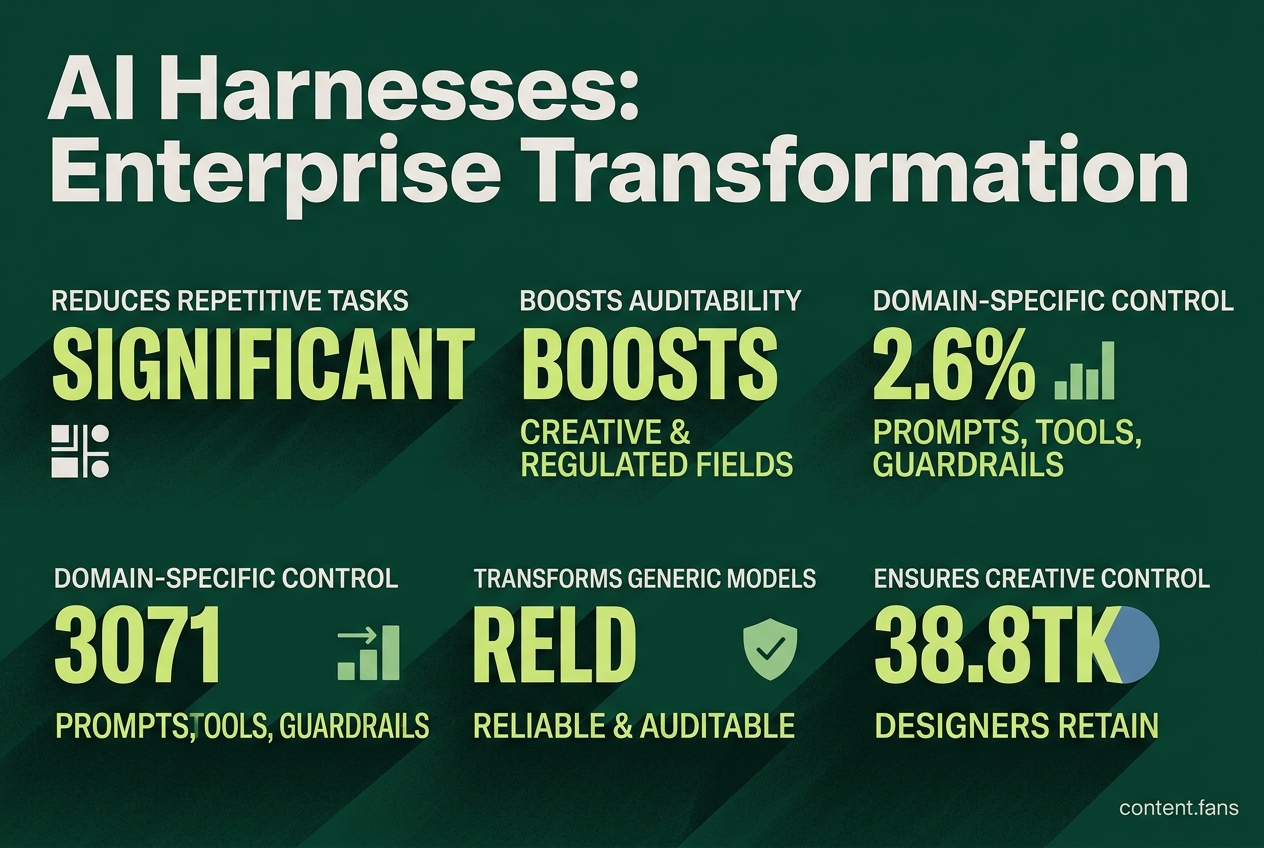
An AI harness is a control layer built around a general AI model, adding domain-specific prompts, tools, and safety guardrails. These systems are critical for enterprises because they transform powerful but generic models into reliable, auditable, and task-specific assistants for regulated and complex workflows.
Design ideation
Integrated directly within the Figma canvas, Figma AI translates natural-language prompts into component layouts and style adjustments. The harness is designed for safety, limiting destructive actions to prevent errors and providing a diff view to ensure designers retain full creative control.
Clinical documentation
Abridge specializes in clinical documentation, capturing conversations between patients and providers to automatically generate draft medical notes. The harness adheres to healthcare AI compliance by routing sensitive data for mandatory clinician sign-off. Because documentation standards vary by medical specialty, local validation is essential for deployment.
Customer service agents
The Sierra harness delivers brand-aligned customer support by allowing firms to configure specific parameters for tone, escalation policies, and refund authority. For quality control, it makes every final answer and its source citations visible to supervisors, who can then correct any responses that deviate from company policy.
Automated code review
Cursor's Bugbot and Greptile automate code review by scanning pull requests to identify anti-patterns and suggest code patches. The harness provides developers with inline suggestions and a complete replay log of every action taken by its sandboxed execution tool, delivering the high level of observability demanded by enterprise-grade systems.
Go-to-market research
Clay streamlines go-to-market research by automatically enriching prospect lists with firmographic data via external API calls and then drafting personalized outreach messages. The platform ensures accuracy and control by allowing sales teams to audit every data enrichment step before any communication is sent.
Enterprise search
Glean functions as a powerful enterprise search harness, indexing internal knowledge bases to provide answers with direct citations to source documents. Crucially, it enforces security by filtering all responses through role-based access controls, ensuring that confidential information remains protected.
Why emerging harness research matters
While the products listed above currently use handcrafted frameworks, emerging research indicates a significant shift towards adaptive orchestration. A survey of frameworks cataloged in the awesome-harness-engineering GitHub project reveals that modern systems increasingly feature modular designs, separating the agent loop, memory, and policy layers into interchangeable plugins. This trend is validated by the "Meta-Harness" research paper, which demonstrated that adaptive systems could achieve a 7.7-point performance gain on text classification while using four times fewer tokens than static wrappers.
Researchers describe three key shifts influencing commercial tools:
- Modular Architectures: Plugin-based designs simplify the process of testing different model versions, guardrails, or new tools without requiring a full rewrite of the core logic.
- Automated Synthesis: Advanced systems can now automatically generate harness scaffolds from task specifications, significantly reducing the engineering effort required for custom or niche workflows.
- Self-Repairing Systems: Cutting-edge research focuses on routines that can analyze failure logs, autonomously propose corrections to the harness, and run regression tests before deploying the fix.
Practical takeaways for teams
- Start Small and Include Human Oversight: Every successful harness profiled begins with a narrowly defined workflow and incorporates human review for high-impact decisions before any action is finalized.
- Log Everything for Auditability: Comprehensive telemetry, including logs and diff views, is essential for meeting the strict audit and discovery requirements found in legal and healthcare environments.
- Embrace Modularity: As suggested by emerging research repositories, future-proofing an AI system is best achieved with a modular design where memory, planning, and policy components are isolated and swappable.
- Validate with Your Own Data: High performance on public benchmarks offers no guarantee of reliability. Teams must validate any tool against their own firm-specific datasets and operational standards.
Ultimately, domain-specific AI harnesses are the key to unlocking enterprise value from general-purpose models. By layering them with fine-tuned prompts, controlled tool access, and robust human oversight, organizations can create specialized assistants that are not only powerful but also dependable, auditable, and secure.
Structured FAQ
What exactly is an AI harness, and why has it become critical for enterprise AI?
An AI harness is the control system surrounding a large language model - encompassing prompt engineering, tool integration, memory management, and safety guardrails. What has transformed the enterprise landscape is the shift from static wrappers to adaptive, evolvable orchestration layers that can rewrite their own control logic during deployment.
The research reveals that enterprises moved away from "fully autonomous general agents" toward domain-specific harnesses that operate inside tightly governed workflows. This evolution was driven by the need for repeatable workflows, observability, and compliance boundaries - particularly in coding, analytics, research, and agentic task automation. The repo was in developer preview and reached extremely rapid growth, with reports ranging from about 95K stars in two days to over 120K within three days and roughly 200K by the end of August, signaling unprecedented developer interest in modular, plugin-based harness architectures.
How do domain-specific harnesses differ from general-purpose AI assistants?
Domain-specific harnesses bake vertical knowledge directly into their architecture rather than relying on the underlying model's training. Leading harnesses exemplify this specialization:
| Harness | Domain | Core Specialization |
|---|---|---|
| Harvey | Legal | Research and drafting workflows with LexisNexis integration |
| Figma AI | Design | Native design tooling integration |
| Abridge | Healthcare | Clinical documentation from patient visits |
| Sierra | Customer Service | Brand-specific agent deployment |
| Cursor's Bugbot & Greptile | Software Development | Automated code review |
| Clay | Sales | Go-to-market research and lead enrichment |
| Glean | Enterprise Search | Citations back to source documents |
The critical distinction is tool calling capability - the harness enables the model to request external actions, transforming AI from passive responder to active workflow participant.
What implementation challenges do regulated industries face with AI harnesses?
Organizations in healthcare and legal sectors confront fragmented regulation, patient-safety liability, and auditability requirements that general-purpose deployments rarely address. Industry research identifies several non-negotiable elements for regulated harness deployment:
- Human-in-the-loop review for outputs affecting care, rights, or legal outcomes
- Immutable audit trails capturing prompts, model versions, outputs, reviewer actions, and overrides
- Local validation before production launch - a tool may perform well in benchmarks yet fail in specific hospital workflows or patient populations
- Vendor contract controls requiring disclosure of development, testing, bias mitigation, and update policies
Healthcare organizations specifically face state-level AI regulation patchworks alongside federal HIPAA obligations and potential FDA oversight for software-as-a-medical-device classifications. Legal workflows add concerns around confidentiality, privilege preservation, and citation provenance tracking.
What evidence exists that adaptive harnesses outperform static approaches?
The Meta-Harness research published March 30, 2026 provides concrete validation: automated harness discovery and optimization achieved 7.7 points improvement on online text classification while using 4× fewer context tokens, with additional gains on retrieval-augmented math reasoning and agentic coding benchmarks.
Further developments demonstrate this trajectory:
- Self-improving loops that mine failure traces, propose harness edits, and validate through regression testing
- SIA (Self-Improving AI) framework updating both scaffold and model weights in single loops, with reported wins on LawBench and specialized technical tasks
- Task-adaptive orchestration selecting sequential, parallel, hierarchical, or hybrid execution based on runtime task structure
These advances matter for enterprises because they enable continuous improvement in production-like environments without sacrificing testability or auditability.
How should enterprises evaluate harness vendors?
Industry research indicates organizations prioritize five core capabilities:
- Observability - traceable steps, execution logs, and failure traces
- Modularity - ability to swap models, tools, and policies without rewriting entire agents
- Safety and constraints - tool schemas, execution guards, and bounded actions
- Continuous improvement - harnesses evolving based on real task streams
- Domain specialization - tailored to specific verticals rather than general chat
Practical adoption patterns show developer tooling and code agents as the fastest-moving category, followed by search, research, and data workflows. Production automation increasingly depends on middleware and orchestration rather than prompt engineering alone. For governed rollouts, enterprises favor harnesses exposing explicit control points for policy, logging, and regression testing - capabilities difficult to achieve with prompt-only systems.