
Dan Shipper's Every argues AI expands expert human work
Serge Bulaev
Dan Shipper's Every essay suggests that AI may not simply replace human work, but instead increases the need for expert judgment and review. As AI makes basic tasks cheaper and faster, companies might need more people to refine and oversee AI output. Evidence from Every's team shows that after automating many tasks with AI, they hired more editors and specialists to ensure quality. Some reports suggest this pattern could happen in many jobs, with AI amplifying the importance of human skills like creativity and decision-making. Shipper recommends leaders focus on review processes and hiring experts to work with AI, rather than just cutting staff.

In a widely-discussed essay, Dan Shipper's Every argues AI expands expert human work, framing artificial intelligence not as a job substitute but as an amplifier of human expertise. His "After Automation" thesis posits that as AI drives down the cost of basic competence, it paradoxically increases the demand for high-level human judgment and creative oversight. This concept, termed the AI paradox link, is detailed in the original Every essay.
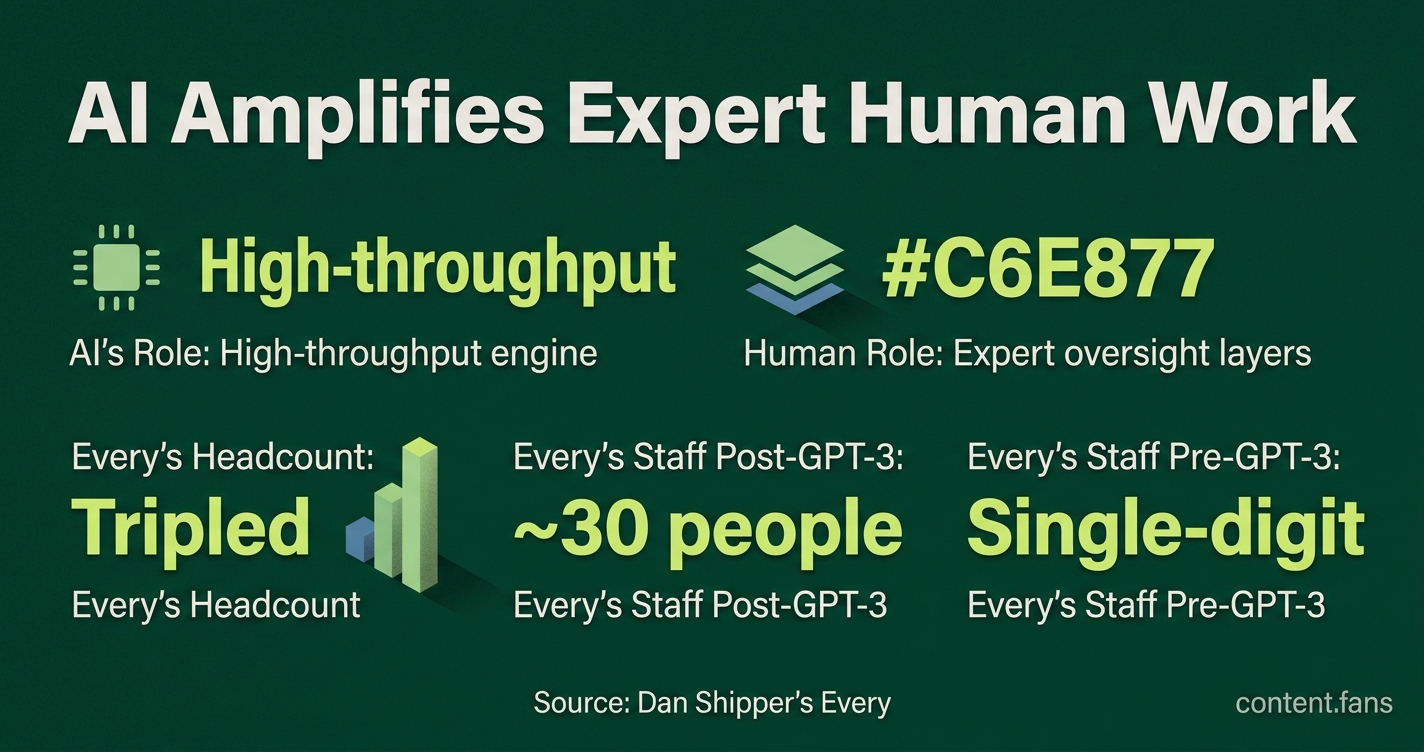
Companies experimenting with large language models are increasingly treating AI as a high-throughput engine while expanding their expert oversight layers. This strategic shift is reshaping hiring practices, workflow design, and product strategy across multiple business functions.
How the thesis reframes AI adoption
Dan Shipper's core thesis is that AI reduces the cost of baseline competence, shifting the primary bottleneck from task execution to expert review. Instead of replacing workers, AI generates a higher volume of raw output, which in turn elevates the need for human experts to provide critical judgment and creative direction.
Shipper frames automation as a drop in the price of competence, not labor. When a model instantly drafts marketing copy, the bottleneck becomes editorial taste; when it generates code, engineering review becomes paramount. This suggests that businesses should:
- Deploy AI to accelerate the routine generation of text, code, and images.
- Preserve or grow headcount in roles that decide, refine, and contextualize AI outputs.
- Measure success by higher throughput and quality per project, not by raw payroll cuts.
Evidence inside Every's own workflows
Every provides a concrete test bed for this thesis with its own internal experiments. A companion podcast, "We Automated Everything With AI and Tripled Our Headcount," details how the team routed numerous mid-loop tasks to AI models while hiring more editors and product specialists to polish the results podcast interview. The discussion reveals that while automated first drafts of articles and pull requests arrived faster, they required more human review to maintain house style and code reliability. Consequently, the company's staff grew to approximately 30 people post-GPT-3, up from a single-digit team beforehand.
Implications for software teams
Shipper's thesis has gained significant traction among product and engineering leaders. He states that future software must be built "for humans and agents to use together," dismissing an "automation-first" mindset. In practice, several startups are reportedly embedding AI code suggestions directly into their pull-request workflows while assigning senior engineers as dedicated reviewers. This signals early adoption of a human-in-the-loop model:
| Workflow stage | AI role | Human role |
|---|---|---|
| Draft | Generate baseline code or copy | Outline intent and constraints |
| Review | Flag obvious bugs or style issues | Decide architectural fit, approve merge |
| Polish | Suggest minor edits | Apply brand voice, validate edge cases |
Alignment with broader labor data
Shipper's argument aligns with broader macroeconomic labor data. A 2026 BCG study finds that 50 to 55 percent of US jobs could be reshaped into "amplified roles" where humans remain central to value creation. Similarly, the World Economic Forum's January 2026 briefing notes that AI is shifting entry-level work away from repetitive tasks and toward judgment, creativity, and collaboration. While these reports do not cite Shipper directly, their conclusions mirror his core claim that automation raises the demand for uniquely human skills.
Practical takeaways for leaders
Leaders seeking to apply this thesis can consult Every's downloadable playbooks, which offer process templates and "compound engineering" camps. At a minimum, Shipper recommends that organizations budget for dedicated review layers, meticulously track model error rates, and hire forward-deployed operators to connect generic AI output with specific business contexts. This strategic orientation helps companies boost productivity without the morale and quality dips often associated with aggressive headcount reductions.
What is the core claim of Dan Shipper's After Automation essay?
AI does not replace expert labor; it multiplies it.
Shipper argues that as AI drives the cost of baseline expert competence toward zero, the total volume of work that still needs human judgment, review, and creative finishing actually increases. In practice, Every turned this insight into two internal workflows:
- Codex handles mid-loop code tasks
- Compound Engineering reserves human effort for ideation and polish
The net effect is a shift from manual execution to oversight, not a reduction in headcount.
How has Every operationalized the "more-AI = more-humans" thesis?
Every's own headcount tripled after full AI adoption, a story detailed in We Automated Everything With AI and Tripled Our Headcount.
Key steps in their playbook:
- Use AI for throughput. Let models draft pull requests, generate thumbnails, or outline articles.
- Hire higher-level reviewers. Engineers, designers, or editors refine, contextualize, and ship the AI output.
- Create new coordination roles. "Forward-deployed" operators ensure the loop between agents and humans stays tight.
This approach is now packaged into public guides and week-long camps that other teams can replicate.
What new roles are emerging as AI commoditizes routine tasks?
Industry data from 2025-2026 shows new categories of human work are scaling fastest:
- Forward-deployed engineers who translate business goals into agent instructions
- AI output reviewers in engineering, marketing, and ops - one LinkedIn survey found that 45 % of data job postings now list AI oversight skills as a requirement
- Integration editors who polish AI-generated drafts for brand tone and factual accuracy
Healthcare and manufacturing alone created hundreds of thousands of AI-adjacent positions in 2025, according to aggregated market trackers.
How should an executive team act on the "augmentation over automation" insight?
BCG's 2026 brief distills Shipper's thesis into a single strategic takeaway:
"Adopt AI for throughput, not headcount replacement."
Practical steps for 2025 planning:
- Budget for supervision layers. Every extra dollar spent on AI should be paired with a dollar for senior review talent.
- Redesign workflows so that humans approve, correct, and contextualize every AI artifact.
- Avoid "zero-touch" roadmaps. The firms that treat AI as a collaborator rather than a substitute are seeing productivity gains without net job loss.
What evidence supports the idea that AI actually creates more work for experts?
- World Economic Forum (Jan 2026): Entry-level roles are moving from fixed processes to "judgment, creativity, and collaboration alongside technology".
- IMF 2026 skills report: AI-related skills now account for nearly one-third of all new IT skill demand.
- OpenAI's own use of Codex: 100 % of internal pull requests are routed through AI for first-pass review, but engineer headcount has still expanded to handle final merges and architectural decisions.
These data points align with Shipper's prediction that "commoditizing the residue of human expertise increases demand for what's different."