
Contrario raises seed, hits $6M revenue ahead of 2026 launch
Serge Bulaev
Contrario, an AI recruiting platform, plans to launch publicly in May 2026 and claims it has already reached about $6 million in annualized revenue. The company raised seed funding from several investors, suggesting some confidence in its AI-heavy approach, though its exact valuation was not shared. Contrario offers an all-in-one recruiting tool, while competitor Juicebox focuses on helping recruiters find candidates using natural language. Analysts suggest there may be room for both types of tools in companies, depending on hiring needs. The use of AI in hiring may help with routine tasks, but it appears that human judgment will still be important, and questions around transparency and bias remain.

AI recruiting platform Contrario has raised seed funding and hit $6M in annualized revenue after officially launching in May 2026, reporting more than $1M paid out to recruiters in under six months. According to a Contrario announcement, the company joins specialists like Juicebox in a race to redefine hiring, raising questions about its product differentiation and investor backing in a crowded field.
Funding picture and early traction
The disclosed investors were 1984 Ventures, 468 Capital, Defy Partners, and Y Combinator, with a third-party source listing a $6.9M valuation. The firm's key achievement is reaching $6 million in annualized revenue, demonstrating strong early market traction.
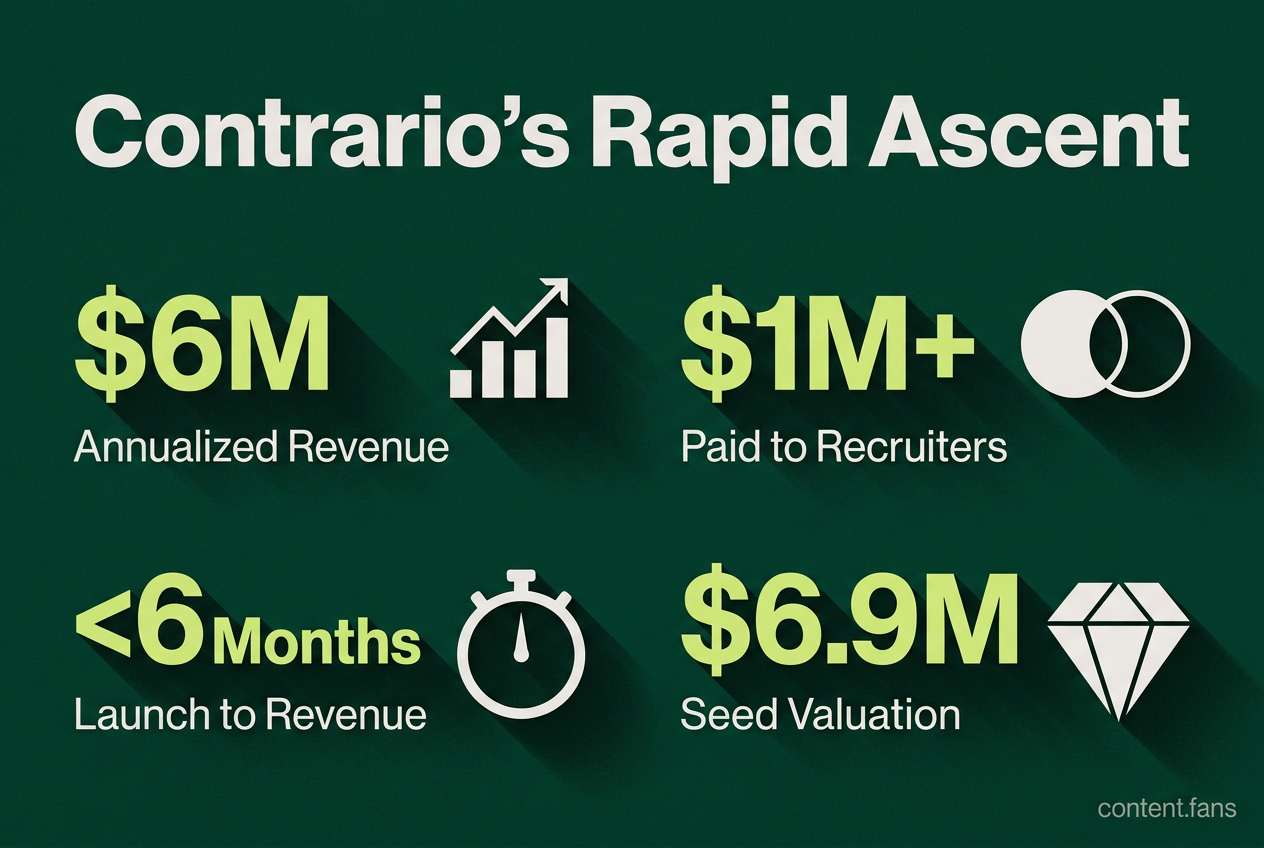
Details from a co-founder's LinkedIn post confirm the seed round included participation from 1984 Ventures, 468 Capital, Defy Partners, Y Combinator, Goodwater Capital, Inventum Ventures, InvestorX, and several angel investors. This backing signals significant investor confidence in its AI-native strategy following its public release.
In a market with many well-funded AI recruiting vendors, capital alone does not guarantee success. Contrario's key differentiator is its claim of $6 million in ARR. If accurate, this performance would indicate strong revenue velocity for an early-stage startup.
Competitive framing: Contrario versus Juicebox
Contrario positions itself as an "AI-native recruiting platform" designed to manage the entire hiring workflow, from sourcing and applicant tracking to scheduling. In contrast, Juicebox is described as an AI recruiting platform that introduced Juicebox Agents to continuously source and engage candidates.
The primary difference lies in their stack breadth:
- Contrario: integrated ATS, CRM, sourcing and analytics in one interface (described in the company blog).
- Juicebox: specialised sourcing layer that connects to a downstream ATS.
Industry analysis suggests that all-in-one platforms like Contrario appeal to teams consolidating their tech stack, while specialized sourcing engines like Juicebox excel at finding candidates for hard-to-fill roles. Consequently, the market may support both models, with companies potentially using them in tandem rather than choosing one exclusively.
Market context in 2026
According to industry reports, several key trends are shaping the HR tech landscape:
1. AI is automating routine tasks such as resume parsing and interview scheduling.
2. Skills-based matching is rising as titles become less predictive of fit.
3. Governance concerns around bias and privacy persist.
Contrario's value proposition directly addresses automation, promising accelerated hiring for hypergrowth companies. Juicebox aligns with the trend toward skills-based hiring through its advanced search capabilities. A critical consideration for potential buyers is that neither vendor has published a full bias audit, making model transparency a key point of due diligence before large-scale adoption.
What early adopters should watch
While strong venture capital support and early revenue indicate robust demand for AI recruiting solutions, user expectations can evolve rapidly. Talent acquisition teams evaluating Contrario, Juicebox, or similar newcomers should focus on several key performance indicators:
• Integration depth with existing HRIS and payroll systems.
• Candidate experience metrics such as time-to-first-response.
• Audit trails that document why a model promoted or rejected a profile.
Experts emphasize that current AI serves as a productivity amplifier, not a replacement for human judgment in recruiting. Therefore, a platform's long-term competitive advantage may depend less on pure automation and more on its ability to empower recruiters to refine, override, and fine-tune AI-driven recommendations.