
ByteDance builds custom AI chips, buys $14 billion in Nvidia hardware for 2026
Serge Bulaev
ByteDance appears to be responding to U.S. chip export controls by both building its own AI chips and buying legal Nvidia hardware, with about $14 billion planned for 2026. The company is also working with Samsung and Qualcomm to get around some of the new limits. These actions may suggest that export rules are encouraging companies like ByteDance to boost domestic chip development, while still using foreign chips when possible. Analysts suggest that export controls are not only a legal issue but have become an important part of engineering and supply planning. The ongoing changes in rules may keep pushing Chinese firms to rely more on their own chips, but the future remains uncertain.

ByteDance is navigating U.S. export controls by building custom AI chips while also planning a substantial purchase of Nvidia hardware. This dual strategy highlights a critical geopolitical and supply chain pivot, answering the core question for policy specialists: are export controls limiting China's AI deployment or accelerating its domestic capabilities?
ByteDance's hybrid hardware play
ByteDance is pursuing a two-pronged strategy in response to U.S. export controls: developing its own custom AI processors while simultaneously purchasing export-compliant GPUs from Nvidia. This approach allows the company to secure its immediate compute needs while hedging against future supply chain disruptions.
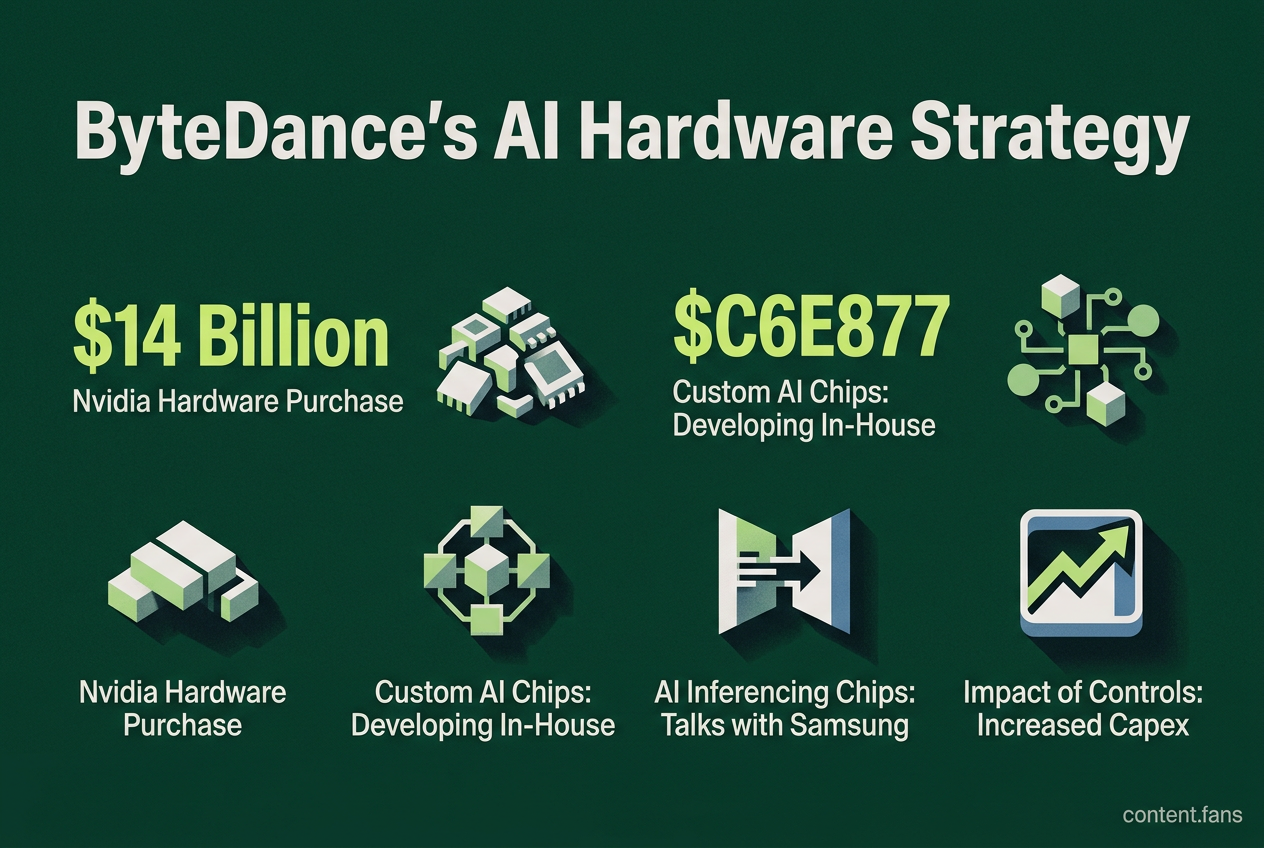
According to Reuters, the company has assembled a team of engineers to design custom AI chips as a direct response to U.S. restrictions on high-end GPUs. Concurrently, the company plans a substantial procurement of export-compliant hardware, as reported by Yahoo Finance.
The company is also pursuing a second track for inference silicon. In 2026 reporting, ByteDance was said to be in talks with Samsung for production of AI inferencing chips and expected sample chips. This layered procurement strategy - combining legal foreign chips with domestically designed alternatives - serves as a hedge against sudden regulatory changes.
What tighter rules appear to be doing
The impact of these tightening regulations is manifesting in several key ways across the industry:
- Substitution Effect - Analysts note that capex has grown significantly, with a substantial portion now dedicated to local silicon fabrication. This suggests export controls are directly creating strong demand for indigenous Chinese chips.
- Compliance Engineering - Reported ASIC deals, structured to stay under U.S. performance ceilings, show how product specifications are now being engineered with legal compliance as a primary feature.
- Supply Diversification - By keeping Nvidia in its hardware mix while also validating Samsung and Chinese foundries, ByteDance is actively reducing its dependency on any single vendor and mitigating geopolitical risk.
Scenarios for regulators and firms
| Scenario | Trigger | Possible market outcome |
|---|---|---|
| Stricter U.S. thresholds | Lower FLOPS or memory caps | Faster pivot to domestic accelerators; less visibility for U.S. vendors |
| Gradual relaxation | Diplomatic compromise | Mixed stacks combining Nvidia, Qualcomm, and Chinese ASICs |
| Reciprocal Chinese restrictions | Data-export or IP rules | Regionalized data centers and compute silos |
Compliance pointers for planning
- Quarterly map all products against existing Commerce Department performance tables to ensure continuous compliance.
- Continuously track Chinese capex disclosures for early signals on the momentum of local chip development.
- Routinely stress-test supply chains against scenarios involving sudden permit denials for high-performance GPUs.
ByteDance's evolving hardware strategy demonstrates that export controls have become a core engineering variable, not just a legal hurdle. The resulting feedback loop - where each new control drives incremental domestic capacity - is set to define the landscape for the foreseeable future. For global technology firms, integrating hardware sourcing and compliance into a single, dynamic workflow is no longer optional, but essential.
What exactly is ByteDance buying from Nvidia, and why does it matter for export-control watchers?
According to industry reports, ByteDance has allocated substantial resources for Nvidia hardware procurement. The purchase is concentrated on the H20-class GPUs - the only high-performance parts that still fall below U.S. performance thresholds. Because Washington has not yet granted import approval for faster H200 chips to Chinese firms, this order represents the legal ceiling of what ByteDance can buy from Nvidia today. In other words, the package is as much a gauge of export-control tightness as it is a capacity buy.
How advanced is ByteDance's in-house chip effort?
Reuters-based coverage indicates that custom chip teams are working on AI inference processors, with chips in tape-out/final design phase and mass production targeted for the coming years. Domestic tape-out and volume production inside China are deliberate risk-mitigation steps; if U.S. restrictions tighten further, ByteDance can still scale its own silicon.
How does domestic chip development affect supply-chain resilience?
Industry analysis shows that regionalized production reduces single-point failure risk but raises costs because of duplicated fabs and tooling. ByteDance's mixed strategy - buying compliant Nvidia parts and producing a domestic alternative - mirrors this trade-off. The result is lower exposure to sudden export bans, but also higher capex: ByteDance's AI infrastructure budget has grown substantially year-over-year.
What policy scenarios should compliance teams prepare for?
Industry outlooks frame three likely paths:
- Status quo: H20-type purchases continue under current thresholds.
- Tightening: Washington lowers the performance bar, cutting off even the H20 tier and accelerating ByteDance's domestic ramp.
- Selective relaxation: the U.S. issues time-bound licenses for H200 chips, easing relations but creating short-term volatility in vendor-customer contracts.
Compliance teams are advised to build dual-sourcing playbooks that treat export controls as a product-design variable, not a post-hoc legal filter.
How does the substantial hardware spend signal future tech governance trends?
The procurement represents one of the largest single-year hardware outlays by any non-U.S. AI firm, marking a turning point where compute access becomes a governance issue. Industry surveys indicate that many organizations feel unprepared for compute-restriction risk, yet a significant majority name AI acceleration as a top priority. ByteDance's hybrid approach - buying the maximum legal import while scaling domestic backup - is therefore emerging as a template for other Chinese hyperscalers and for multinationals navigating a fragmented global supply chain.