
Brands adopt new metrics to track AI discovery in 2026
Serge Bulaev
Brands are starting to use new ways to measure how often AI recommends them, but early tools often disagree on how much money these recommendations bring in. When AI assistants like ChatGPT or Gemini send users to a site, it may look like "Direct" traffic, making it hard for brands to track. Some researchers warn this mis-labeling, called "dark AI traffic," makes it tricky to know if advertising is working. New metrics, such as tracking how often a brand is mentioned by AI or noticed after an AI mention, are being tested. By 2030, over half of first-time brand discoveries may happen through AI, so brands may need clear ways to measure and adapt.

As brands adopt new metrics to track AI discovery in 2026, they face a core challenge: early dashboards rarely agree on the revenue from AI-driven sales. This attribution gap creates a new blind spot, as visits from assistants like ChatGPT often register as "Direct" traffic in GA4. Researchers label this phenomenon "dark AI traffic," cautioning that return-on-investment debates are pointless if a brand isn't even surfaced in key AI prompts.
From ranking to retrieval
Marketers are developing new measurement frameworks because traditional analytics fail to capture AI's growing influence. When assistants like ChatGPT recommend a product, the referral is often mislabeled as "Direct" traffic, obscuring the true source of discovery and making it impossible to calculate accurate ROI.
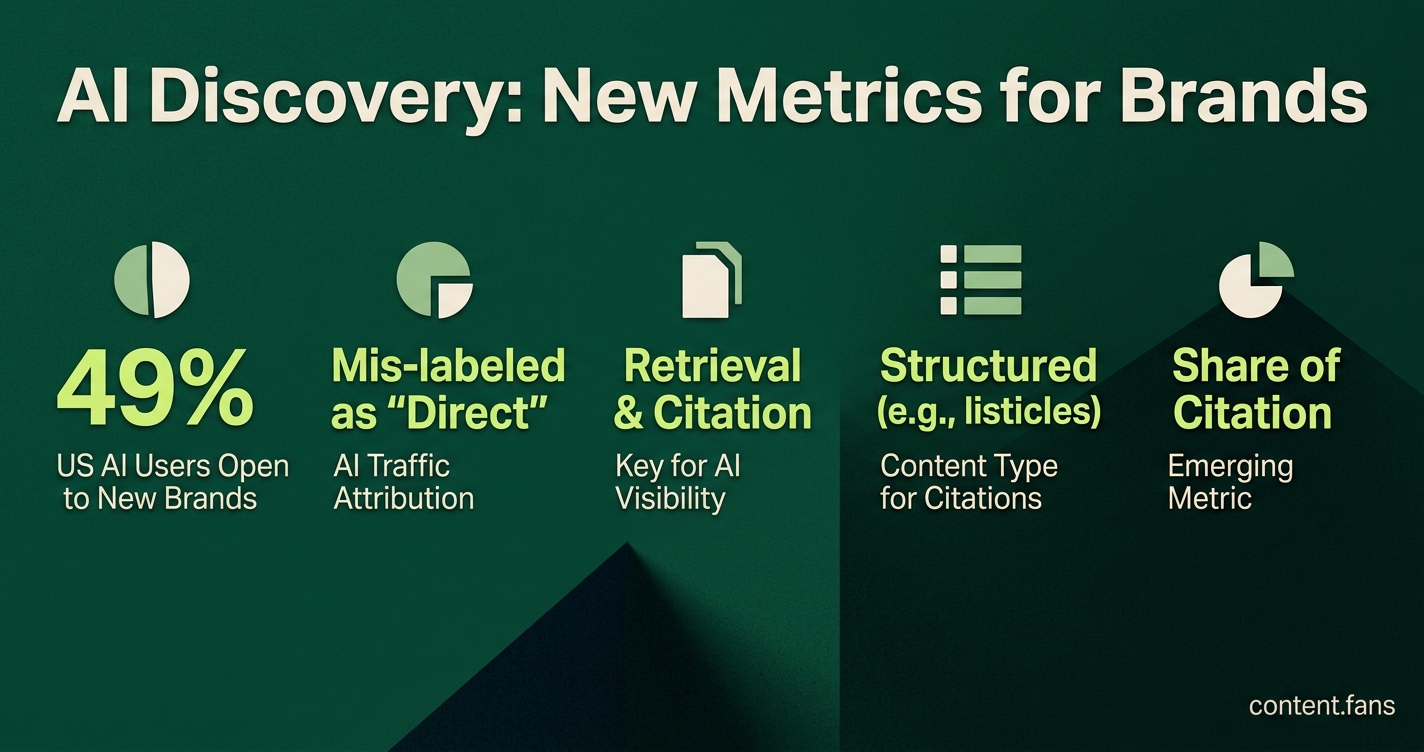
In this new landscape, visibility hinges on being retrieved and cited within conversational AI. According to Shopos AI, engines prioritize brands with clear entity signals, strong third-party mentions, and well-structured answers. This creates higher barriers for unknown sellers, as assistants often favor familiar brands - a trend supported by industry research from sources like McKinsey and Bain. Yet, consumers are adapting quickly. eMarketer reported that 49% of US AI users say they are likely or very likely to try a different brand than usual if an AI assistant suggests one as an alternative. Furthermore, many users provide personal context in their queries, offering richer signals than simple keywords.
New yardsticks for AI discovery
Since conventional attribution models fail to capture this influence, analysts are turning to hybrid and probabilistic frameworks. AuthorityTech suggests tracking "Share of Citation" - the frequency a brand appears in AI answers across engines like ChatGPT and Gemini. A rising Share of Citation often correlates with an increase in branded search impressions, providing a valuable second-order signal.
A short list of emerging metrics:
- Direct AI referral sessions (captured by custom GA4 channel)
- Share of Citation versus named competitors
- Branded search lift after an assistant mention
- Self-reported "found you via AI" notes in sales calls
To make this traffic measurable, Involve Digital advises creating a custom "AI Search" channel in GA4 for domains like chatgpt.com. For platforms that permit it, Airbridge recommends adding UTM parameters (e.g., utm_source=[engine_name] and utm_medium=organic_ai) to ensure consistent reporting.
Content and technical adaptation
To get recommended by AI, brands must create content that large language models (LLMs) can easily parse. Industry best practices suggest that structured content formats like listicles tend to earn more citations than narrative articles. Search Engine Land emphasizes using stacked schema (Article, ItemList, FAQPage) to help crawlers extract direct answers.
On the technical side, teams must audit their robots.txt to allow crawlers like GPTBot and PerplexityBot. Adding an llms.txt file is also recommended to specify data usage permissions and mitigate risks of partial indexing.
What boardrooms are asking
Executives now demand weekly reports on AI brand mentions and their conversion rates. While GA4's data-driven attribution can be effective with over 700 monthly conversions, Digital Applied warns that smaller brands must triangulate data from analytics, citation monitoring, and surveys. The stakes are high: industry projections suggest that AI intermediaries could drive a significant portion of initial brand discoveries by 2030. As this trend accelerates, having a clear measurement framework will be crucial for guiding investments in SEO, paid search, and the emerging field of Generative Engine Optimization.
Why are brands focusing on AI discovery measurement?
AI engines are no longer side tools - they are the front door to purchase decisions.
According to the Klaviyo AI Consumer Trends Report 2026, 60% of global consumers interact with AI weekly and 41% have purchased a product AI recommended in the last six months. Because many of these referrals hide in analytics as dark traffic, marketers need fresh KPIs such as share-of-citation and AI-to-cart to prove real business value.
Which methods capture AI-driven traffic that lacks UTM parameters?
Teams rely on hybrid probabilistic models that triangulate:
1. Direct AI clicks with forced UTMs (utm_source=chatgpt)
2. Branded search uplift - when an AI mention lifts your query volume in Search Console
3. Self-reported attribution from sales calls and post-purchase surveys
Together these techniques reconstruct journeys that GA4 alone cannot see.
What is "share of citation" and how do you grow it?
Share of citation is the new share of voice for generative engines: how often your brand appears inside answers versus category rivals. Boost it by:
- Writing definition-first structured content (these formats tend to earn more AI citations)
- Embedding multiple outside citations throughout content
- Adding FAQ and HowTo schema so the content is machine-readable
- Securing third-party mentions on Reddit, LinkedIn, and industry sites (many AI brand references are off-site)
How does the AI funnel differ from traditional search?
The classic Awareness-Consideration-Purchase funnel collapses into a single prompt: the AI simultaneously introduces, vets, and often checks out the product inside the chat. Optimizing for this new journey means:
- Structuring data for retrieval rather than keyword ranking
- Answering emotional or personal queries (many prompts contain personal context)
- Recognizing the decision may happen before a site visit ever occurs
What practical steps help marketers start measuring AI discovery today?
- Create a custom "AI Search" channel in GA4 to capture traffic from chatgpt.com, perplexity.ai, claude.ai
- Add an llms.txt file and unblock AI crawlers in robots.txt
- Tag AI-referred links with
utm_source=chatgpt&utm_medium=organic_ai - Monitor prompt responses regularly with test queries like "best x for y in 2026" to see whether the engine cites you
- Combine these numbers with branded search lift and self-reported surveys for a complete picture