
AWS Trainium Cuts AI Costs Up to 50% for Anthropic, Uber
Serge Bulaev
Amazon, Google, and Meta are now competing in AI by focusing on things like computer chips, data systems, and how companies make money from AI. AWS's custom Trainium chips reportedly help companies like Anthropic and Uber cut AI costs by up to 50 percent, though the use of these chips is still selective. Microsoft is focusing on controlling data access and security, which might make it harder for companies to switch away from their products. Reports suggest most AI startup revenue is now going to just two companies, OpenAI and Anthropic, which together may control about 89 percent of the market. These trends suggest that control over chips, data, and APIs may decide which companies lead in AI, but it is not yet clear who will win.

AWS says Trainium is a purpose-built AI accelerator for training and inference, and Amazon has announcements showing Uber and Anthropic using or expanding use of AWS custom silicon. The competition for AI supremacy among tech giants like Amazon, Google, and Meta has pivoted from model breakthroughs to the critical infrastructure of chips, data pipelines, and customer economics. A key factor in this shift is AWS's custom AWS Trainium silicon, which AWS markets as offering significant cost advantages. This focus on foundational layers suggests the future of AI will be shaped by control over hardware, data access, and API monetization.
AWS Trainium Gains Traction as a Cost-First Alternative
AWS Trainium is Amazon's custom-built AI accelerator chip designed to offer a high-performance, lower-cost alternative to traditional GPUs for machine learning. AWS markets Trainium1 as offering up to 50% lower training costs than comparable EC2 instances, while Trainium2 is marketed as 30-40% better price performance than certain GPU-based EC2 instances.
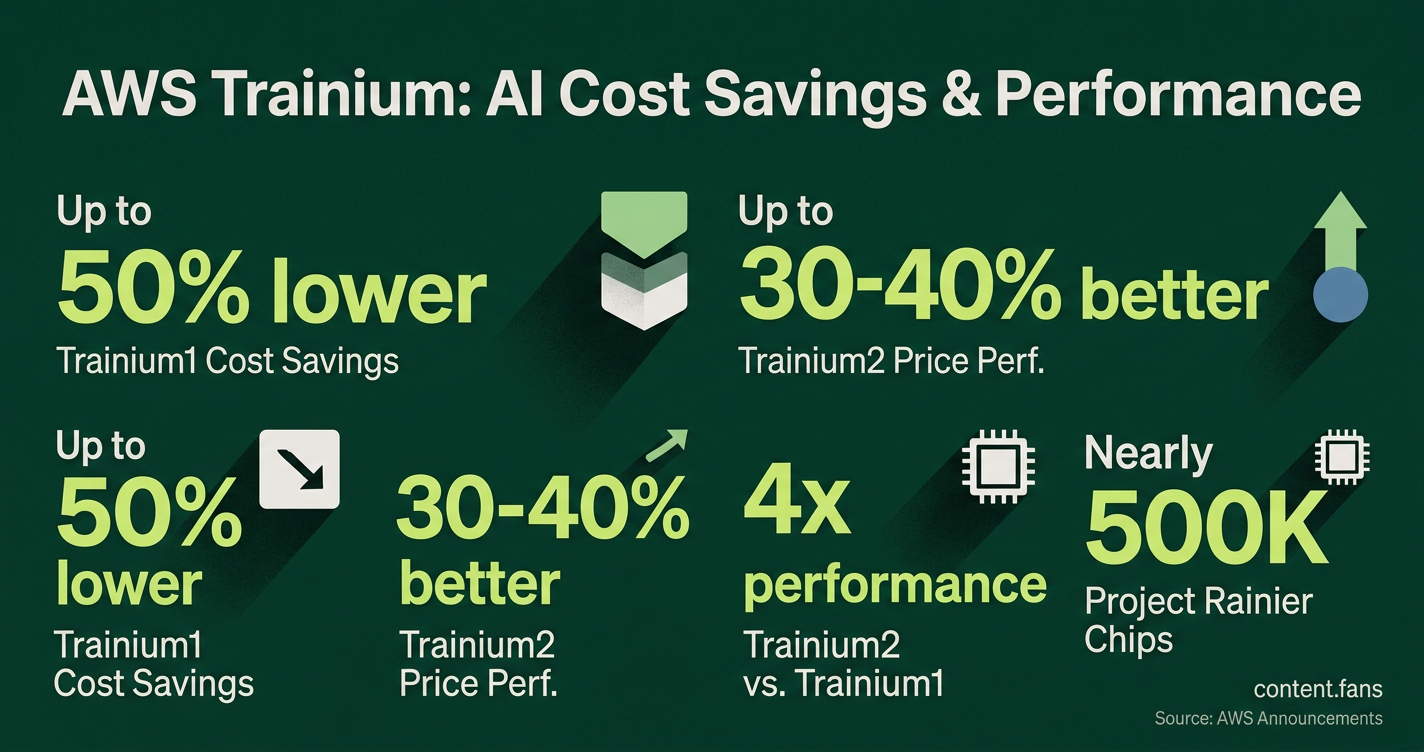
AWS is strategically positioning its custom silicon as a vital alternative amid the scarcity of Nvidia GPUs. The second-generation Trainium2, available via EC2 Trn2 instances, is engineered to scale into massive, multi-exaflop UltraClusters for demanding jobs. According to industry reports, Anthropic expanded its use of Trainium for large language model training. AWS's provided source attributes the 4x performance claim to Trainium2 versus first-generation Trainium, not to Trainium3, and the provided sources do not support a 50% cost-cut claim for Trainium3. AWS said Project Rainier uses nearly half a million Trainium2 chips and that Anthropic is using it; Uber expanded its AWS partnership in April 2026, moved more ride-serving workloads to Graviton4, and began piloting Trainium3 for AI model training. While Nvidia's GB200 leads in raw performance, AWS's focus on total-cost metrics appears to be a compelling strategy against GPU market inertia.
Microsoft's Strategy: Securing the Enterprise AI Data Layer
Microsoft is leveraging a different competitive advantage: control over the enterprise data membrane that AI agents require. Its strategy, detailed in recent security briefs, involves embedding agents into its ecosystem with strict governance. The roadmap features Copilot Studio for low-code agents and Microsoft Foundry for custom builds, mandating that all data connectors authenticate securely. According to industry reports, emerging layers allow agents to query governed datasets instead of accessing raw, unfiltered information. For customers, this means analytics data remains protected by existing permissions and audit logs, a tight integration that could increase switching costs and channel monetization through compliance services rather than model usage fees.
Revenue Concentration: OpenAI and Anthropic Dominate the API Market
The concentration of startup revenue offers another clear signal of where power is accumulating. According to industry reports, OpenAI and Anthropic have achieved significant revenue growth, with the two companies together capturing a substantial portion of all AI startup revenue. This indicates that control over model endpoints and usage-based billing is consolidating market power much faster than broader market share metrics might suggest.
These parallel strategies for dominance - cost-focused silicon from AWS, governed data fabrics from Microsoft, and unprecedented cash flow aggregation by the top model vendors - reveal the new battlegrounds for AI leadership. How effectively Google, Meta, and other contenders align their own hardware, data control, and economic models will determine their place in this evolving landscape.
What exactly are AWS Trainium chips and how do they reduce AI costs?
Trainium is Amazon's proprietary accelerator designed for machine-learning training and inference.
AWS markets Trainium1 as offering up to 50% lower training costs than comparable EC2 instances, while Trainium2 is marketed as 30-40% better price performance than certain GPU-based EC2 instances (WSJ). The cost savings come from both the silicon itself and AWS's ability to offer it at cloud scale, avoiding the street-price premiums that have plagued scarce Nvidia GPUs.
Who is already using Trainium at scale?
AWS said Project Rainier uses nearly half a million Trainium2 chips and Anthropic is already running workloads.
- AWS said Project Rainier uses nearly half a million Trainium2 chips and that Anthropic is using it.
- Uber expanded its AWS partnership in April 2026, moved more ride-serving workloads to Graviton4, and began piloting Trainium3 for AI model training. Public coverage also notes Trainium3 cost claims of roughly 30% to 50% versus comparable Nvidia hardware.
Although AWS also uses the chips internally, these two marquee customers provide the clearest proof-points that Trainium is moving from pilot projects into large-scale production.
How does Trainium performance compare to Nvidia GPUs?
On raw specs, Nvidia still leads - but the gap narrows when you look at cost per token.
- Peak FP16 throughput: Nvidia's GB200 shows roughly 3.85× higher FLOPS and 2.75× more memory bandwidth than Trainium2 (SemiAnalysis).
- Real-world economics: AWS promotes metrics like cost per token and cost per memory bandwidth that favor Trainium for specific training and inference workloads. In practice, developers report comparable job completion times at significantly lower spend, especially when GPU list prices spike.
What is Microsoft's strategy for controlling data access for AI agents?
Microsoft is integrating agents directly into its productivity stack and wrapping every data call with governance tooling.
Instead of letting AI agents roam freely across corporate repositories, Microsoft 2025-2026 guidance recommends:
- Copilot Studio for low-code SaaS agents and Microsoft Foundry for custom PaaS agents.
- OAuth / OpenID Connect connectors for services such as Power BI, ServiceNow and Office documents, all mediated by Entra ID identity controls.
- Purview audit logs, runtime DLP policies, and centralized agent registries to enforce least-privilege access.
The result is that agents surface insights from enterprise data without gaining raw, unconstrained access, creating a potential lock-in pathway built on governance rather than just raw performance.
How concentrated is AI startup revenue today?
According to industry reports, OpenAI and Anthropic together capture a significant portion of all AI startup revenues. Breaking that down:
- OpenAI has achieved substantial annualized revenue growth as of early 2026.
- Anthropic is believed to have experienced significant revenue growth, according to industry reports.
The remaining portion is split across many smaller AI startups, illustrating the extreme revenue concentration at the very top of the market.