
AWS signs $4 billion AI infrastructure deal with Pinterest through 2031
Serge Bulaev
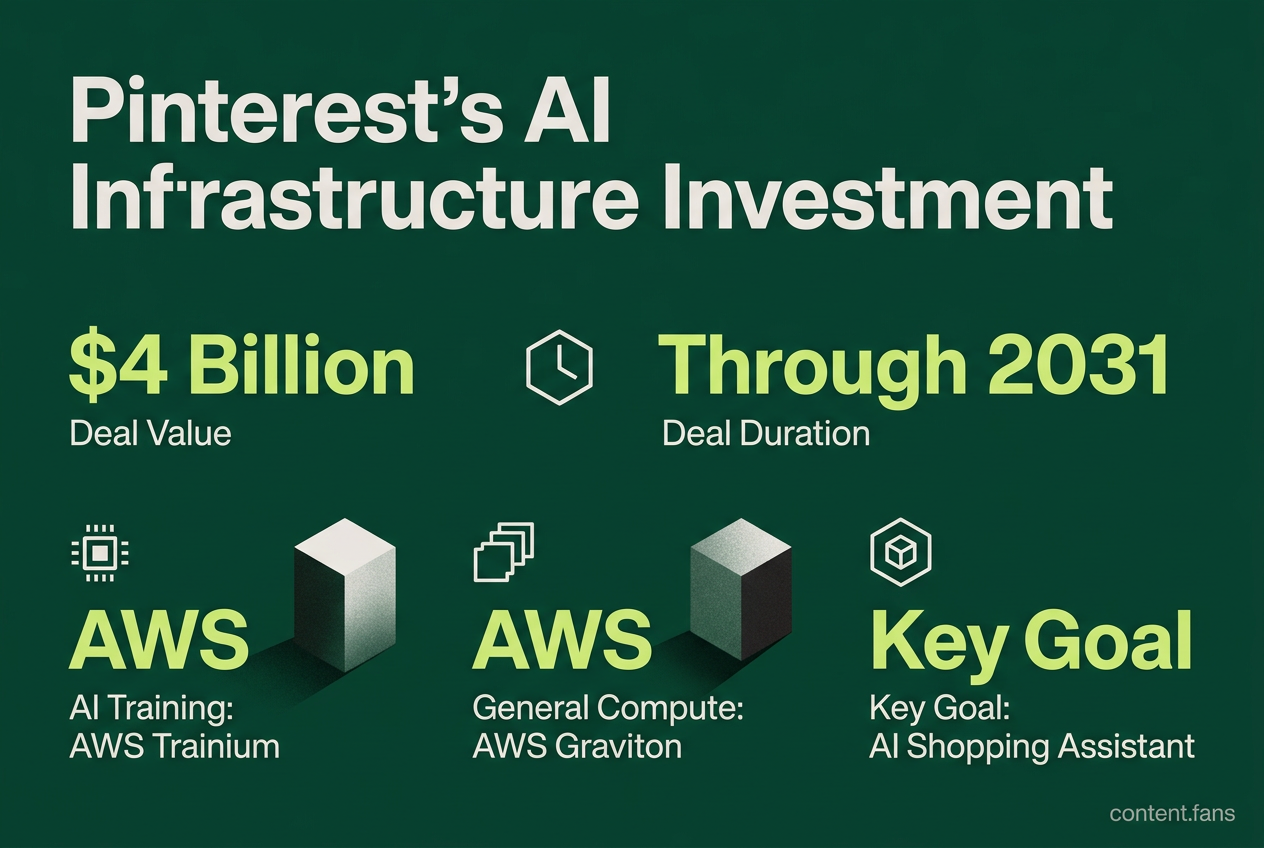
AWS and Pinterest have signed a $4 billion deal through 2031 for AI infrastructure, extending their existing cloud partnership. Pinterest will use AWS's Trainium and Graviton chips, which AWS claims may offer faster and more cost-effective training than other options, based on limited customer stories. The deal is part of a broader industry trend where companies secure long-term contracts for cloud and AI resources, possibly to ensure access as demand grows. Pinterest plans to use this capacity for AI-powered search, shopping, and personalization features. The true impact and future rollout of these AI products may depend on costs and how users respond.

In a landmark agreement, AWS signs a $4 billion AI infrastructure deal with Pinterest extending through 2031, signaling a major investment in generative AI by the visual discovery platform. This long-term contract deepens their existing cloud partnership and secures critical compute resources for Pinterest's future AI-driven products, as first reported by CNBC.
The deal reflects a key strategy for cloud providers like AWS: locking in long-term revenue by bundling proprietary hardware, software, and guaranteed capacity into multi-year commitments. For customers like Pinterest, this approach ensures price predictability and access to essential AI training and inference hardware.
Hardware economics inside the AWS Signs $4 Billion AI Infrastructure Deal with Pinterest Through 2031
The deal includes Pinterest's planned use of AWS Trainium and Graviton for AI model training and inference. Pinterest will use AWS Trainium chips for model training and Graviton CPUs for processing, securing long-term capacity for its AI-powered search, shopping, and personalization features on the platform.
Pinterest's move to embrace AWS's proprietary silicon over a sole reliance on NVIDIA GPUs exemplifies a wider industry trend toward diversified AI hardware stacks. Under the agreement, Pinterest will utilize Trainium accelerators for model training and Graviton CPUs for general compute. Industry reports indicate Trainium2 instances provide improved price-performance on specific language model workloads. This is complemented by Graviton4 CPUs, which offer enhanced host processing throughput over the previous generation.
The silicon package includes:
- AI Training: AWS Trainium2 and the forthcoming Trainium3 accelerators.
- General Compute: Graviton4 CPUs for data preprocessing and inference orchestration.
- Networking: EC2 UltraCluster fabric for large-scale, multi-node operations.
Where the contract fits in the 2024-2026 AI cloud land rush
This agreement is part of an industry-wide "AI cloud land rush," where major technology companies are securing massive, multi-year infrastructure contracts. For context, according to industry reports, there have been several major multi-billion-dollar compute agreements between hyperscalers and AI companies. Pinterest's commitment represents a significant investment for a consumer technology firm.
Industry reports show this trend accelerating, with numerous hyperscaler investment announcements across many countries in recent months. Industry analysts suggest that securing guaranteed access to compute capacity amid potential shortages is now a primary driver for these long-term deals, often outweighing pure cost considerations.
How Pinterest plans to use the capacity
Pinterest aims to leverage this new capacity to solidify its position as an "AI-powered visual-first shopping assistant." Key initiatives include enhancing its conversational and visual search capabilities, developing auto-collage tools for advertisers, and scaling its sophisticated personalization engines. The company is also optimizing costs; industry reports suggest that using smaller open-source models has significantly reduced internal inference costs for many companies, freeing up resources for more demanding frontier models.
To support this AI focus, Pinterest has been restructuring its workforce, reallocating a significant portion of its staff to AI-centric roles. According to public filings, this strategic shift is intended to accelerate the development and go-to-market strategy for its next generation of AI products.
The immediate impact of the AWS deal, as noted in the initial CNBC coverage, will be the expansion of accelerated computing for personalized visual search and discovery. The broader rollout of new features will hinge on model performance and user adoption. Ultimately, market observers view this contract as a pragmatic move by Pinterest to guarantee access to specialized AI hardware while mitigating risks associated with global GPU supply constraints.
What does the $4 billion AWS-Pinterest deal cover until 2031?
The agreement commits $4 billion over six years to run and train Pinterest's AI models almost exclusively on Amazon Web Services. Pinterest will use AWS Trainium2 and Trainium3 accelerators for model-training workloads and Graviton4 processors for orchestration, data-preprocessing, and inference services. The deal locks Pinterest into specific AWS chip families, making future workloads more cost-predictable while giving AWS a guaranteed, long-term revenue stream.
How do AWS Trainium chips compare with NVIDIA GPUs for Pinterest's AI training?
According to AWS-issued benchmarks, Trainium3 UltraServers deliver up to 4.4× more raw compute and 4× better energy efficiency than Trainium2, pushing 362 FP8 PFLOPs per rack. AWS also claims customers saw improved price-performance versus comparable NVIDIA GPU instances. While these figures are vendor-reported, they indicate Pinterest could gain lower per-training-hour costs without sacrificing throughput on supported model architectures.
Is Pinterest's $4 billion commitment unusually large?
No. According to industry reports, hyperscalers and AI labs have signed several multi-billion-dollar compute agreements in recent years. Pinterest's $4 billion through 2031 represents a significant commitment by a consumer-tech company in the context of the growing number of large-scale infrastructure deals being announced across the industry.
What AI products will Pinterest power with this new infrastructure?
Pinterest is transforming itself into an "AI-powered visual-first shopping assistant". New initiatives already being scaled include:
- Conversational search and AI shopping assistant for faster product discovery
- Auto-collages for advertisers that turn catalogs into shoppable pins
- Model-agnostic personalization layer that blends proprietary, open-source, and third-party models (Anthropic, OpenAI, Alibaba Qwen) to serve each query at significantly reduced cost for some workloads
The infrastructure expansion will allow Pinterest to train multimodal models continuously and refresh personalization signals in near real time.
How does the deal affect Pinterest's operating costs and margins?
By committing to AWS-designed silicon, Pinterest gains predictable pricing tied to AWS-published Trainium/Graviton price lists instead of volatile GPU spot markets. AWS claims Trainium3 offers improved energy efficiency, which directly lowers power and cooling line items. Combined with open-source model use that significantly cuts per-token costs, Pinterest expects the new stack to compress AI compute cost per user session, improving gross margin even as AI-driven engagement rises.