
Atlassian, Microsoft expand knowledge graphs for enterprise AI
Serge Bulaev
Atlassian, Microsoft, and other companies are working to make knowledge graphs for enterprise AI, which may help AI understand company data better. These knowledge graphs could make AI more efficient and reliable, but they might also make it harder for companies to switch vendors later. The market for these tools appears to be growing quickly, and many buyers may want easy-to-use software and tools that speed up setup. Some experts warn about risks, like losing control over data or slower performance with large graphs. It is not clear if the benefits will be worth the possible downsides for all customers.

Tech giants Atlassian and Microsoft are leading an expansion into knowledge graphs for enterprise AI, igniting competition with ServiceNow and others to provide large language models (LLMs) with structured, compact views of company data. This strategic push aims to make AI assistants more efficient and reliable, but it also introduces risks of vendor lock-in, making it harder for companies to switch platforms later.
The move is framed as a significant revenue opportunity, not just an engineering upgrade. Vendors hope that by packaging curated graph layers, they can differentiate their product suites, increase customer dependency, and reduce the costly tokens consumed with each AI request. The market for these tools is growing rapidly, with buyers seeking easy-to-use software that accelerates setup and delivers immediate value.
Atlassian and Peers Drive Knowledge Graph Boom for Enterprise AI
Knowledge graphs are driving a boom in enterprise AI because they provide a structured, interconnected map of company data. This allows AI agents to understand relationships and context, enabling them to answer complex questions more accurately and efficiently than by simply searching through disconnected documents.
Independent analysis confirms the efficiency gains. Glean describes an enterprise graph as a "structured representation that can be quickly queried at run-time," while Atlan adds that agents using defined relationships can "apply trust signals instead of guessing from retrieved text" to reduce errors and wasted steps.
Industry reports suggest that knowledge graphs significantly improve AI reliability by providing structured context, though the specific performance gains can vary by workload and implementation.
Market size and competitive signals
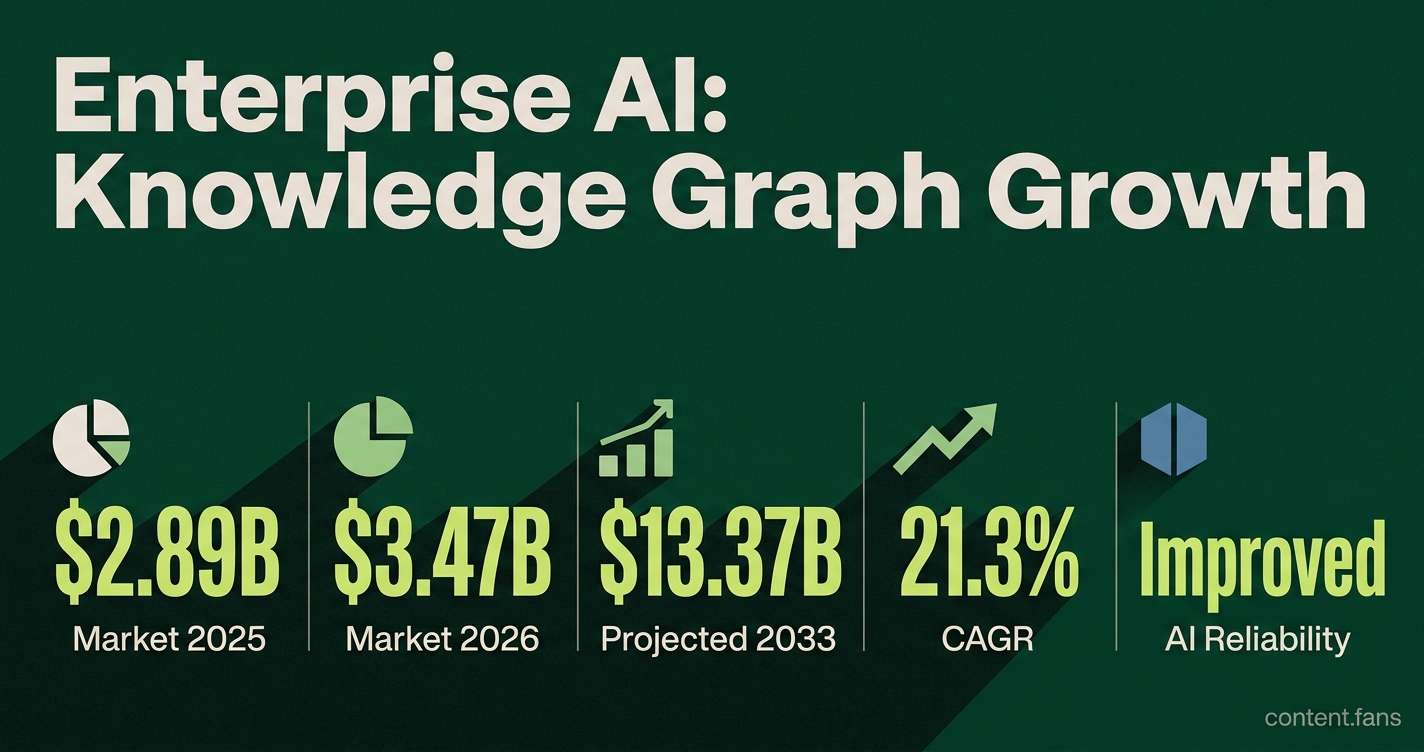
While Microsoft is a top provider in the knowledge graph market, Atlassian and ServiceNow are carving out niches within their collaboration and workflow ecosystems. According to Grand View Research, the global enterprise knowledge graph market was USD 2,891.5 million in 2025, USD 3,467.9 million in 2026, and is projected to reach USD 13,370.8 million by 2033 at a 21.3% CAGR.
Industry reports indicate that collaboration suites like Atlassian's have room to monetize graph-enabled AI without directly challenging core database leaders, as the market shows significant fragmentation among various providers.
Market data indicates that customers are prioritizing ready-made software solutions over raw graph storage. Software solutions account for a significant portion of revenue, with semantic search and knowledge management applications representing a substantial share. This suggests that buyers value pre-built connectors, ontologies, and governance tools that shorten deployment times.
Governance and lock-in questions
While knowledge graphs increase efficiency, analysts caution they can also create significant vendor lock-in. BCG has termed this "cognitive lock-in," a scenario where a company's operational context becomes so deeply embedded in a proprietary model that switching costs become prohibitive. Further, Improvado notes that multi-hop queries on large graphs can introduce 2 - 10 second latencies, potentially limiting real-time applications.
Potential risks for enterprises to monitor include:
- Proprietary APIs that impede data export and migration
- Centralized graphs that mix data with different sensitivity levels
- Complex deletion processes for facts stored across nodes, edges, caches, and embeddings
- Residency or audit gaps if logs remain on vendor-controlled clouds
To mitigate these risks, industry guides from Kong and AvePoint recommend using portable data models, implementing hybrid architectures, and establishing upfront data lineage controls.
For now, vendors appear willing to accept this governance complexity to capture the performance and revenue upside of graph-grounded AI. The extent of customer adoption will reveal whether these promised efficiency gains are worth the long-term costs of reduced data portability.
What are knowledge graphs and why are they suddenly critical for enterprise AI?
Knowledge graphs are structured representations that connect company information into interlinked networks of entities, relationships, and context - rather than storing data in isolated documents or databases. According to Glean, they provide "a structured representation that can be quickly queried at run-time," giving AI agents compact, navigable context instead of forcing them to search through large text bundles repeatedly.
AI agents have become the catalyst driving renewed vendor investment in this technology. These autonomous systems need to reason across multiple data sources, follow relationships between business entities, and maintain context across complex workflows - capabilities that raw document retrieval struggles to provide. The market is responding accordingly: Grand View Research estimates the enterprise knowledge graph market at USD 2,891.5 million in 2025, projected to reach USD 13,370.8 million by 2033 at a 21.3% CAGR.
How do knowledge graphs actually improve AI agent performance?
The performance gains are substantial and measurable according to industry reports. Research suggests that LLMs answering complex enterprise queries show significant accuracy improvements when using knowledge graph grounding compared to operating without structured context - representing a meaningful performance boost.
Atlan notes that agents using knowledge graphs "traverse defined relationships and apply trust signals instead of guessing from retrieved text," enabling multi-hop reasoning and explainability that document search cannot match. This structured approach reduces trial-and-error retrieval and wasted agent steps.
Atlassian has reported specific efficiency gains: customers using its Teamwork Graph with AI coding assistants saw nearly 50% fewer tokens consumed - though this specific claim comes from the vendor and independent verification was not found in available research.
Who are the main competitors and how is the market structured?
According to GMI Insights and Fortune Business Insights data, the competitive landscape shows Neo4j and Microsoft as major players alongside specialized graph vendors, while Atlassian and ServiceNow occupy adjacent positions:
| Vendor | Market Position | Evidence |
|---|---|---|
| Neo4j | Leading position with significant market share | Multiple industry reports |
| Microsoft | Major market presence | GMI Insights estimates |
| AWS | Substantial market share | GMI Insights estimates |
| Notable market presence | GMI Insights estimates |
Industry reports indicate that the top providers collectively hold a significant portion of market revenue, indicating moderate concentration with room for specialized vendors.
Notably, Atlassian and ServiceNow do not appear in market-share leaderboards as standalone knowledge graph platform vendors. They compete more indirectly through workflow automation, ITSM, collaboration platforms, and AI assistant layers that incorporate graph-like capabilities. Atlassian launched its Teamwork Graph in 2023, with CEO Mike Cannon-Brookes calling it the "most underappreciated part of Atlassian."
What risks should enterprises consider before committing to a knowledge graph strategy?
Vendor lock-in represents the most significant strategic risk. BCG describes this as "cognitive lock-in" - when an organization embeds "all of its operational context so deeply into a model, platform, or surrounding operating stack" that changing becomes prohibitively difficult. This occurs through:
- Proprietary APIs and custom data formats that resist migration
- Tight coupling between graph schemas, embeddings, vector stores, and ingestion pipelines
- Ontology tooling built around vendor-specific languages
Governance concerns intensify because knowledge graphs centralize highly sensitive business context:
| Risk Area | Specific Challenge |
|---|---|
| Data lineage | Tracing fact origins and transformations becomes complex in centralized pipelines |
| Access control | Fine-grained authorization critical when graphs combine data of varying sensitivity |
| Retention/deletion | Content replicated across nodes, edges, embeddings, caches, and logs complicates enforcement |
| Compliance evidence | Difficulty proving controls to auditors when ownership is unclear |
How can organizations mitigate these risks while still capturing benefits?
Industry guidance suggests practical risk reduction strategies:
- Use portable data models and avoid proprietary-only formats
- Separate content from platform logic - keep ontology, access policy, and application code independent
- Maintain export and migration plans for graph data, embeddings, evaluation data, and logs
- Require governance controls upfront for lineage, residency, deletion, and audit trails
- Design for multi-vendor or hybrid architectures to preserve operational flexibility
Technical limitations also warrant consideration: Improvado notes that multi-hop graph queries across large datasets can take 2-10 seconds, with deeper traversals degrading further at scale. Industry experts warn that graph grounding helps only when the graph encodes real semantic context, not just connected records - and that static knowledge graphs can go stale without continuous governance.
Why are vendors treating knowledge graphs as commercial products rather than just infrastructure?
The shift reflects a strategic repositioning of enterprise data as monetizable assets. Vendors see three revenue opportunities:
- Product differentiation in crowded AI assistant markets
- Customer lock-in through deep integration with operational context
- New revenue streams by packaging curated, structured enterprise knowledge for AI consumption
This framing - treating technical infrastructure as a potential commercial product line - explains the competitive urgency among Atlassian, Microsoft, ServiceNow, and others. The knowledge graph becomes not merely a better way to organize data, but a platform-level moat that makes switching costs prohibitive and creates ongoing subscription value through continuous knowledge refinement.
For enterprises, this means evaluating knowledge graph proposals requires dual analysis: assessing technical capabilities alongside commercial terms, portability guarantees, and long-term cost projections that account for potential exit scenarios.