
Asana Acquires StackAI for $75M, Boosts No-Code AI Agent Strategy
Serge Bulaev
Asana has acquired StackAI for $75 million to help speed up its strategy for adding no-code AI agents to its platform. This deal may let Asana offer tools that help non-coders build and manage AI-powered workflows within its main product. Market research suggests there is growing demand for no-code AI tools, which may be due to a shortage of tech workers. Asana's leaders say they plan to treat AI as a helpful teammate and focus on smart automation in their products. It appears that features from StackAI could start showing up in Asana over the next few product updates, but there is no clear release date yet.

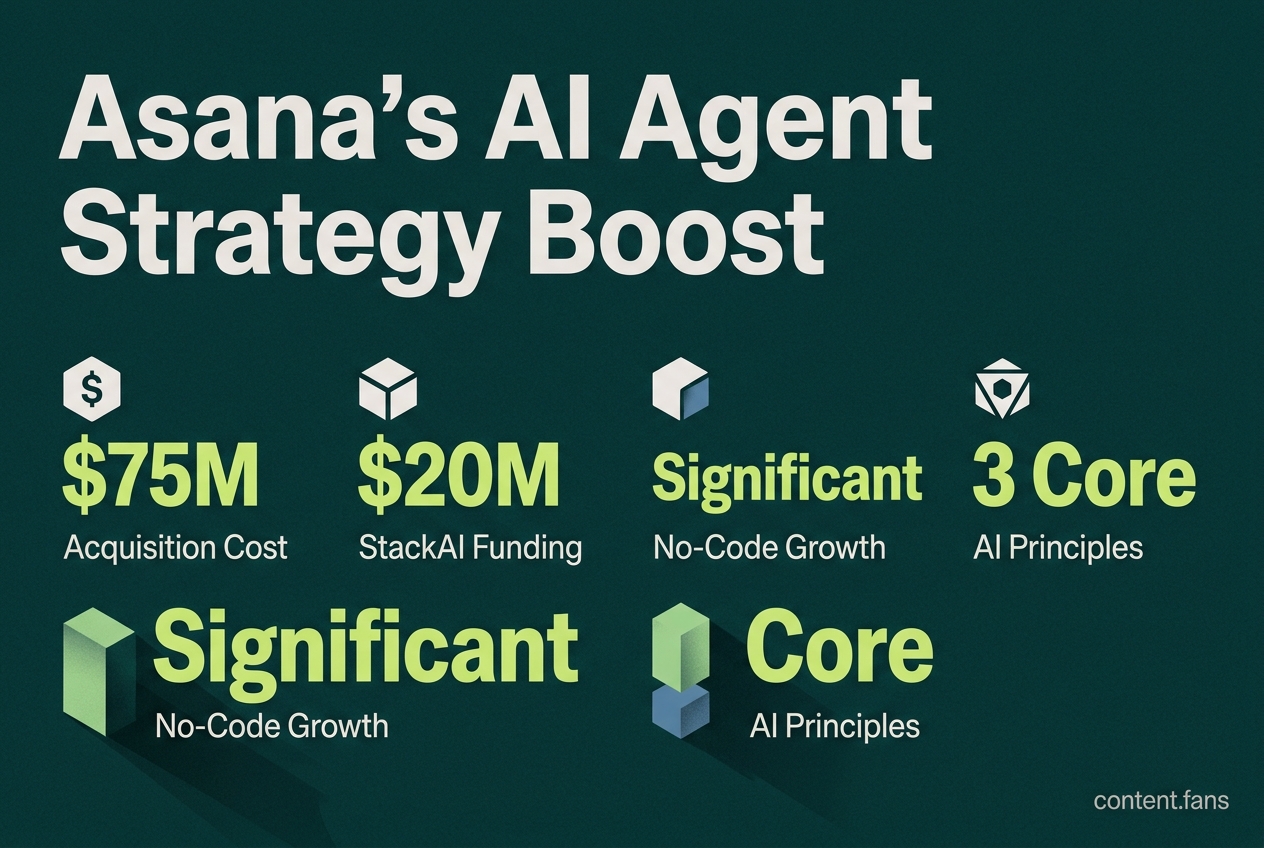
In a strategic move to accelerate its no-code AI agent strategy, Asana has acquired StackAI for $75 million. This cash-and-stock deal integrates StackAI's platform for building autonomous agents directly into Asana's work management suite, folding a startup with a reported $20 million in funding into Asana's product organization.
The acquisition reinforces Asana's vision for "AI teammates" - context-aware agents embedded within workflows, moving beyond simple generative AI add-ons.
Why StackAI fits the roadmap
Asana acquired StackAI to embed a no-code builder for creating autonomous AI agents directly within its platform. This strategic purchase allows non-technical users to design and deploy "AI teammates" that automate tasks, aligning with Asana's goal of delivering intelligent, customizable workflows that accelerate project completion.
The acquisition supports Asana's strategic roadmap, which focuses on customizable automations and AI teammates to improve project delivery timelines. By integrating StackAI's technology, Asana immediately gains key features including visual agent orchestration, version control, and template libraries. The platform's core capabilities include:
- Enabling non-developers to create automated action chains across various SaaS applications.
- Providing a governance layer to record prompts, outputs, and handoffs, a critical feature for enterprise clients.
- Offering templates for key business functions like support triage and revenue operations, areas where Asana is pushing for deeper automation.
This integration will likely enable customers to design sophisticated automations within Asana's AI Studio, eliminating the need for external tools.
Market appetite for no-code builders
The acquisition taps into a rapidly growing market. Industry reports indicate significant growth in the no-code AI platform segment, driven by increasing demand for accessible automation tools. The specific niche for no-code AI agent builders is experiencing substantial expansion according to market research. Analysts attribute this demand to tech talent shortages and the rise of citizen-developer initiatives that prioritize visual tools over custom coding.
Aligning with Asana's Core AI Principles
The acquisition aligns with core principles for AI that industry leaders emphasize for effective implementation:
- Treat AI as a teammate: The AI should understand project priorities and ownership.
- Redesign workflows first: Intelligent automation should be layered onto redesigned, more efficient processes.
- Track outcomes, not output: Focus on meaningful results like risk reduction instead of raw productivity metrics.
These principles mirror StackAI's focus on building agents that pursue specific business goals, suggesting Asana is moving toward creating role-based AI agents with clear accountability within its Work Graph.
Competitive lens
Industry analysis suggests that work management platforms increasingly need capabilities to supervise both human and digital workers. Without native agent orchestration, these platforms risk becoming passive task trackers. Asana's acquisition signals a strategy of buying, rather than partnering, to build this crucial competency.
Geographically, while North America represents a large market for no-code AI tools, industry data shows Asia-Pacific as a fast-growing region. This trend could influence Asana's global strategy for marketing its new StackAI-powered capabilities.
What happens next
While Asana has not announced specific shipping dates, integration work of this scale typically takes several quarters. The first features are expected to appear as AI Studio previews or new "AI Teammate" templates in upcoming release cycles. Key developments to watch include the potential integration of StackAI's governance dashboard as a native Asana feature and the introduction of new pricing models for metered AI agent usage.
What is driving Asana's acquisition of StackAI?
Work management vendors are racing to embed agent orchestration inside their platforms. By folding StackAI's no-code agent builder into its workflow layer, Asana gains an immediate way to let customers design AI "teammates" that can claim tasks, move projects forward, and report outcomes without custom code. The move mirrors a wider industry pivot from human-only task tracking to hybrid human-agent collaboration.
How will StackAI's capabilities fit into Asana's strategic roadmap?
Expect new AI Studio templates and AI Teammates that surface inside Asana projects. Non-technical teams will drag together agents that pull data from sales dashboards, draft status e-mails, or reopen tasks when deadlines slip. Asana's strategic roadmap emphasizes customizable automations and collaborative AI to improve delivery timelines, matching StackAI's strengths.
Why are no-code AI agent startups hot acquisition targets?
Market forecasts show significant growth in the sector according to industry reports. Enterprises face talent shortages yet need governance-friendly production deployments. Buying a ready-made builder skips quarters of R&D while instantly plugging revenue leaks caused by standalone integrators.
Which competitors could make similar moves after this deal?
Watch for moves from Monday.com, ClickUp, Smartsheet, or Atlassian. Each already markets automation layers; adding an agent builder would match Asana's bet. Cloud giants like Salesforce, Microsoft, or Google Cloud could also tuck in a specialist to pair with their low-code stacks, repeating the "tuck-in" pattern seen when ServiceNow picked up Intellibot or when UiPath absorbed PeakAI.
What limits and governance questions arrive with point-and-click AI agents?
Production-grade agents need role-based permissions, audit trails, and kill switches. Industry experts warn adopters to prepare for "silicon-workforce management," meaning human supervisors must own approvals, exception handling, and performance metrics. Buyers should insist on guardrails that log every agent action, throttle API costs, and align agent goals to business KPIs rather than vanity counters.