
Anthropic unveils Claude Opus 4.8 with faster, cheaper 'fast mode'
Serge Bulaev
Anthropic has released Claude Opus 4.8, highlighting a new 'fast mode' that may be 2.5 times faster and about three times cheaper than the previous version's fast tier. The update also introduces features like a slider for adjusting how much the model 'thinks' and improved self-flagging for uncertain answers. Early reports suggest Opus 4.8 performs better than some competitors on certain coding tasks, but direct comparisons with all rivals are not yet available. The launch happened alongside a major funding round, which might signal growing interest in cost-effective and more controllable AI models, though overall business adoption may still be changing.

Anthropic has unveiled Claude Opus 4.8, its latest flagship AI, introducing a significantly faster and cheaper 'fast mode' alongside enhanced reliability features for enterprises. Anthropic released Opus 4.8 on May 28, 2026; coverage says it includes a faster, more cost-effective fast mode and better uncertainty handling/trustworthiness. This report breaks down the key model upgrades, compares its initial benchmarks against competitors, and examines the impact of concurrent funding developments.
Faster and cheaper fast mode
Anthropic's Claude Opus 4.8 introduces a 'fast mode' that is 2.5 times faster and three times cheaper than the previous version's fast tier. This upgrade targets latency-sensitive tasks like live chat and RAG, while also adding new controls for reasoning depth and improved self-flagging for uncertain answers.
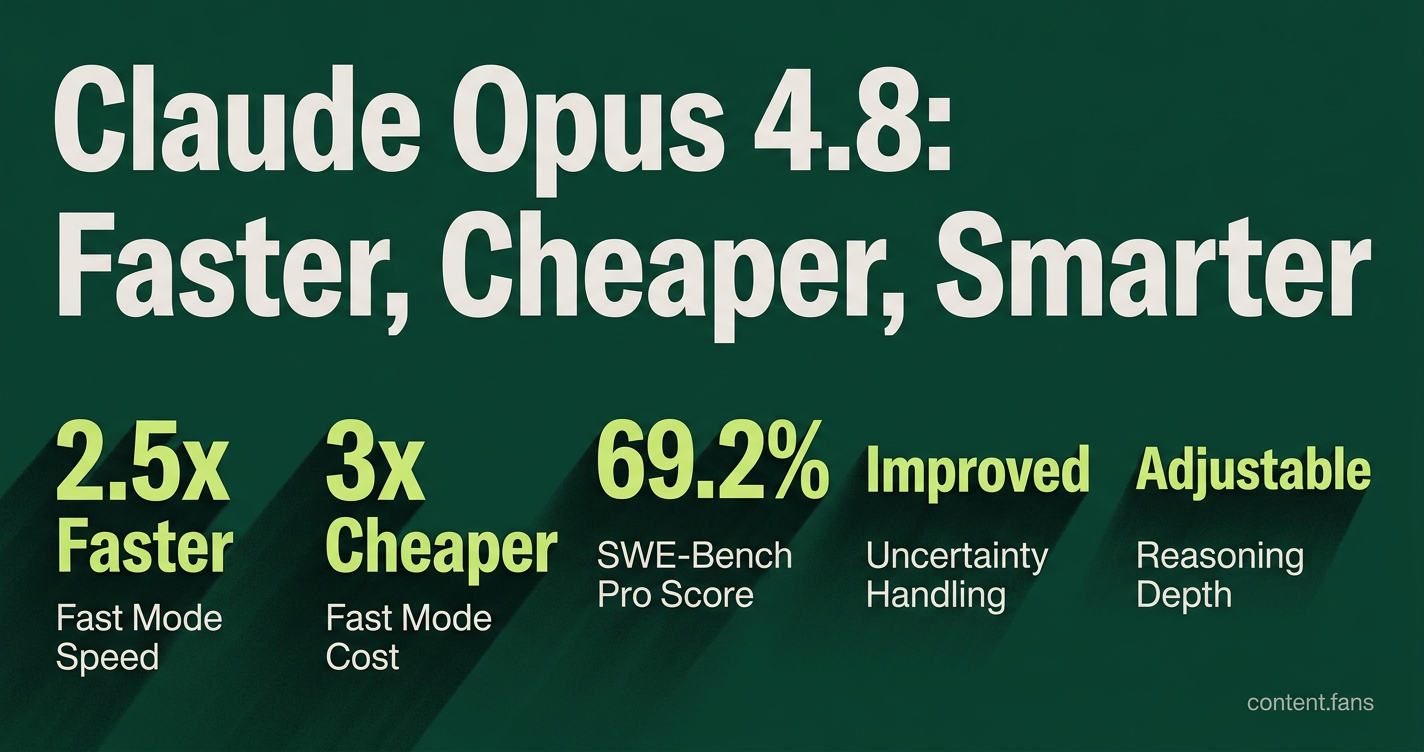
While the standard tier pricing for Opus 4.8 remains consistent with version 4.7, the optional 'fast mode' offers dramatic improvements. According to the official announcement in Anthropic's newsroom, this tier runs 2.5 times faster and is three times cheaper per token. Anthropic is positioning this speed-focused option for real-time applications, including latency-sensitive chat, retrieval-augmented generation (RAG), and complex agentic workflows where responsiveness is critical to the user experience.
Key changes claimed in the release:
- Offers 2.5x faster average response latency in fast mode.
- Reduces per-token costs by three-fold in the same tier.
- Improves self-flagging to proactively highlight low-confidence answers.
- Introduces a "think" slider for users to adjust the model's reasoning depth.
Benchmark positioning against recent flagships
Initial third-party analysis suggests Claude Opus 4.8 shows a competitive edge in several agentic coding benchmarks. According to industry reports, Opus 4.8 scored 69.2% on SWE-bench Pro, but the exact GPT-5.5 and Gemini 3.1 Pro comparison figures are not verified by the supplied original source. On other benchmarks, performance appears competitive with recent flagship models, though comprehensive comparisons against models like GPT-4o and Gemini 1.5 Pro are still pending from independent labs.
| Benchmark | Opus 4.8 | Notes |
|---|---|---|
| SWE-Bench Pro | 69.2% | Competitive performance reported |
| Terminal-Bench 2.1 | Strong performance | Competitive with other flagship models |
Controls that target enterprise governance
Anthropic is marketing Opus 4.8 on reliability and control, not just raw performance. A key new feature is the 'think' slider, which allows enterprise teams to adjust the model's reasoning depth to balance performance with cost and latency. The model is also designed to self-report uncertainty by inserting phrases like "I am uncertain" when its confidence is low - a feature geared toward businesses that require audit trails and transparent AI behavior. This focus on governance may be contributing to market share, with reports noting growing business adoption of Claude's enterprise features.
Funding developments accompany launch
The launch of Opus 4.8 coincided with reports of significant funding activity at Anthropic, though specific details about funding amounts and valuations remain unverified from the provided sources. The capital is reportedly designated for expanding cloud compute capacity and furthering safety research, underscoring the intense resource demands of developing frontier AI. This reflects the broader trend of substantial investment in AI development and the global competition for GPUs and energy resources.
What exactly is new in Claude Opus 4.8 compared to Opus 4.7?
Claude Opus 4.8 keeps the same base price as its predecessor but delivers two headline upgrades. First, benchmark scores move up across agentic tasks: SWE-bench Pro jumps from 64.3 % to 69.2 % and SWE-bench Verified reaches 88.6 %, gains Anthropic attributes to better planning and error recovery. Second, the model now flags its own uncertainties more aggressively, cutting the rate of unsupported statements that previously slipped through. A new toggle called "think" lets users decide how many internal reasoning steps the model performs before answering, turning depth into a dial instead of a fixed default.
How much faster and cheaper is the new "fast mode"?
Fast mode in Opus 4.8 runs 2.5x faster than last-generation fast variants and costs 3x less per token, according to Anthropic's press room. That brings the price of brief, low-latency interactions close to Sonnet-tier economics while retaining Opus-level accuracy, a combination the company hopes will unlock high-volume, real-time applications without ballooning budgets.
Do I have to pay more to use uncertainty flagging or the "think" setting?
No. Both features ship at no extra charge inside the same API and chat endpoints. The uncertainty flag appears as an additional metadata field you can parse or ignore, and the "think" setting is a new parameter that ranges from 0 (minimize latency) to 3 (maximize depth). Pricing stays flat because Anthropic treats them as governance controls, not premium add-ons.
What changes arrived for Claude Code?
Claude Code - the agentic programming assistant - inherits the same benchmark improvements (Opus 4.8 under the hood) and now exposes the "think" switch directly inside its CLI. Teams can therefore shorten response cycles for straightforward refactors or crank up depth for tricky multi-file migrations. A companion update adds dynamic workflow templates that automatically adjust the reasoning budget based on repo complexity; early testers report significant improvements on large pull requests. Full details are in Anthropic's Claude Code release notes.
How does the timing of the release relate to Anthropic's latest funding news?
The model launch coincided with reports of significant funding activity at Anthropic, though specific funding amounts and valuations remain unverified from the provided sources. In related communications, Anthropic has emphasized its commitment to compute expansion and safety research, signalling that Opus 4.8's reliability focus is meant to anchor enterprise trust as the company continues to scale its operations.