
Anthropic, others detail how to build reliable AI workflows
Serge Bulaev
Reliable AI workflows may be built by treating each step as a clear, dependable product rather than a loose group of scripts. Experts suggest using modular pipelines, making each part deterministic and observable, and adding complexity only when needed. Regular checks, retries, and sometimes human review should be included to handle failures or uncertain results. Monitoring tools and clear targets for data quality, model output, and speed help teams notice problems quickly and decide when to stop or fix issues. Tools like Airflow, Prefect, and Kubeflow each offer different ways to manage and track these workflows, but all should keep detailed logs and version control for easier troubleshooting.

Building reliable AI workflows requires treating them as first-class, production-grade products rather than a loose collection of scripts. This professional practice focuses on making every step deterministic, observable, and recoverable. Recent guidance from industry leaders emphasizes modular, transparent pipelines, with Anthropic's agent design paper advising teams to "choose the simplest solution" and add complexity only when essential.
Modular pipelines and deterministic components
A dependable workflow is built from clear, isolated stages like ingestion, generation, and validation. This modular architecture contains failures and simplifies testing. Key components, especially those using LLMs, must be made deterministic by fixing parameters like model version and temperature to ensure consistent, repeatable outputs.
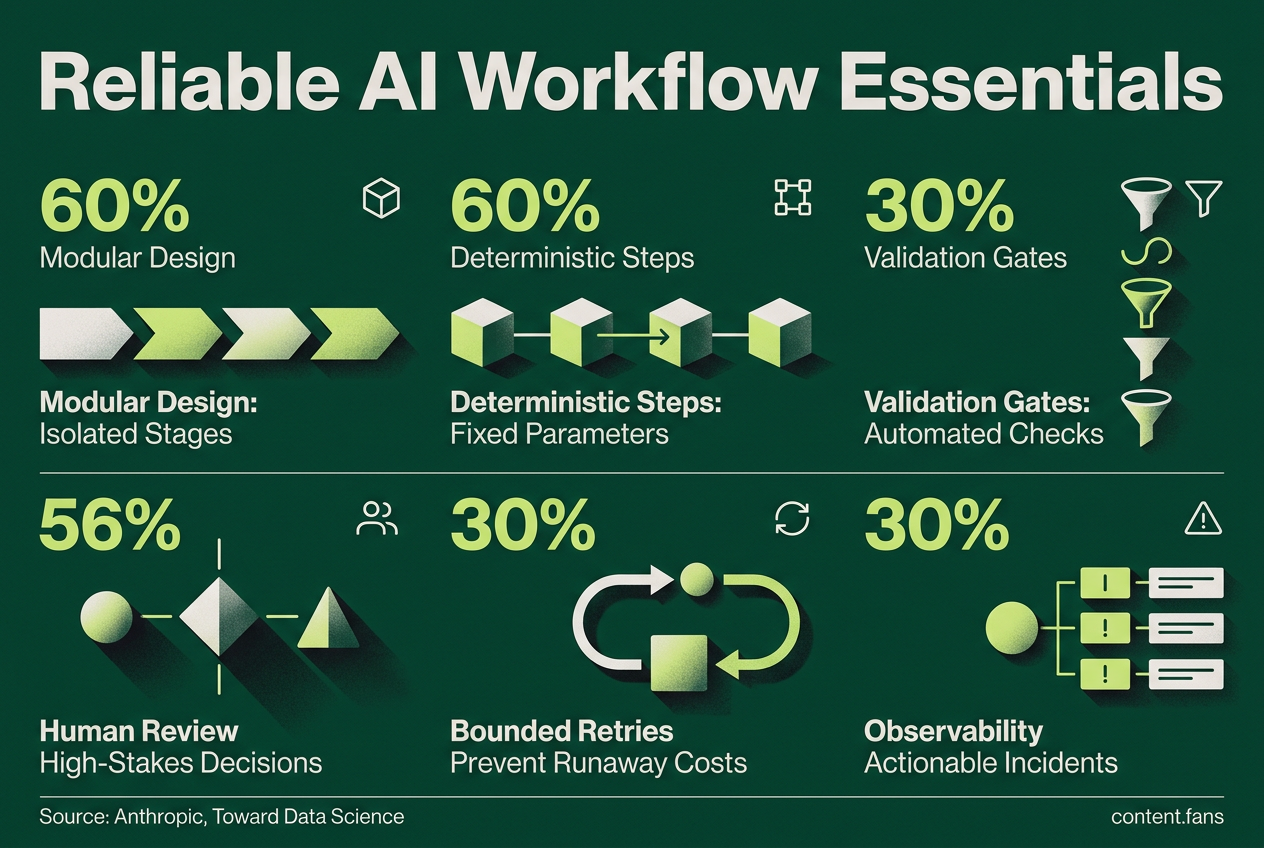
The foundation of a reliable AI workflow is a modular pipeline with distinct stages: ingestion, normalization, retrieval, generation, validation, and execution. This separation of concerns minimizes the blast radius of any single failure. As a Toward Data Science comparison notes, a modular design with explicit input/output contracts greatly simplifies rollbacks and isolated testing. Determinism is equally critical. When a step involves an LLM, lock the prompt, model version, and temperature, or enforce a seed to minimize variance. For any unavoidable variation, capture it in metadata to inform downstream validation and confidence scoring.
Validation gates, retries, and human review
Effective validation is non-negotiable for production AI. Automated schema and rules-based checks should gate any output before it leaves the system. For high-stakes decisions, human approval is often required for regulated or irreversible actions. A robust validation pattern follows this logic:
- Execute automated sanity tests (rule-based or embedding-based) on every model response.
- Validate response confidence against a predefined threshold; low scores trigger a retry, perhaps with different parameters.
- If retries fail, escalate the case to a human-in-the-loop (HITL) review queue.
To prevent runaway costs, retries must be strictly bounded. Orchestrators like Airflow provide mature retry semantics, while Prefect offers dynamic reruns that can incorporate updated parameters on the fly. Implementing circuit breakers is also crucial to prevent cascading failures when upstream data quality degrades.
Observability, orchestration, and SLO templates
Comprehensive monitoring transforms silent failures into visible, actionable incidents. While Kubeflow provides essential execution metadata, it often requires extra setup for rich dashboards. In contrast, Prefect offers real-time dashboards and automatic state tracking out of the box, whereas Airflow teams typically export metrics to tools like Prometheus and Grafana for deep analysis.
Service Level Objectives (SLOs) provide a shared, quantitative standard for reliability. Modern case studies recommend a multi-layered approach to setting targets:
| Layer | Sample metric | Typical target |
|---|---|---|
| Data quality | Schema failure rate | < 0.1% per day |
| Model output | Hallucination rate | < 1% on benchmark set |
| User experience | p95 latency | < 2 s |
When an SLO is breached, incident runbooks should dictate clear actions, such as freezing deployments, activating a fallback workflow, or paging the on-call owner. Pairing SLOs with error budgets helps teams make data-driven decisions about when to roll back a model versus absorbing temporary degradation.
Putting it together with common orchestrators
While principles are universal, tool selection shapes the specific implementation:
• Airflow: A battle-tested scheduler ideal for calendar-driven jobs like model retraining and complex ETL, known for its strong backfill capabilities.
• Prefect: A Python-native choice gaining favor for LLM agent workflows due to its dynamic task generation and real-time visibility.
• Kubeflow: The practical choice for Kubernetes-native environments, especially for GPU-intensive tasks like distributed model fine-tuning.
Regardless of the platform, best practices demand maintaining a single source of truth for the workflow definition (e.g., a DAG file) in version control. Annotate every task with its input and output schemas and emit structured logs enriched with request IDs, model versions, and token counts. This discipline is fundamental for effective root-cause analysis when performance drifts or costs spike.
What makes Level 5 "Workflow" the turning point where AI stops being a prototype and starts acting like production-grade software?
Bringing AI outputs to Level 5 reliability means turning loosely coupled agent calls into modular, observable pipelines that can survive bad data, model drift, and human oversight gaps. Anthropic and other 2024 playbooks converge on one rule: define the workflow first, then add LLM agents only where the task truly needs non-determinism. This shift forces teams to replace implicit prompt magic with explicit validation gates, deterministic fallbacks, and policy-driven rollbacks. The result is an architecture that behaves like any other mission-critical service: measurable SLOs, alertable error budgets, and safe, continuous deployment.
How do I structure a pipeline so that each stage can be rolled back or hot-fixed without touching the rest of the flow?
Design every workflow as a chain of idempotent, observable micro-stages:
- Input Gate - Schema, freshness, and completeness checks.
- Normalization Layer - Clean, deduplicate, enrich.
- AI Step - Scoped task with deterministic fallback branch.
- Validation Layer - Rule checks, confidence thresholds, hallucination probes.
- Human Gate - Review queue for low-confidence or regulated outputs.
- Execution Layer - Only trigger downstream actions after approval.
- Monitoring Layer - Logs, metrics, and feedback loops.
Each stage publishes state, trace-ids, and version hashes to a central observability store. When any stage breaches its SLO or error budget, the system auto-routes to a safe branch (canned response, human handoff, or last-known-good model) while the faulty stage is updated or rolled back in isolation.
Which orchestration tool should I pick in 2025 for real-time visibility and dynamic branching in LLM pipelines?
- Prefect - Best for Python-native AI workflows: real-time dashboards, automatic state tracking, and dynamic DAG generation make it trivial to add conditional retries or model A/B gates without redeploying the entire flow.
- Airflow - Still the most battle-tested scheduler when you need complex calendar-driven dependencies and mature back-fill logic; pair with Prometheus/Grafana for deeper observability.
- Kubeflow - Choose when the workload is Kubernetes-first and GPU-heavy (for example, nightly fine-tuning across multiple A100 nodes); observability is powerful but expects DevOps maturity.
A mid-2024 benchmark showed Prefect cut mean-time-to-detect (MTTD) pipeline failures by 38 % compared to Airflow in LLM-heavy stacks, largely because of built-in failure surfacing and automatic retries.
What concrete SLOs should I define for an LLM customer-support agent, and how do I measure them?
Treat the model as one micro-service and attach measurable targets:
| SLO | Target | Source of Truth | Breach Action |
|---|---|---|---|
| Policy-compliant response rate | ≥ 99 % | Guardrail classifier + human spot checks | Route to fallback agent |
| Grounded answer with citation | ≥ 95 % | Retrieval match score + human audit | Queue for manual fix |
| Response latency (p95) | < 2 s | Edge gateway metrics | Auto-scale replicas |
| Hallucination rate on golden set | < 1 % | Weekly benchmark + human review | Freeze new deployments |
| Data freshness | < 15 min lag | Data ingestion timestamp | Block training until caught up |
Store all metrics in a rolling 7-day window and pair each SLO with an error budget. When the budget is exhausted, deployment gates lock until reliability improves.
How do I keep humans in the loop without turning the pipeline into a ticket queue?
Use risk-weighted sampling instead of blanket human review:
- High-stakes domains (health, finance) - 100 % human approval before any downstream action.
- Regulated outputs - Run automated policy scans first; humans only step in when scans flag a violation.
- All other flows - Surface a statistical sample (1-5 %) for continuous grading and bias detection.
Embed a single-click approve/reject UX inside the observability dashboard. Feedback tags are pushed back to training data and to the SLO calculation in near-real time. Mid-2024 case studies show this pattern reduced human review latency by 54 % while maintaining safety parity with 100 % manual checks.