
Anthropic launches Claude Platform on AWS, bypassing Bedrock for enterprises
Serge Bulaev
Anthropic has made its Claude Platform available on AWS, letting enterprises use native Claude features with their existing AWS credentials. The platform may offer faster access to new features and uses Anthropic's own infrastructure, which means some data might leave the AWS region. This option gives customers more direct control but may not fit organizations with strict data residency needs. Companies might choose between this and the Bedrock version based on privacy needs or feature requirements, and some may use both for different tasks.

The Claude Platform on AWS is now generally available, offering enterprises direct access to Anthropic's native AI features using their existing AWS IAM credentials. This new service operates alongside Claude on Amazon Bedrock but introduces a distinct trust model, giving customers a direct line to Anthropic's latest innovations while retaining consolidated AWS billing and auditing. This hybrid approach could set a new standard for how specialized AI vendors integrate with major cloud providers.
What the GA release actually delivers
The Claude Platform on AWS provides the complete set of API endpoints that Anthropic offers directly. According to the Claude Platform page, key features immediately available include:
- Managed Agents (beta)
- Web Search and Web Fetch
- Code Execution workspace
- Skills and Remote MCP connectors
- Batch processing and prompt caching
Crucially, these services run on Anthropic's own infrastructure, not within the standard AWS service boundary.
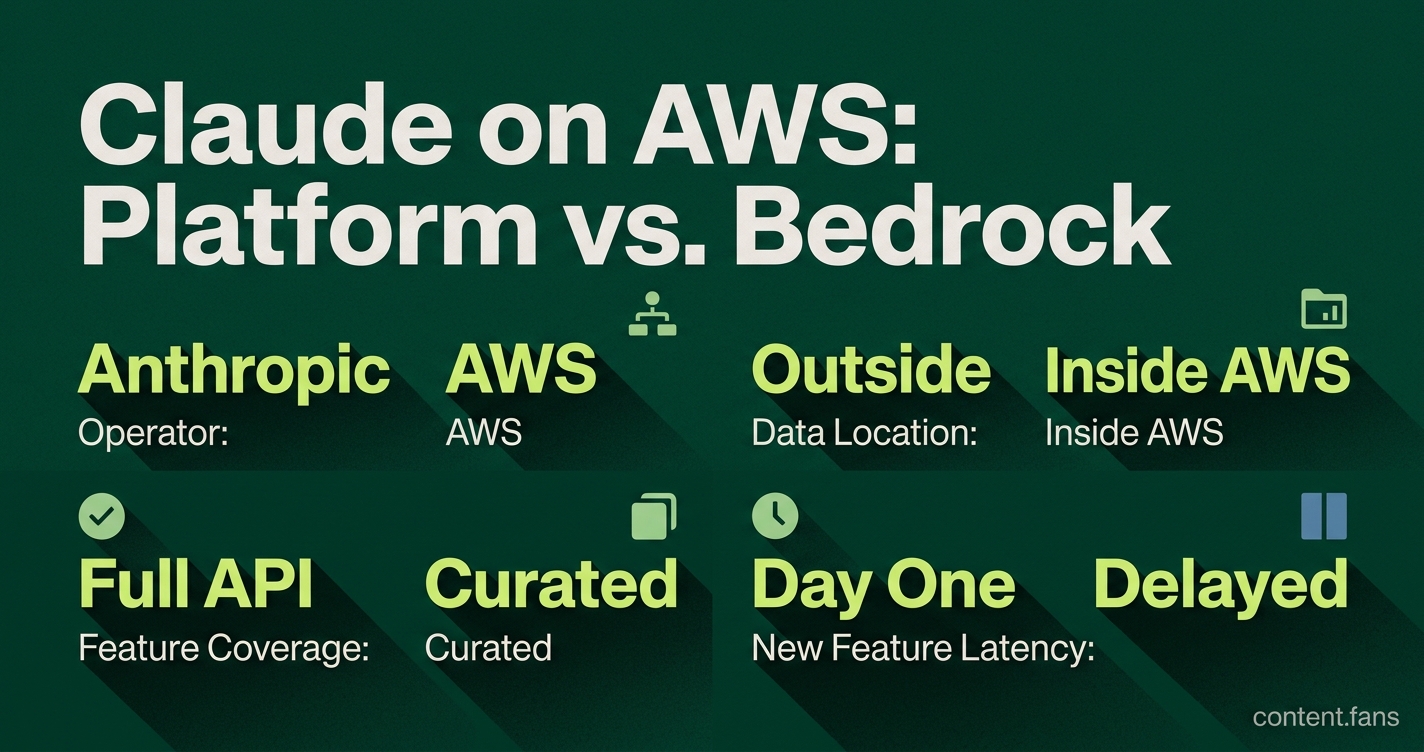
The Claude Platform on AWS provides native Anthropic features directly, including Managed Agents and web search, but processes data outside of the AWS environment. In contrast, Claude on Bedrock is an AWS-managed service ensuring data remains within AWS infrastructure but may experience delays in receiving Anthropic's newest features.
Governance hooks remain inside the AWS account
Despite being operated by Anthropic, the platform integrates tightly with AWS governance tools. Authentication uses standard IAM roles, allowing security teams to apply existing policies without managing separate credentials. All API calls are logged in CloudTrail as management events, enabling seamless integration with SIEM pipelines. Billing is also consolidated, appearing in Cost Explorer through a Marketplace subscription. However, users should note that prompt data is processed outside the AWS region on Anthropic's infrastructure. For organizations with strict data residency requirements, the Bedrock version remains the recommended option.
Claude Platform on AWS versus Claude on Bedrock
| Dimension | Claude Platform on AWS | Claude on Bedrock |
|---|---|---|
| Operator | Anthropic | AWS |
| Feature coverage | Full native API | Curated subset (Guardrails, Knowledge Bases) |
| Data location | Outside AWS boundary | Inside AWS boundary |
| Multi-model support | Claude models only | Multiple providers |
| Launch latency for new features | Day one, per YouTube launch demo | After AWS integration |
A detailed Classmethod analysis confirms that advanced features like Web Fetch, Memory, and Managed Agents are currently exclusive to the Claude Platform and not available on Bedrock.
Practical adoption tips
Enterprises can activate the service via the AWS Marketplace and should begin with a pilot in a non-production account. Before a broader rollout, it is critical to audit the following key areas:
- Confirm CloudTrail captures all required inference and management events.
- Benchmark latency against existing Bedrock endpoints to validate performance.
- Validate that all outbound data traffic complies with corporate data-egress policies.
- Estimate token costs, which maintain price-parity with Bedrock but appear as a unique line item.
Strategic context for enterprises
With Claude holding significant enterprise market share for complex reasoning tasks, this move shows AWS is adapting to meet customer demand for full-featured AI tooling within their existing security framework. For teams already using the Anthropic API, this new platform simplifies integration. Conversely, teams heavily invested in Bedrock's multi-model capabilities or strict guardrails may find the existing service remains a better fit. Ultimately, many enterprises may adopt a hybrid strategy, using Bedrock for sensitive workflows and the Claude Platform for advanced, agent-based automations.