
AI-generated overload hurts learning, 2026 reports show
Serge Bulaev
Recent reports from 2026 suggest that too much AI-generated information may hurt learning by causing decision paralysis, mental tiredness, and less confidence. Researchers found strong links between having too many choices from AI and not being able to make decisions, as well as more anxiety and weaker critical thinking. Some students who used AI tools like GPT-4 scored lower when they had to work without them, which may mean they relied too much on the technology. Experts suggest that helping learners take small daily actions, using bite-sized lessons, and adding social support might help overcome these problems. While there is still debate about long-term effects, many agree that too many options from AI can make it harder for people to move from learning to actually doing.
Emerging industry reports suggest that AI-generated overload may hurt learning, shifting the conversation from a skills gap to a psychological challenge. Experts like Peter J. Denning argue that endless AI-generated content creates a deceptive feeling of progress, trapping learners in a cycle of consumption without action. This article explores the research-backed reasons for this paralysis and the emerging design solutions to overcome it.
Psychological barriers amplified by AI
Excessive AI-generated information creates significant psychological hurdles for learners. This overload leads to decision paralysis, cognitive fatigue, and diminished confidence when working without assistance. The constant influx of options can overwhelm a person's ability to process information, ultimately preventing them from translating knowledge into practical skills.
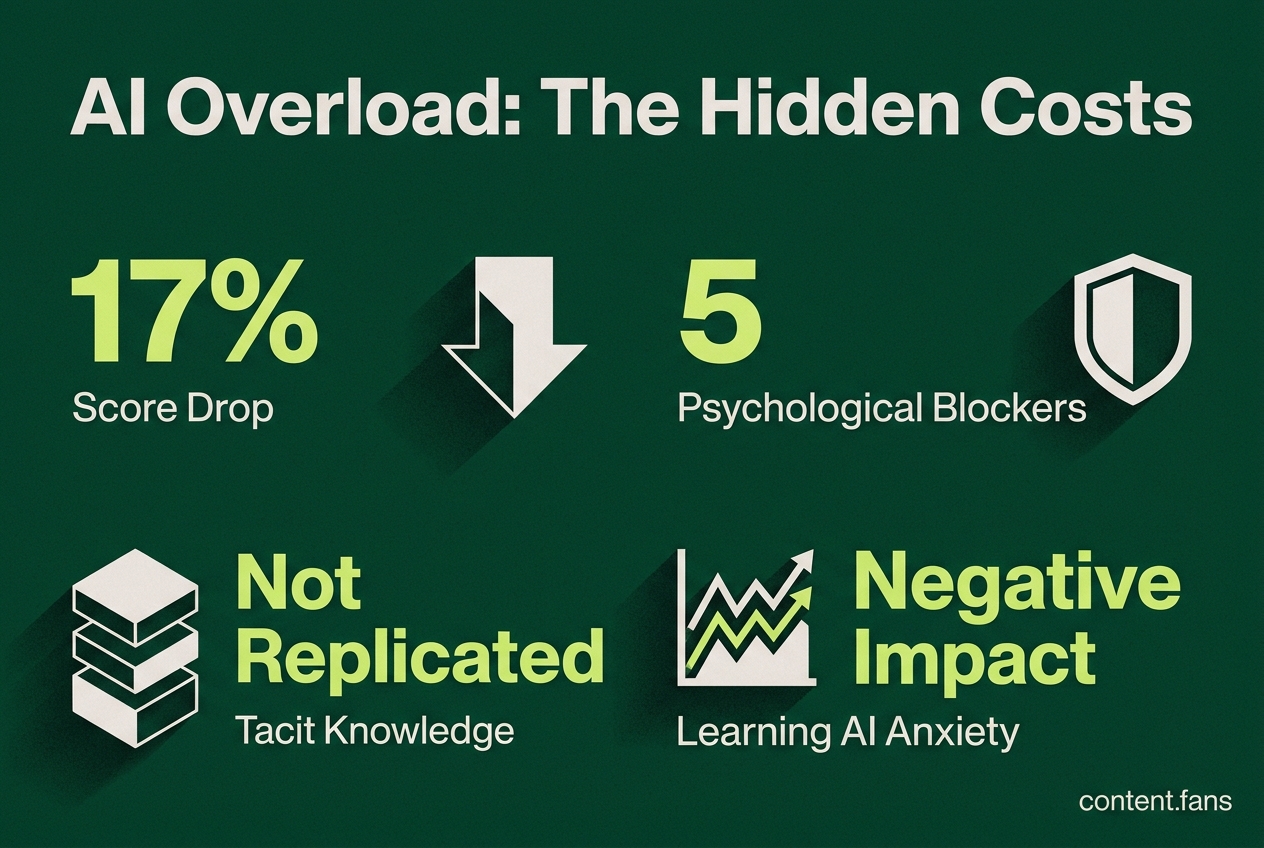
Peter Denning's research posits that AI cannot replicate tacit knowledge gained through experience. This suggests passively consuming AI-generated content is an ineffective substitute for real-world practice.
Recent academic studies validate these concerns. Industry reports reveal a strong correlation between AI-driven choice overload and decision paralysis. Further data linked prolonged AI use to decreased self-assurance, while another report found "learning AI anxiety" negatively impacts critical thinking. The Stanford 'Evidence Base on AI in K-12' (2026) provides a practical example: students using GPT-4 for assistance saw their scores drop by 17% on average when the tool was taken away, highlighting a displacement of cognitive effort.
Information Overload and PhD-Level AI Make It a Psychological Problem, Not a Skill Problem
Researchers have identified five primary psychological blockers that emerge from an endless stream of AI-generated answers:
- Decision paralysis from too many options
- Cognitive exhaustion that saps attention
- Agency decay as users outsource judgment
- Declining self-assurance when working unaided
- AI-related anxiety that dampens re-engagement
These issues are not resolved by consuming more information; they require structured, action-oriented solutions.
From content dumps to action design
In response, industry leaders are shifting from simple content delivery to "action design" to restore learner momentum. Key strategies include:
- Small Daily Actions: Embedding micro-prompts directly into workflows to reduce context-switching and build habits through progress indicators and quick wins.
- Modular Learning Objects: Breaking lessons into small, easily updated blocks to keep content current with fast-paced product development.
- Peer Accountability Scaffolds: Creating structured learning pairs with regular check-ins to reframe progress as a social commitment.
- AI-First Drafting, Human Editing: Using generative AI for initial drafts allows designers to focus on pedagogical quality, which can significantly reduce production time.
These approaches position AI as an amplifier for human effort, not a replacement for critical thought. Denning emphasizes that once psychological barriers are lowered, the primary need becomes iterative practice - observe, adjust, repeat - rather than more passive learning.
Forward-thinking education teams are now forming cross-functional councils to align learning interventions with product roadmaps. This proactive approach helps translate knowledge into measurable business outcomes, such as reduced customer churn and faster onboarding.
While the debate on long-term cognitive effects continues, the immediate consensus is clear: the main obstacle is the inactivity caused by overwhelming choice. The most effective learning products are those that encourage small commitments, provide immediate feedback, and incorporate social accountability to help users bridge the gap from knowing to doing.
Why does AI-generated content make learners feel "stuck" instead of smarter?
Abundant AI answers trigger a dopamine loop that rewards passive consumption and masks the real blockage: psychological resistance to action. Over-exposure lowers attention capacity according to industry studies and breeds decision paralysis so that the learner keeps scrolling instead of practicing.
What exactly is the "learning-without-doing" trap Peter Denning warns about?
Denning, who runs a multi-million-dollar education company, says consuming endless explanations without application keeps users hooked on the feeling of progress while real skills stay flat. Once someone finally overcomes the mental block, the next need is iteration - repeated tries - not more content.
How does recent research confirm that over-reliance on AI harms long-term retention?
The Stanford 'Evidence Base on AI in K-12' experiment showed students who used GPT-4 during study sessions scored 17% worse after AI access was removed. Escalating choice overload and eroded self-assurance leave learners anxious and unable to act without the tool.
What product tactics help learners move from passive watching to deliberate practice?
- Micro-action loops: break objectives down to two-minute tasks
- Visible progress cues: badges and streaks that reward doing, not viewing
- In-tool adoption panels: tooltips and sidebars inside the app prevent context switching and keep the user creating in the same workspace
Designers adopting these habits report significantly faster content production while human facilitators shift to coaching rather than lecturing.
Where should creators invest effort if more courses are no longer the answer?
- Action dashboards that log attempts, mistakes and revisions - iteration data outweighs completion rates
- Peer accountability pairs who check in fortnightly; belonging architecture significantly increases re-engagement
- Spaced retrieval: swapping info dumps for spaced challenges, because active recall cements tacit knowledge that AI cannot encode
Platforms that treat AI as a power tool for quick feedback loops - not an autopilot - are the ones keeping users learning by doing.