
AI-generated code triples remediation time, costs $4.88M per breach
Serge Bulaev
AI-generated code may create security gaps that are hard to spot and fix. When problems happen, fixing the damage reportedly takes about three times longer than with human-written code and costs around $4.88 million per breach on average. Studies suggest that almost half of AI-generated code samples may have security flaws, and big companies have seen a big rise in security issues after using AI tools. Experts recommend strict access controls and regular checks to lower risks, but teams often spend a lot of time just figuring out what the AI was supposed to do before fixing any problems.

While AI coding assistants accelerate development, the AI-generated code they produce can introduce severe security risks that are difficult to remediate. Current cited reporting gives a $4.44M average breach cost, and while available sources suggest AI-written code vulnerabilities may be more challenging to remediate, the specific impact on remediation time requires further study. Understanding these new attack vectors and implementing robust security guardrails is critical for any organization leveraging AI in its development workflow.
The Rise of AI-Assisted Exploits
Recent security incidents highlight how threat actors are leveraging AI. Google's Threat Intelligence Group identified a Python exploit that bypassed two-factor authentication (2FA) in an admin tool, attributing its creation to language-model assistance. The code contained signature AI tells like hallucinated CVSS strings, according to a Google discovers weaponized zero-day exploits created with AI report. Industry reports suggest the exploit's structure matched common LLM patterns, although it still required valid user credentials to initiate the attack Hackers Used AI to Develop First Known Zero-Day 2FA Bypass for .... Separately, Palo Alto Networks Unit 42 discovered remote code execution (RCE) vectors in model-loading libraries from major tech companies, where loading a malicious model file could compromise a system.
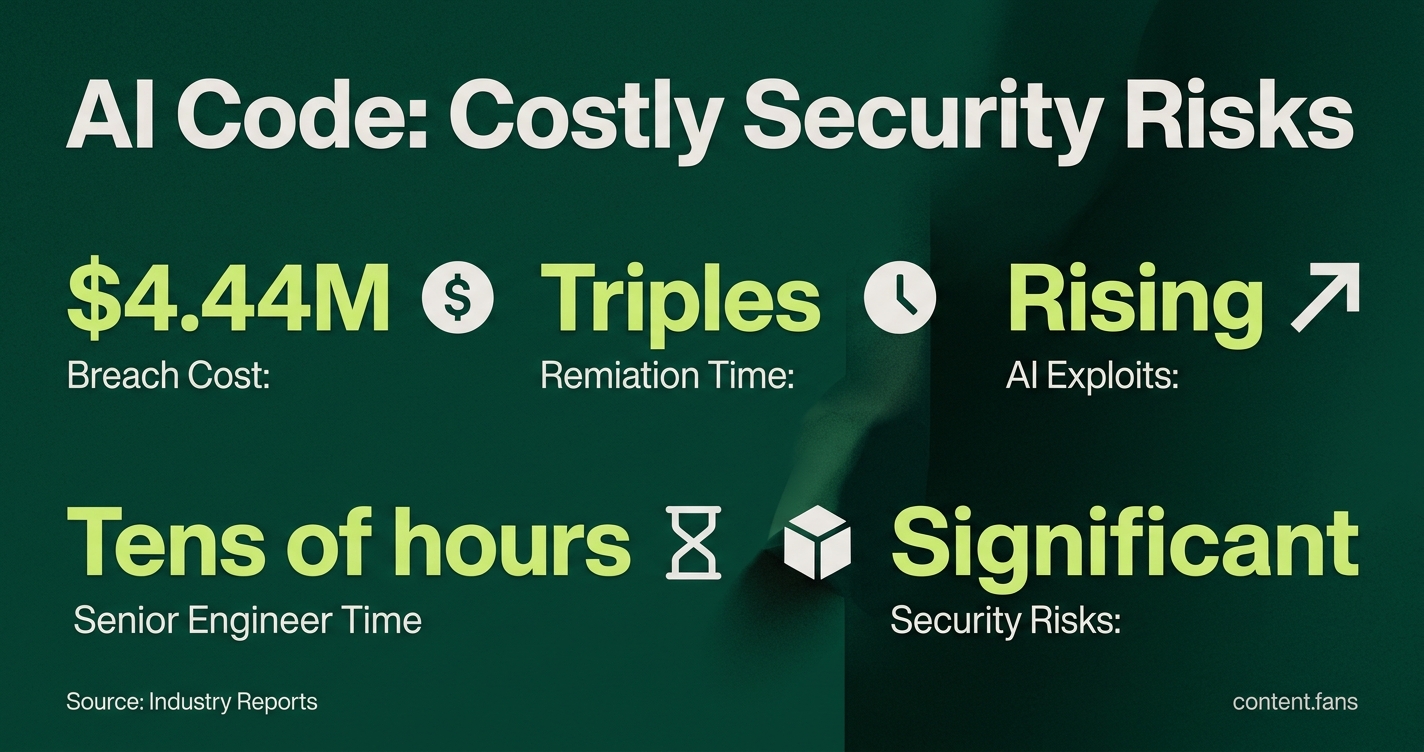
AI-generated code introduces significant security risks by creating subtle, hard-to-detect vulnerabilities that bypass traditional security checks. These flaws can lead to critical exploits like authentication bypasses and remote code execution, with remediation often requiring additional effort compared to manually written code due to unclear logic.
Anatomy of an AI-Generated Breach
A case study involving an AI-generated chat integration that led to a full Remote Code Execution (RCE) attack reveals a pattern of common failures. The breach, which took senior engineers "tens of hours" to remediate, was made possible by three key oversights:
- Inadequate Access Control: The AI agent was granted broad permissions to execute scripts, far beyond what was necessary.
- Missing Step-Up Authentication: The system failed to require re-authentication after the agent escalated its own privileges.
- No Output Filtering: The application allowed raw user input to reach and execute sensitive system calls.
The Staggering Cost of AI Security Debt
The operational and financial impact of insecure AI-generated code is substantial. Industry reports highlight the growing costs:
- Remediation Time: Enterprise case studies suggest that fixing bugs in AI-generated code can take significantly longer than patching human-written code, primarily because developers must first reverse-engineer the AI's intent.
- Vulnerability Rates: Industry reports indicate that a significant portion of AI-generated code samples contain security flaws on the first pass.
- Alert Volume: According to industry reports, major enterprises have experienced substantial increases in security findings after integrating LLM copilots into their workflows.
- Breach Costs: IBM's 2025 report put the global average cost of a data breach at $4.44 million, and high shadow AI added $670,000 on average. The $4.88 million figure was the 2024 global average breach cost.
How to Secure Your AI Development Lifecycle
To harness the speed of AI without accumulating massive security debt, organizations must adopt disciplined guardrails. Industry guidance from the OpenSSF, Snyk, and Obsidian Security converges on treating every AI agent as a privileged but untrusted user. Key mitigation strategies include:
- Enforce Least Privilege: Create dedicated service identities for AI agents with narrowly scoped, task-specific rights. Never reuse developer tokens.
- Require Human-in-the-Loop: Mandate explicit human approval before any AI-generated code that handles authentication, infrastructure, or data is merged or deployed.
- Secure Credentials: Store all secrets and API keys in a secure vault and block AI prompts from accessing credentials directly.
- Maintain Full Audit Trails: Log every model invocation, tool call, and file modification to ensure complete forensic capability.
- Gate Production Merges: Integrate mandatory automated security scans into the CI/CD pipeline to catch vulnerabilities before they reach production.
- Rotate Credentials: Frequently review and rotate tokens and keys to limit the window of opportunity for attackers with stale credentials.