
AI Coding Agents Shift Engineers to Oversight in 2026
Serge Bulaev
By mid-2026, coding agents may be handling most of the routine coding work, such as writing code, testing, and making pull requests, while human engineers focus on supervision and review. Reports suggest agents like OpenAI Codex, Claude Code, Cursor Composer, and GitHub Copilot Agent Mode now manage full workflows, including debugging and documentation. Teams choose between using one agent for simple tasks or several agents in parallel for bigger, modular tasks, depending on the job and oversight needs. No single tool appears to lead in all benchmarks, and the best option seems to depend on the kind of task. Forecasts suggest engineers might spend more time on oversight and coordination, though some experts warn that progress may be slower than hoped.

AI coding agents are increasingly used in 2026 and are being discussed as a major shift in engineering workflows, transforming how development teams approach implementation tasks. Industry reports suggest these agents write code, run tests, and open pull requests, shifting human engineers into tech lead roles focused on supervision and review. According to industry analysis, leading tools like OpenAI Codex, Claude Code, and GitHub Copilot Agent Mode are developing multi-step autonomy and repository awareness capabilities.
This evolution signifies a major leap from simple autocomplete helpers to sophisticated workflow agents. Industry reports indicate that leading tools can now manage complete implementation cycles - including debugging and documentation - within a single agentic loop, capable of decomposing tasks and merging results from multiple sub-agents.
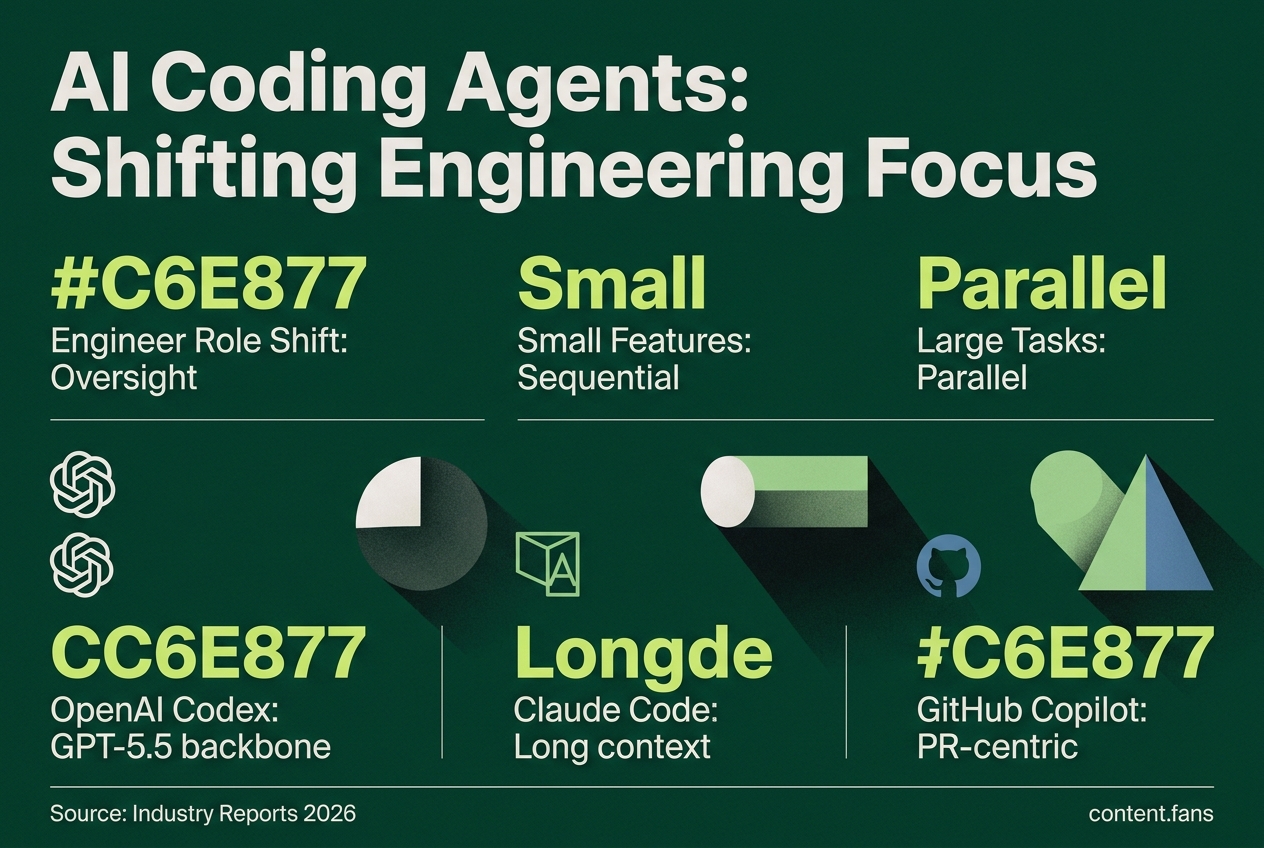
Choosing sequential or parallel execution
AI coding agents are autonomous tools that handle routine development tasks like writing code, running tests, and opening pull requests. This allows human engineers to transition from line-by-line implementation to a strategic oversight role, focusing on system architecture, code review, and overall project governance.
Single-agent, sequential workflows remain the standard for smaller features. Defined by a single context window and an ordered chain of steps, this approach offers simpler debugging and more straightforward oversight. Parallel execution, in contrast, involves an orchestrator coordinating multiple specialized agents in separate workspaces before merging their outputs. This model dramatically reduces development time for large, modular tasks but requires robust observability to manage.
When teams pick an execution model, they tend to weigh three factors:
- Task size and independence
- Governance and audit needs
- Available tooling for orchestration
Current tool positioning
| Tool | Primary surface | Reported strengths |
|---|---|---|
| OpenAI Codex | Cloud, CLI, IDE, ChatGPT | Multi-agent worktrees, background execution, GPT-5.5 backbone |
| Claude Code | Terminal-first | Long context, complex repo navigation, SWE-bench Pro performance |
| Cursor Composer | AI-native IDE | Fast local iteration, integrated diff view |
| GitHub Copilot Agent Mode | IDE plus GitHub | Enterprise adoption, PR-centric workflows |
The agentic tool market has no single winner; performance is highly task-dependent. Industry benchmarks suggest different tools excel at different tasks, with some variants performing better for terminal orchestration while others top benchmarks for code repair. This split highlights that the best-in-class tool depends on whether the primary task is orchestration or code repair.
Early signals on senior-level capability
While current agents excel at implementation, their capacity for senior-level tasks remains a topic of debate. Some industry projections forecast significant improvements in reliability for complex software tasks in the coming years, but prominent skeptics like Gary Marcus argue these timelines may be overly optimistic. The consensus is that agents will first master routine implementation, leaving system design and ambiguous requirements to human engineers, who will increasingly focus on orchestration, oversight, and final review.
Practical takeaways for ADLC teams
- Frame agents as tireless junior developers requiring consistent supervision.
- Define clear project intent, then select an execution model (sequential or parallel) that aligns with your risk tolerance.
- Establish tight review loops. The leading agent platforms integrate with diff and PR review hooks, making rollbacks inexpensive and safe.
- Select agent platforms based on benchmarks relevant to your specific tasks (e.g., code repair vs. orchestration), not just overall scores.
Ultimately, these trends signal a fundamental shift in the software development lifecycle. The "building" phase is becoming agent-first, elevating the role of human engineers to focus on high-level architecture, strategic oversight, and ultimate accountability.
How do AI coding agents change the day-to-day role of a software engineer in 2026?
Agents now own the keyboard: they spin up multi-file edits, run tests, and push green builds while engineers approve pull requests, refine specs, and guard production. The shift is from writing every line to orchestrating autonomous workflows. Teams report that engineers can supervise multiple active agents, with many organizations seeing significant reductions in delivery cycles on well-scoped features.
Which agentic tool should my team adopt first - Claude Code, Cursor, Copilot Agent Mode, or OpenAI Codex?
Match the tool to your workflow, not the hype:
- OpenAI Codex - strong platform for teams that want cloud delegation, background agents, and unified review loops. It performs well on industry benchmarks and supports multi-agent worktrees.
- Claude Code - top choice for terminal-first work on complex, long-context repos. An arXiv study shows it improved 11 out of 11 legacy algorithm implementations in one working day.
- Cursor Composer - most adopted AI-native IDE for individuals and small teams; keeps agent and diff in one surface for fast iteration.
- GitHub Copilot Agent Mode - safest enterprise path if you already live inside GitHub and need governance-friendly, IDE-native behavior.
When is parallel multi-agent execution better than sequential, and when is it overkill?
Use parallel agents when the roadmap can be split into independent chunks - new endpoints, test suites, documentation - and you have bandwidth to review concurrent outputs. Tools like Codex and Claude Code now spawn isolated worktrees and merge later, cutting large features from days to hours.
Stick with sequential for tasks that need tight reasoning chains or strict compliance - bug fixes that touch critical payment paths, for example. Coordination overhead can erase the speed gains on small, linear tasks.
How reliable are forecasts that agents will reach senior-level capability in the coming years?
Industry forecasts suggest significant improvements in reliability for complex software tasks in the coming years. Critics such as Gary Marcus warn the timeline is highly uncertain and note that system design, product judgment, and accountability remain hard for models. Bottom line: expect agents to absorb routine implementation and large-scope refactoring first, not architectural decisions or stakeholder negotiation.
What practical steps should engineering leads take today to prepare for an oversight-first future?
- Codify your definition-of-done - agents need explicit exit criteria.
- Invest in fast review cycles - parallel agents produce PRs faster than most teams currently review.
- Track agent KPIs - merge time, test failure rate, rollback count - to spot when an agent drifts.
- Upskill senior staff in prompt engineering and workflow orchestration; the premium moves from writing code to specifying, verifying, and integrating it.
- Insist on deterministic environments - containerized worktrees, locked dependencies - so agent runs are reproducible and auditable.