
AI Agents Reshape SaaS, Threaten Seat Licenses by 2026
Serge Bulaev
AI agents may change how SaaS companies price and deliver their products by 2026. Reports suggest that traditional seat licenses could become less important as AI agents get better at doing work for many people, not just guiding them. Experts believe vendors are slowly adding AI features to test what works, which might help them avoid big risks. Some studies predict many enterprise apps will have AI agents by 2026, and companies focused only on selling many seats may struggle. Buyers seem to value practical AI features like automation and good data handling, so vendors who offer these may adapt better to changes.
By 2026, the rise of AI agents will reshape SaaS markets, challenging traditional per-seat licensing models as autonomous software begins to execute work rather than merely guide users. This fundamental shift signals a major restructuring for software vendors. As AI agents gain the ability to serve multiple users, the value proposition of seat-based licenses diminishes, forcing companies to rethink pricing, product roadmaps, and workflow ownership.
From Seat Licenses to Outcome-Based Billing
Agentic AI is poised to disrupt legacy SaaS pricing by enabling a single agent to perform tasks for multiple users, weakening the value of per-seat licenses. According to industry reports, this is pushing vendors toward hybrid models that combine usage-based billing with pricing based on measurable business outcomes.
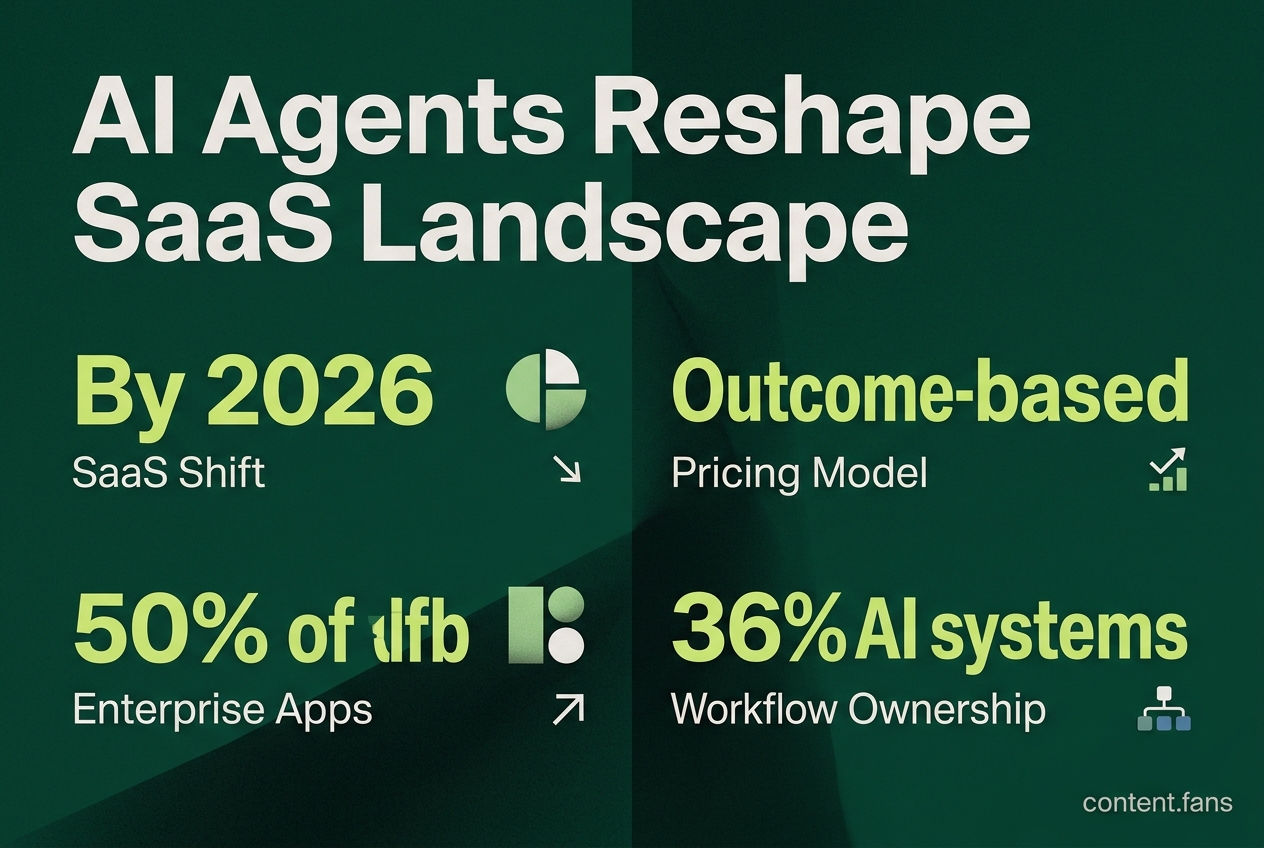
Industry analysts suggest that agentic AI makes applications "more intelligent, personalized, adaptive, and autonomous," directly challenging seat-based licensing. This shift forces a move toward hybrid usage- and outcome-based billing. Underscoring this trend, industry forecasts predict that a significant portion of enterprise apps will feature AI agents by 2026, representing a substantial increase from current levels, making agent capabilities a standard expectation.
How Leading SaaS Vendors Are Responding
Leading SaaS companies are embedding agents to protect their market share and create new revenue streams. Rather than overhauling entire platforms, they are taking an incremental approach by testing feature-level autonomy to gather usage data and mitigate risk. Key examples include:
- Zapier Agents: Customers can build natural-language bots to orchestrate tasks across thousands of apps, shifting Zapier from simple triggers to full agentic workflow management.
- Microsoft Copilot: By embedding agents across Microsoft 365, Graph, and Azure, Microsoft lowers adoption barriers, allowing users to leverage AI within familiar applications via a low-code studio.
Key Areas of Disruption and Opportunity
Analysis of industry trends reveals five key areas where AI agents will likely create significant disruption or opportunity:
- Seat-based pricing compression
- Workflow commoditization when data lives elsewhere
- Higher demand for governed systems of record
- Emergence of AI-native startups competing on lower cost and speed
- Expansion of vertical SaaS that packages domain data with agents
A recent BetterCloud brief reinforces these points, warning that vendors who depend on high seat counts with little differentiation are at risk. The brief notes that the market is shifting from human-assisting tools to AI systems that "execute work and own outcomes."
What Enterprise Buyers Now Expect from SaaS
The market is rapidly shifting to reward measurable productivity over feature lists. Industry reports indicate a significant increase in AI adoption, and studies show mid-market software firms are feeling the pressure from AI-native entrants and large platforms. As a result, enterprise buyers are evaluating SaaS vendors against a new set of practical expectations:
- Context awareness and predictive recommendations in daily workflows
- Embedded automation that closes the loop on routine tasks
- Transparent governance around data handling and model behavior
SaaS providers that demonstrate clear value in these areas and offer adaptive pricing models are best positioned to thrive through this market restructuring.
What is meant by the 'SaaSpocolypse' and how realistic is it for 2026?
The term 'SaaSpocolypse' describes the fear that AI agents will replace entire categories of SaaS products by handling workflows directly, reducing the need for human-operated software. While headlines predict significant market disruption, the consensus among major research firms is more nuanced. Industry analysts view the coming years as a period of selective disruption and re-platforming rather than collapse. Some research characterizes it as a "slow restructuring" where traditional seat-based licenses come under pressure but the overall software market could still expand significantly due to AI-generated productivity gains.
How will AI agents change SaaS pricing models by 2026?
Industry experts expect that per-seat pricing will lose relevance because a single AI agent can perform work that once required many human users. Vendors are already piloting hybrid monetization: combining usage-based, outcome-based, and tiered subscription models. Industry outlook suggests that "subscriptions and seat-based licensing may give way to hybrid usage- and outcome-based pricing," while analysts warn that AI agents acting like users are directly undermining the old licensing logic. Early adopters report price compression on legacy seat SKUs as buyers demand value linked to tasks completed or business outcomes rather than headcount.
Which SaaS companies are already winning with AI agents?
Several high-profile vendors have moved beyond pilots and are embedding production-grade agents:
- Salesforce Agentforce turns CRM from a data-entry system into an AI-assisted revenue engine, autonomously executing follow-ups and service tasks.
- Zapier Agents orchestrate workflows across thousands of SaaS apps, letting teams replace repetitive multi-tool processes with autonomous bots.
- Apollo.io uses AI agents for lead identification and personalized outreach, reportedly increasing sales-team capacity significantly.
- Intuit has launched finance agents that automate bookkeeping, tax, and payments, positioning its platform as an action-oriented finance co-worker.
These examples align with industry forecasts that a significant portion of enterprise apps will host task-specific AI agents in the coming years.
What new customer expectations should SaaS vendors prepare for?
Enterprise buyers are shifting from feature checklists to outcome contracts. They now demand:
- Context-aware interfaces that understand intent without extra clicks.
- Continuous self-improvement - products expected to learn from usage and get better automatically.
- Embedded, autonomous execution - routine tasks must run without human initiation.
Industry surveys indicate that a majority of CIOs will prioritize vendors whose AI agents can prove measurable productivity gains within short timeframes.
How can SaaS vendors defend against agent-driven disruption?
Incumbents that rely on high seat counts and thin workflow wrappers face the greatest risk. The most defensible strategies focus on deep data moats and governance:
- Anchor the AI agent layer on proprietary, industry-specific data (e.g., patient records in healthcare SaaS).
- Offer explainable AI and compliance controls - industry research cites stronger governance as a key buying criterion.
- Shift roadmaps from AI features to AI-native architectures, redesigning products so AI agents sit at the core, not the periphery.
Vendors following these steps are seeing higher net retention rates than peers, according to industry analysts.