
Agentic AI cuts incident response times for cybersecurity teams
Serge Bulaev
Field evidence from 2024-2026 suggests that using agentic AI may help cybersecurity teams respond to incidents much faster, sometimes cutting response times by hours. Some platforms appear to resolve over 90% of basic alerts and might reduce response times to under 4 minutes if proper controls are set up. Teams often start by testing AI on low-risk systems and keep humans involved for the most critical actions to stay safe. Success is usually measured by how fast and accurately incidents are contained, and how much analyst time is freed for more important work. The process seems to work best when combining AI automation with layers of human oversight and strong safety checks.

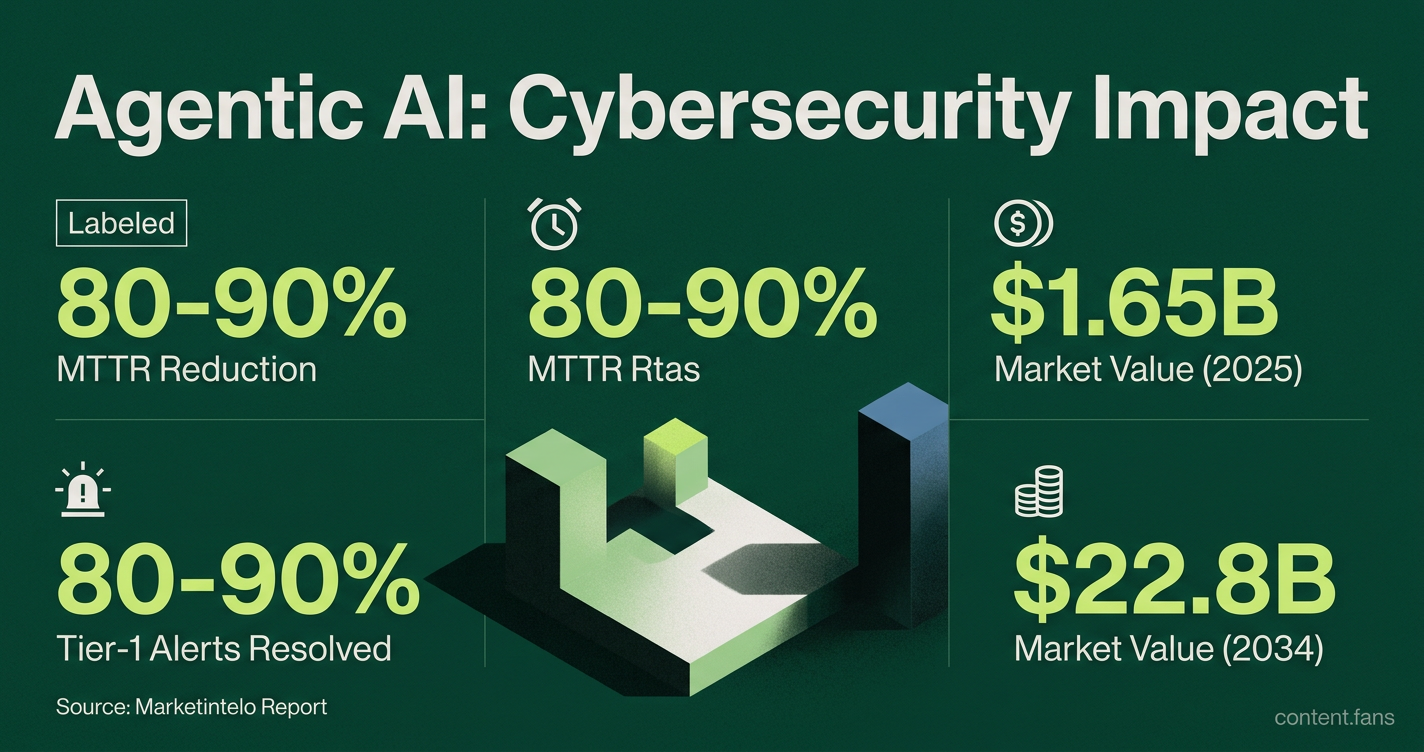
For cybersecurity teams, agentic AI is a powerful tool that significantly cuts incident response times. The primary challenge is transitioning from static scripts to autonomous yet safe workflows without losing control. Early adopters are seeing substantial reductions in their mean time to respond (MTTR) by 80-90%.
According to market research from Marketintelo, the agentic AI cybersecurity platform market is valued at $1.65B in 2025 and projected to reach $22.8B by 2034. Leading agentic platforms can autonomously resolve up to 80-90% of tier-1 alerts and reduce MTTR by 80-90%. These results underscore how a well-designed architecture with robust guardrails enables machine-speed containment while ensuring full auditability.
The following playbook deconstructs that architecture and the steps needed to design, pilot, and scale it.
Reference architecture: from telemetry to action
A typical production architecture follows four stages: telemetry ingestion, decision logic, orchestrated action, and human approval gates. First, agents ingest signals from endpoints, networks, cloud, and identity platforms. They then use a combination of LLM-driven reasoning and deterministic rules to recommend or execute containment actions. These actions are passed to an orchestration layer capable of isolating hosts, revoking tokens, or blocking domains. Crucially, high-impact changes are paused for human approval, following risk-based, time-boxed SLAs as outlined in Strata.io's oversight framework.
Agentic AI works by ingesting diverse security telemetry and applying contextual reasoning to identify threats. It then autonomously executes containment actions like isolating hosts or revoking access. To ensure safety, a human-in-the-loop model requires approval for high-risk actions, balancing automated speed with necessary human oversight.
Start small: sandboxed pilot scenarios
Initial adoption should begin with pilots on low-risk assets, like development endpoints or non-production cloud environments. Agents are particularly effective at automated enrichment and triage; a valuable first step is allowing them to correlate phishing alerts and quarantine suspicious emails. After verifying rollback capabilities and rate limits, teams can expand the scope to include credential revocation and host isolation.
Embedding human oversight and safety checks
A proven strategy for embedding safety involves a four-tier workflow model: Assist-Only, Approval-Required, Bounded-Autonomous, and Post-Action-Review. Security Operations Centers (SOCs) typically place irreversible actions, like disabling a production user, in the 'Approval-Required' category. To combat automation bias, teams can implement red-team drills and require two-factor judgment - an independent analyst review combined with a model-driven sanity check - for all critical actions.
Measuring success and spotting drift
Success is measured by improvements in speed, fidelity, and analyst capacity. Organizations are reporting significant reductions in containment times and substantial decreases in false positives. Key Performance Indicators (KPIs) to track include:
- MTTR for tier-1 and tier-2 incidents
- Percentage of autonomous resolutions
- False positive rate before and after automation
- Containment success within policy boundaries
- Analyst hours reallocated to proactive hunting
Vendor evaluation checklist
With stricter audit and explainability requirements from regulations like EU NIS2 and the SEC's 2023 disclosure rules, vendor evaluation has become critical. When evaluating platforms, security architects should prioritize the following capabilities:
1. Readable decision logs that map each agent step to source telemetry.
2. Support for scoped, short-lived credentials (Agentic IAM).
3. Native hooks for human-in-the-loop approval lanes.
4. Integration stacks covering SIEM, EDR, identity, and ticketing tools.
5. Built-in prompt-injection detection or compatibility with agent governance add-ons.
Scaling to production
Following a successful pilot, agents can be graduated into progressively higher-trust environments. Use cases like host isolation, token revocation, and DNS blocking can safely move to a Bounded-Autonomous mode once robust rollback scripts and observability dashboards are established, according to Kanerika case studies. A comprehensive scaling plan must include capacity testing, drift-detection alerts, and regular no-blame debriefs to continuously refine the system with human feedback.
By methodically layering telemetry, reasoning, orchestration, and human oversight, organizations can harness agentic AI for autonomous containment. This approach achieves machine-speed response while preserving the essential human judgment required to navigate regulatory demands and real-world complexity.