
Adobe Acquires Semrush for $1.9B, Integrates SEO into Experience Cloud
Serge Bulaev
Adobe has confirmed it bought Semrush for $1.9 billion, aiming to add Semrush's SEO and discoverability tools to its Experience Cloud platform. Analysts suggest this move may help Adobe offer a single view of content performance and could make companies prefer using fewer, more integrated platforms. Early reports indicate this deal might push customers toward more expensive Adobe plans and shift how marketing teams measure success, possibly focusing more on sales pipelines than just keyword rankings. There may be challenges, as Adobe still needs to show it can serve both small businesses and large companies with this new setup. The integration will happen in steps, and users may see changes to how tools work together over the next few quarters.

Adobe completed its acquisition of Semrush for about $1.9 billion and said it would strengthen its customer experience capabilities. This strategic move aims to provide marketers with a unified view of content performance, from creation to discovery, and signals a significant shift toward consolidated, AI-powered marketing technology stacks.
Why the Adobe-Semrush Deal Matters for Every Marketing Stack
This acquisition signals a major shift toward integrated marketing platforms. By embedding Semrush's SEO and discoverability intelligence into Experience Cloud, Adobe is compelling businesses to consolidate their tools, favoring comprehensive suites with shared data and AI capabilities over a collection of single-purpose vendor solutions.
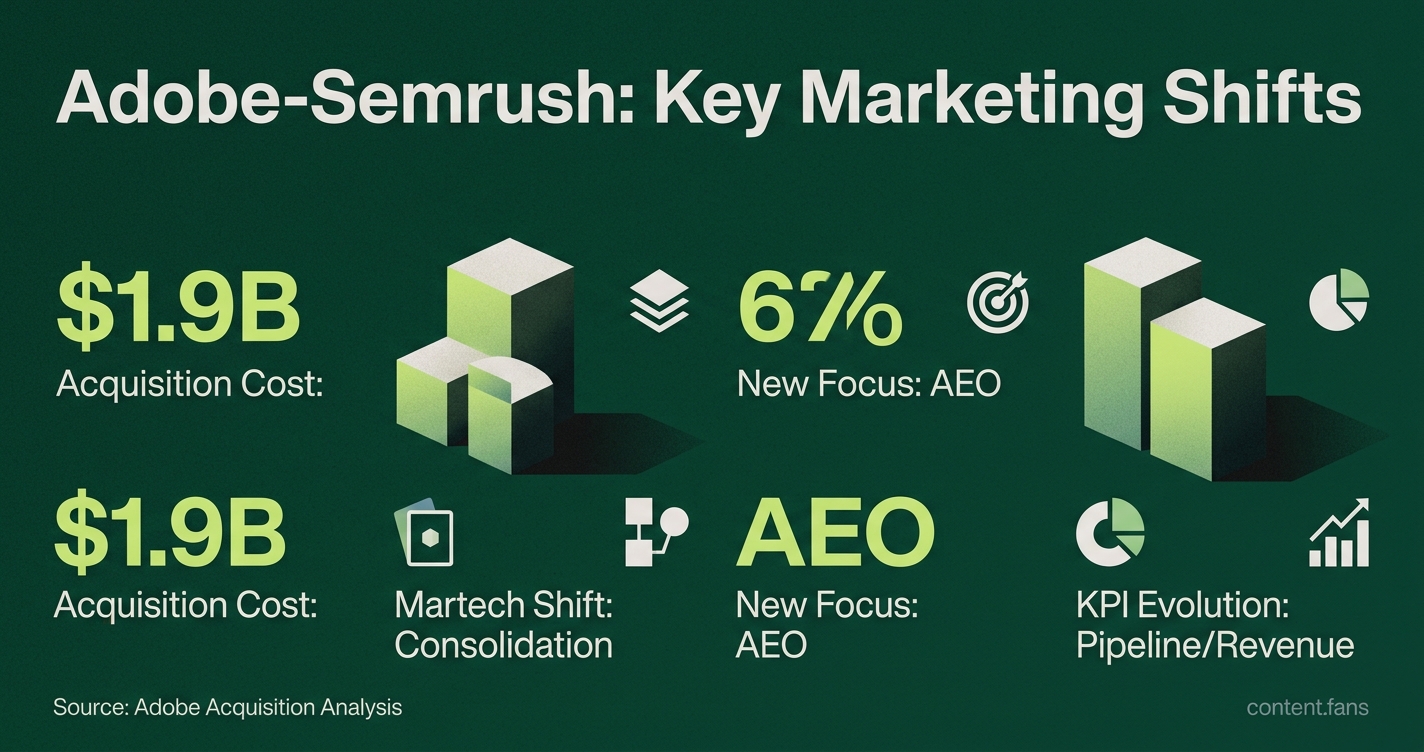
Most enterprise search teams currently use a mix of tools for rank tracking, content optimization, and search monitoring. According to industry reports, many organizations favor platforms with native AI and shared first-party data. By folding Semrush into Experience Cloud, Adobe pressures standalone vendors and accelerates market consolidation. Early analysis points to three immediate effects:
- Deeper Adobe Ecosystem Integration: Tighter integration, as noted by MediaPost, could encourage customers to upgrade to higher-tier Adobe subscriptions to access the full suite of capabilities.
- Martech Stack Rationalization: CMSWire reports that companies are increasingly auditing their marketing technology, prioritizing native platform features over external add-ons to reduce complexity and cost.
- A Shift in Measurement: Success metrics are evolving from simple keyword rankings to qualified sales pipeline and revenue, reinforcing the value of outcome-based dashboards that connect SEO efforts to business results.
AEO and Discoverability Strategies After the Deal
Answer Engine Optimization (AEO), which focuses on tuning content for LLMs and voice agents, becomes even more critical. The Martech Podcast highlights that modern AEO builds on traditional SEO but requires reusable content modules, unified data schemas, and governed workflows. This consolidation amplifies the need for a structured approach.
| Stack area | Practical adjustment |
|---|---|
| Content models | Prioritize modular how-to and FAQ blocks that feed classic SERPs and assistant snippets. |
| Data layer | Centralize identity and conversion signals inside a CRM or CDP to inform agent personalization. |
| Governance | Apply tighter permissions since AI agents can publish or trigger campaigns across systems. |
| KPIs | Track pipeline quality or assisted revenue, not just organic clicks. |
This framework, supported by analysis from CMSWire and DMEXCO, emphasizes that process quality - not the number of vendors - is what drives discoverability gains in the AI era.
Competitive Landscape After Adobe Buys Semrush
Standalone SEO suites now face intense competition. As Search Engine Journal notes, Adobe can now bundle content insights, customer journey data, and creative tools into a single license. Competitors are likely to respond by:
- Forming Alliances: Partnering with CDP, analytics, or commerce platforms to match Adobe's breadth.
- Innovating with AI: Adding advanced agentic features that automate research, content drafting, and validation.
- Offering Transparent Pricing: Using clear pricing tiers to differentiate from complex, bundled enterprise contracts.
However, Reuters analysts caution that Adobe must still prove it can serve Semrush's core mid-market customer base while scaling for Fortune 500 workflows. The company's future pricing strategy will reveal whether its focus is on market volume or profit margin.
What to Watch Next
Adobe is planning a phased integration, starting with shared logins and unified reporting, with full feature convergence expected in the coming quarters. Practitioners should monitor:
- Changes to APIs and data exports that could disrupt existing dashboards.
- The product roadmap for new Generative Engine Optimization (GEO) and agentic search modules.
- Any shifts in credit allocation within Adobe Analytics that could change how channel performance is measured.
The overarching theme is the convergence of AI-driven discovery with comprehensive customer experience management. This requires marketing teams to adopt a process-centric roadmap: resolve data debt, streamline workflows, and embed validation before simply swapping tools. Without this, consolidation only creates the same complexity behind a different login screen.
What is the confirmed timeline and value of Adobe's acquisition of Semrush?
Adobe announced its definitive agreement to acquire Semrush on November 19, 2025, in an all-cash deal valued at approximately $1.9 billion - or $12 per share, representing a 77.5% premium over Semrush's prior closing price. The acquisition was subsequently completed on April 28, 2026, with Adobe officially designating Semrush as a "leading brand visibility platform."
How will Semrush integrate with Adobe's existing Experience Cloud products?
Adobe has outlined plans to deeply embed Semrush capabilities across its core enterprise marketing stack. Semrush will integrate with Adobe Experience Manager, Adobe Analytics, and Brand Concierge - creating a more unified workflow for enterprise marketers who need end-to-end visibility across both owned channels and emerging AI search surfaces. This integration signals Adobe's strategic bet that SEO, generative engine optimization (GEO), and agentic search optimization (ASO) will become inseparable from broader customer experience management.
What does this deal mean for marketing teams' current SEO and content optimization strategies?
The consolidation pressures teams to rethink their martech stack architecture. With Semrush becoming part of Adobe's broader CX platform, organizations now face a choice: deepen their Adobe ecosystem investment or seek alternative standalone solutions. Marketing teams should audit duplicate capabilities across their current tools and evaluate whether native Adobe features can replace point solutions before adding new vendors. The shift also means AEO (Answer Engine Optimization) strategies must become more operational - focusing on structured, reusable content, unified first-party data, and workflow-centered execution rather than isolated rank tracking.
How is AI discovery changing the value proposition of SEO tools post-consolidation?
The market is rapidly moving beyond traditional search ranking toward visibility in LLMs and AI assistants. Adobe's framing of the Semrush acquisition emphasizes "discoverability intelligence" - the ability to optimize for AI-mediated discovery, not just conventional search engines. This aligns with emerging trends where many valuable tools combine orchestration, domain-specific workflows, contextual memory, and measurable business outcomes rather than functioning as standalone research or content generators. Teams should prioritize platforms that can prove measurable lift in specific workflows rather than broad "AI transformation" claims.
What risks should organizations consider when evaluating this consolidated ecosystem?
Several market dynamics warrant careful consideration. Adobe ecosystem lock-in may intensify - with Semrush capabilities potentially favoring higher-tier Adobe customers or requiring broader platform commitments. Organizations should also recognize that consolidation without workflow redesign preserves the same inefficiencies; simply cutting vendors without fixing broken processes, ownership structures, and data lineage will not improve outcomes. Finally, data governance becomes critical - AI agents require reliable access to identity, permissions, and conversion data across integrated systems, making architectural flexibility and clean data layers essential evaluation criteria.