
2026 Report: AI Attribution Trims CPA Up To 36%
Serge Bulaev
AI is now helping companies track and credit every step a customer takes, which cuts the cost of getting new customers by up to 36 percent. Instead of focusing on getting lots of leads, teams now use smart signals to find out when someone is truly ready to buy. Tools like Amplemarket and ZoomInfo make it easier for sales teams to spot the best opportunities and reply faster. Machine learning checks every action and tells companies where to spend their money for the best results. All of this works only if companies use data safely and follow strict privacy rules, keeping trust high.

New AI attribution models can trim cost per acquisition (CPA) by up to 36% by accurately tracking complex B2B buyer journeys. According to a 2026 report, companies using these models grow their pipeline without increasing ad spend by focusing on purchase-ready intent signals instead of raw lead volume. The most successful firms now unify prospecting, scoring, and attribution on a single data platform, ensuring every marketing dollar is allocated based on its direct impact on revenue.
Signals Over Volume
AI attribution models analyze every touchpoint in the customer journey, assigning credit based on actual influence rather than fixed rules. This allows teams to reallocate budget from low-impact channels to high-performing ones in real time, directly lowering the average cost to acquire a new customer.
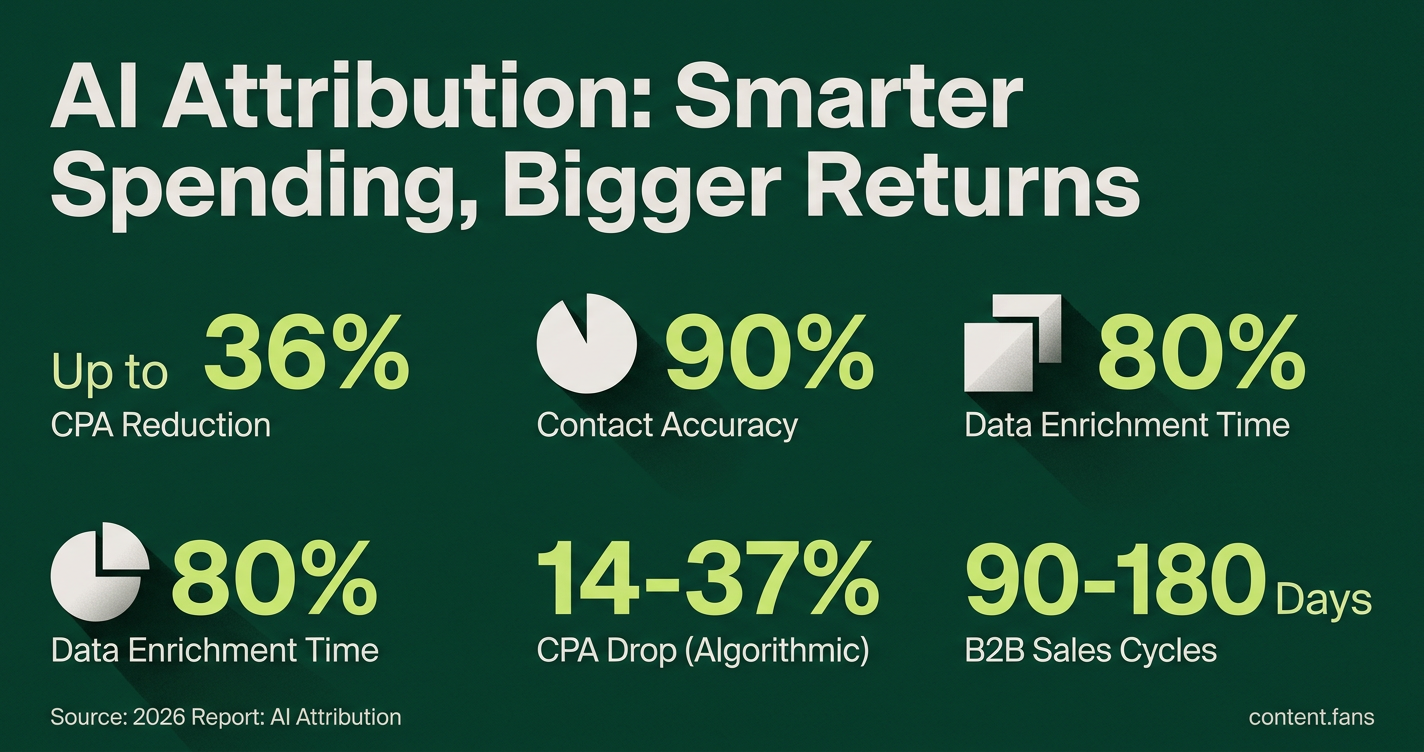
An AI-first sales stack helps teams prioritize high-value activities. For example, tools like Amplemarket's Duo copilot can boost reply rates by automatically surfacing critical events like job changes or new funding rounds within the prospecting workflow (Amplemarket). A study of top tools finds that leading data providers like Seamless.AI, ZoomInfo, and Apollo.io now offer over 90% verified contact accuracy, which reduces manual data enrichment time by 80% (Improvado).
AI-driven scoring systems then rank accounts by their likelihood to convert. Platforms like ZoomInfo use intent models that combine firmographics, engagement history, and surge data to identify top opportunities. This allows sales reps to focus on fewer, higher-quality leads, creating a clear link between marketing outreach and revenue.
AI-Savvy Attribution: Insights from The 2026 Guide to Multi-Touch Attribution in an Automated World
Instead of using fixed rules, machine learning attribution engines analyze thousands of historical conversion paths to measure the incremental lift from each marketing touchpoint. Research from Improvado confirms that teams switching from last-click models to algorithmic attribution see their CPA drop by 14-37% (Improvado). Key advantages include:
- Dynamic Credit Allocation: Models adapt to changing buyer behavior throughout long (90 - 180 day) B2B sales cycles.
- Unified Account Views: Identity resolution connects anonymous website visits to known accounts, enabling true account-based measurement.
- Predictive Forecasting: Algorithms identify underperforming channels weeks in advance, allowing teams to adjust strategy before targets are missed.
To be effective, these advanced platforms require clean, unified data. A typical workflow involves feeding CRM, ad platform, and website event data into a central data warehouse. From there, modeled insights are pushed back to reporting dashboards and automated bidding systems.
Ethical Guardrails Keep Gains Sustainable
Achieving attribution excellence is meaningless without maintaining customer trust. The latest compliance standards emphasize the need for explicit consent for collecting contact data, transparent data sourcing, and regular bias audits of AI models. Brands that monitor privacy as a key performance indicator (KPI) and maintain public governance dashboards build credibility while avoiding significant fines.
Forward-thinking marketing leaders now integrate ethics checkpoints into every stage of an AI implementation, from initial data ingestion to final predictive scoring. This creates a powerful revenue engine that is both persuasive and respectful of customer privacy.
What exactly changed in 2026 that lets AI-powered multi-touch attribution cut CPA by up to 36%?
Algorithmic MTA models replaced the old rule-based ones. Instead of pre-set "linear" or "time-decay" formulas, machine-learning engines compare every converter to non-converters and re-assign credit nightly. The result is 14-36% lower cost per acquisition for teams that feed the model at least 300 closed-won deals per quarter. Early adopters also report a 6% conversion-rate lift within the first 90 days because spend is shifted away from low-impact impressions the model proves are simply "hanging around" the path.
Which 2026 AI tools already bundle lead generation + multi-touch attribution in one stack?
Amplemarket and Factors.ai are the two platforms that natively combine signal-driven prospecting with algorithmic attribution. Amplemarket's copilot surfaces contact-level intent, then writes and sends the email, while its built-in MTA module shows exactly which sequence step pushed the account to "opportunity." Factors.ai starts with anonymous website visitor ID (>75% resolution) and links those visits to later CRM stages, giving ABM teams a single dashboard that moves dollars from paid social to the webinars that actually create pipeline.
How do I know our data is clean enough for AI attribution to be trustworthy?
Start with one unified data set: ad impressions, site events, CRM stages and revenue. If your CRM shows two contacts with the same email or campaign names vary by channel, fix that first. Companies that skip the unify step see model accuracy drop 18-22% and risk "garbage-in, garbage-out" budget moves. Run a quarterly closed-won validation report: when the model's top five "high-impact" touches appear in at least 80% of won deals, your data hygiene is solid.
Does AI attribution expose us to new privacy or compliance risk?
No new laws were added in 2026, but regulators now expect an auditable consent log inside every AI marketing tool. Choose vendors that store opt-in timestamps and offer a one-click export; this keeps you compliant with GDPR/CCPA and ready for the Digital Dashboard audits that go live in late 2026. Also insist on an explainability panel - a plain-English sentence such as "LinkedIn ad viewed 3× within 7 days lifted win probability 12%" - so your team can defend credit allocation to finance or external auditors.
How long before we see ROI after switching to AI-driven MTA?
Most B2B SaaS teams see budget-efficiency gains within 45 days and a 19% ROI increase in the first full year. The 36% CPA reduction quoted in the headline is the upper quartile; it appears when (1) you run $150k+ monthly paid spend and (2) at least three stakeholders touch each deal. Smaller programs still gain 14-20% CPA relief, but only after the model accumulates 300+ conversions - below that threshold the engine reverts to conservative rules and your finance team will not feel the difference.