
PitchBook Unveils AIBQ Framework to Rate Frontier AI Companies
Serge Bulaev
PitchBook has created the AIBQ framework to score frontier AI companies across five key areas, including revenue quality and capital efficiency. Early descriptions suggest that some of the most expensive labs may not perform as well as their peers on basic business metrics. Databricks reportedly scored highest in the group, while OpenAI and xAI appear to have lower scores despite high valuations. The framework may help investors compare AI deals more clearly by turning concerns about things like cloud dependence into numbers. This comes as investors are putting more money into AI, even though the business models might still be changing.

PitchBook's AIBQ framework reveals a critical paradox in AI investing: the most valuable frontier AI labs often show the weakest business fundamentals. This new analysis questions the sustainability of recent valuation spikes by scoring companies on core operational metrics, not just hype.
How the AIBQ scorecard works
The AIBQ (AI Business Quality) framework is a proprietary scoring system from PitchBook for evaluating frontier AI companies. It provides a 0-10 rating based on five weighted dimensions, including revenue quality and capital efficiency, offering investors a standardized metric to compare high-stakes AI investments.
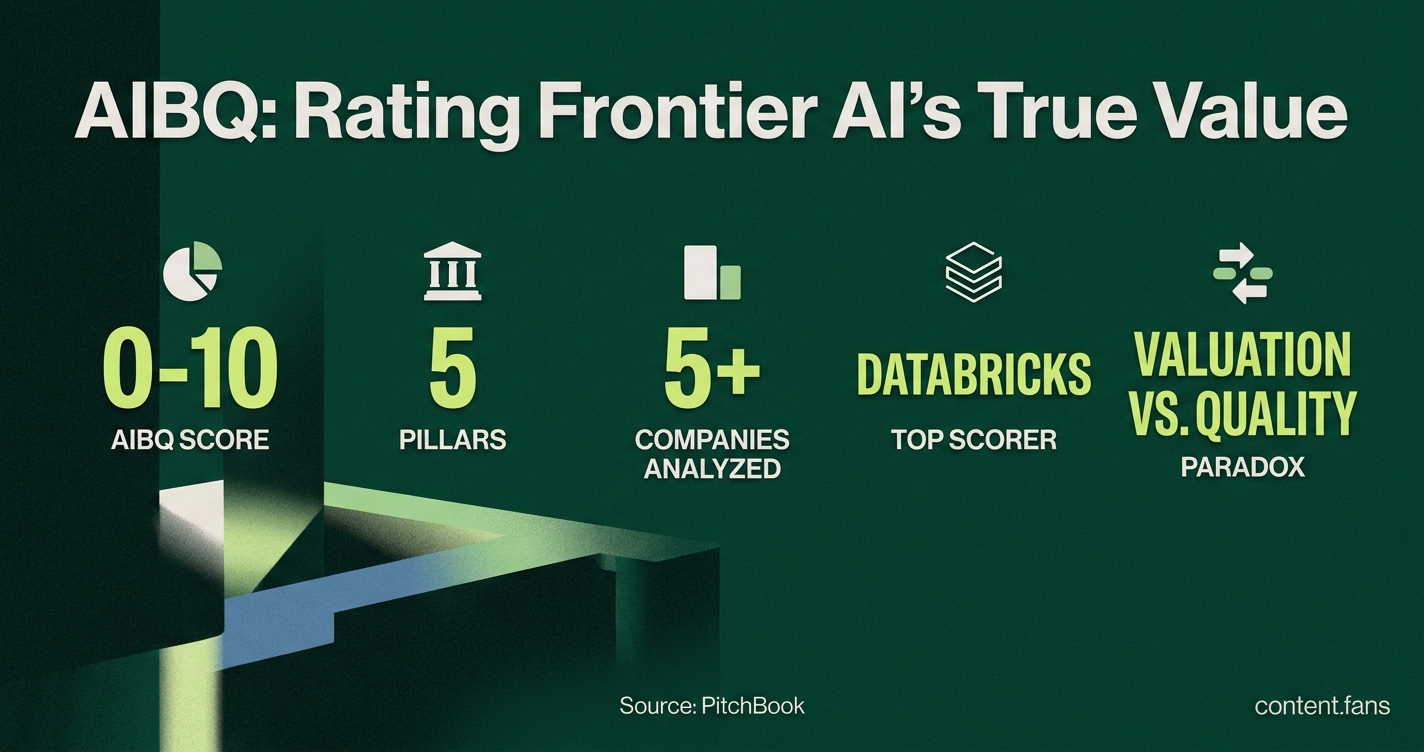
According to industry reports, the AIBQ framework rates companies on five pillars designed to measure underlying business health:
- Revenue Quality
- Capital Efficiency
- Governance Optionality
- Competitive Durability
- Computing Independence
The frontier cohort and their reported scores
The initial analysis covered several private AI leaders including Databricks, Anthropic, OpenAI, xAI, and Safe Superintelligence (SSI). Reports indicate Databricks leads the cohort with a strong score, bolstered by positive free cash flow. Other companies in the analysis show varying performance across the framework's dimensions, with some high-valuation firms scoring lower on fundamental business metrics.
Evidence of the valuation-quality paradox
PitchBook appears to argue there is a valuation-quality paradox in which higher valuations do not align with stronger AIBQ scores. However, the exact wording and specific company valuations and profitability timelines in this analysis require further verification from primary sources. The framework suggests that some of the most highly valued AI companies may face challenges in converting their valuations into sustainable business fundamentals.
Why investors care
As institutional capital floods into frontier AI, the tools to analyze these unique companies have lagged behind. The AIBQ framework addresses this gap by converting abstract risks - like cloud provider lock-in or regulatory hurdles - into a single, comparable score. This gives LPs and secondary investors a data-driven method for benchmarking deals beyond their sky-high valuations.
Broader market backdrop
The need for such a framework is amplified by current market trends. Industry reports suggest that AI startups command significant premiums over non-AI companies in their valuations. This demonstrates that capital is chasing strategic potential, often overlooking the volatile business models underneath.
Ultimately, the AIBQ framework provides a crucial signal in a noisy market. It helps investors distinguish which frontier AI labs are effectively converting massive research investments into sustainable, cash-generating businesses and which are simply riding a wave of valuation hype.
What is the AIBQ framework and why did PitchBook create it?
AIBQ stands for AI Business Quality, a five-dimensional scorecard that condenses fundamentals such as revenue durability, capital efficiency and computing independence into a single 0-10 rating. PitchBook built it because institutional exposure to frontier AI has surged, yet analytical infrastructure has not kept up, leaving investors with headline valuations but little insight into which businesses can support durable value.
Which five dimensions drive the score, and how are they weighted?
The five AIBQ attributes are Revenue Quality, Capital Efficiency, Moat Durability, Computing Independence, and Governance Optionality. The exact weighting scheme and detailed methodology require verification from primary sources.
| Dimension | What it captures |
|---|---|
| Revenue Quality | Net-revenue retention, churn, enterprise mix |
| Capital Efficiency | ARR per dollar raised; cash-burn trajectory |
| Governance Optionality | Flexibility to navigate regulation or cap-table shocks |
| Competitive Durability | Moat depth beyond model parameter counts |
| Computing Independence | Freedom from single-cloud or single-GPU lock-in |
Who are the companies analyzed and how do they rank?
The study covers several major AI companies including:
- Databricks
- Anthropic
- OpenAI
- xAI
- SSI (Safe Superintelligence)
According to industry reports, Databricks leads with strong fundamentals, being the only member already free-cash-flow positive. Other companies show varying performance, with some high-valuation firms scoring lower on underlying business metrics, illustrating what appears to be a "valuation-quality paradox": higher valuations don't necessarily correlate with stronger business fundamentals.
What concrete numbers show the paradox?
Industry reports suggest significant premiums for AI companies compared to traditional metrics, though specific valuation figures and timelines require verification from primary sources. The framework appears to show that many highly valued AI companies face challenges in fundamental business metrics despite commanding premium valuations.
How can investors use AIBQ day-to-day?
Think of the score as a balance-sheet companion to the cap-table:
- Screen prospects before term-sheet issuance - low AIBQ scores with high valuations may signal down-round risk.
- Track quarterly movements in Computing Independence - declining scores often precede margin compression as infrastructure costs rise.
- Pair Governance Optionality with geopolitical stress tests; low scores here flag potential regulatory or structural exit challenges that could impact IPO timing.
By embedding AIBQ in diligence, limited partners gain a common yardstick for comparing capital-intensive labs that otherwise trumpet incomparable "frontier" metrics.