
OpenAI unveils 'Daybreak' cybersecurity with GPT-5.5-Cyber
Serge Bulaev
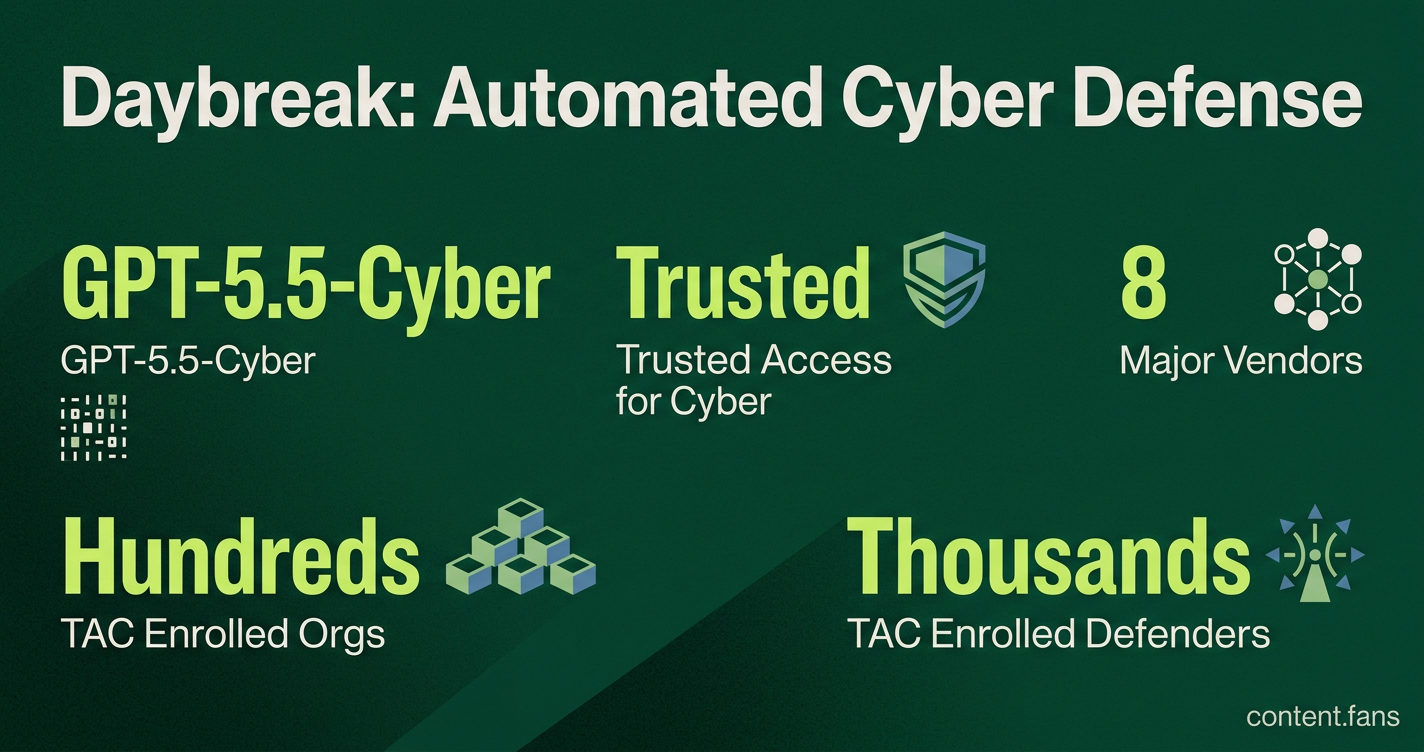
OpenAI recently launched Daybreak, a cybersecurity tool built with GPT-5.5-Cyber and Codex Security, which may help automate defensive security tasks for verified users. Early reports suggest Daybreak could speed up threat modeling and patching, but there is not yet independent data on its real-world effectiveness. Hundreds of organizations and thousands of users have joined so far, though hard performance numbers are not available. Analysts say Daybreak may work alongside existing tools, and strong governance appears central to its use. Some experts believe Daybreak might be the strongest AI for cyber tasks yet, but the product remains unproven at scale.

OpenAI has unveiled 'Daybreak,' its new cybersecurity initiative built on GPT-5.5-Cyber to automate defensive security tasks. According to OpenAI's product page, the platform integrates the advanced reasoning of GPT-5.5 with Codex Security under a new governance model called Trusted Access for Cyber (TAC).
The company's stated goal is to "accelerate cyber defenders and continuously secure software," according to an Infosecurity Magazine report. To achieve this, a coalition of eight major vendors - including Cloudflare, CrowdStrike, and Palo Alto Networks - are integrating with the platform to streamline security workflows from threat modeling to patch validation.
Architecture and Workflow
OpenAI's Daybreak is an agentic cybersecurity platform designed to automate defense workflows. It uses GPT-5.5 for high-level reasoning, a specialized GPT-5.5-Cyber model for security tasks, and Codex Security for suggesting code fixes, all operating within a secure, isolated environment to manage and remediate vulnerabilities.
As described by OpenAI, Daybreak functions as an agentic system that uses its models to orchestrate a complete security cycle. It can build a threat model for a code repository, reproduce identified vulnerabilities, generate a patch, and test the fix before providing evidence of remediation. Cybersecurity Dive highlights the core workflow in three stages:
- Prioritize high-impact vulnerabilities.
- Generate and test exploits in a sandbox.
- Produce audit-ready evidence of remediation.
Industry analysts suggest a measured integration path. Gartner analyst John Watts noted that Daybreak will likely "complement" existing application security tools, allowing enterprises to adopt it alongside their current technology stack as confidence in the new platform grows.
Early Adoption and Effectiveness
While hard performance metrics have not yet been released, early adoption signals are strong. Infosecurity Magazine reports that "hundreds of organisations" and "thousands of individual defenders" have enrolled in the TAC program. Cloudflare's CTO told TechRadar that the model's advanced reasoning could enhance current workflows with "agentic execution," though concrete data on breach reduction is not yet available.
Governance appears as critical as capability. OpenAI emphasizes that TAC blocks malicious activities like credential theft and unauthorized exploitation. The framework underscores the platform's focus on secure, controlled access through enhanced authentication requirements.
Competitive Landscape: Daybreak vs. Glasswing
Daybreak enters a market where other major AI labs are also developing defensive tools. Its main competitor is Anthropic's Project Glasswing, which launched a month prior. While both leverage frontier AI models, their market strategies differ significantly. Anthropic has restricted Glasswing to a small set of partners, including Apple, Microsoft, and Google, citing a major capability jump.
In contrast, OpenAI aims to work with "as many companies as possible," positioning Daybreak as a broader commercial platform, albeit one that still requires user vetting through TAC. While features like vulnerability discovery overlap, Daybreak's publicly outlined workflow includes dependency analysis and repository-level patch validation, which are not explicitly mentioned for Glasswing.
Model Capabilities and Guardrails
The specialized GPT-5.5-Cyber model is available in a limited preview for vetted teams. Permitted uses include red teaming, malware analysis, and detection engineering. However, OpenAI has implemented strict guardrails, prohibiting tasks related to persistence or stealth operations to prevent misuse.
Adding weight to OpenAI's claims, an early evaluation by the UK AI Security Institute concluded that GPT-5.5 achieved a performance level "similar" to the best model previously tested and "may be the strongest" evaluated for cyber tasks to date. Despite this positive assessment, analysts agree that Daybreak remains promising but unproven at scale until longitudinal data from its user base becomes available.
What is Daybreak and how does it use GPT-5.5-Cyber?
Daybreak is OpenAI's enterprise-first cybersecurity platform that pairs GPT-5.5-Cyber with Codex Security to give defenders an AI-native workbench. Inside a single workflow it can:
- build an editable threat model of a repo
- find, test, and rank vulnerabilities in an isolated sandbox
- auto-generate patches and push them back to the repo with audit-ready evidence
The goal, in OpenAI's words, is to "accelerate cyber defenders and continuously secure software."
Which security vendors are already plugged in?
Eight of the biggest names are shipping connectors on day one under the "Trusted Access for Cyber" label:
Cloudflare, CrowdStrike, Palo Alto Networks, Akamai, Cisco, Fortinet, Oracle, and Zscaler.
The connectors let Daybreak read logs, enforce policies, and even deploy patches through the same dashboards security teams already use.
How is Daybreak different from Anthropic's Project Glasswing?
Both programs put frontier models in defenders' hands, but the go-to-market posture is opposite:
| Aspect | Daybreak (OpenAI) | Glasswing (Anthropic) |
|---|---|---|
| Model access | Multiple tiers, request-based, wants "as many companies as possible" | Invite-only, small partner list |
| Public adopters | Vendor ecosystem (Cloudflare, CrowdStrike, etc.) | Apple, Microsoft, Google, Amazon |
| Feature depth | End-to-end workflow - threat model → patch → evidence | Focus on early risk detection and resilience |
In short, Daybreak is the broader platform play; Glasswing is the tightly gated elite club.
What tasks can GPT-5.5-Cyber actually perform?
Under the Trusted Access for Cyber rules, vetted teams can use the model for:
- Red-team exercises and controlled penetration tests
- Binary reverse engineering and malware unpacking
- Detection engineering - writing or tuning SIEM rules
- Patch validation - reproducing bugs and confirming fixes
OpenAI still blocks credential theft, unauthorized exploitation, and malware deployment, so the scope stays strictly defensive.
Is there any proof that Daybreak works?
Independent benchmarks are not yet public, but the UK AI Security Institute evaluated an early GPT-5.5 checkpoint and stated it "may be the strongest model we have tested" on advanced cyber tasks. OpenAI claims hundreds of organizations and thousands of defenders are already in the TAC program, although third-party outcome data is still pending.