
OpenAI unveils ChatGPT Personal Finance Pro for US users
Serge Bulaev
OpenAI has introduced ChatGPT Personal Finance Pro for U.S. Pro users, which may let them connect their bank and investment accounts for spending and portfolio insights. The tool uses Plaid for account linking and has several security features, such as not storing banking passwords and letting users erase their data within 30 days. Experts note that while these features seem to balance privacy with convenience, users should still be careful since AI answers are only as good as the information provided. The release appears to join a busy market of AI finance tools, and it may expand access after OpenAI sees how early users respond. Experts suggest this tool might help with financial planning but is not likely to replace human advisors for more complex needs.

OpenAI has launched a preview of ChatGPT Personal Finance Pro for its U.S. Pro users, enabling them to link financial accounts for personalized spending and investment analysis. The feature positions conversational AI as a direct interface for live transaction data, a capability long pursued by fintech companies.
Early coverage is focused on the tool's security controls and its potential to disrupt the competitive fintech market as OpenAI gauges user trust with sensitive financial data.
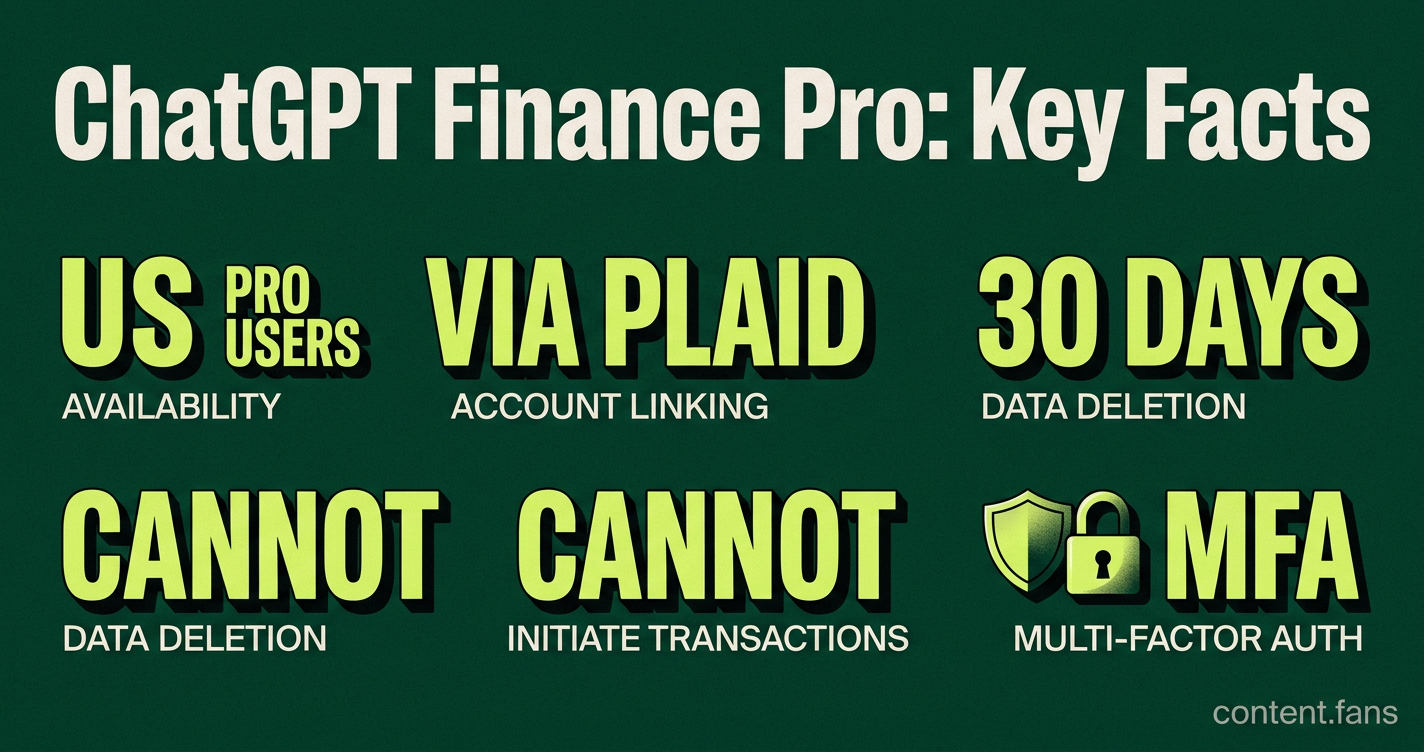
How the ChatGPT Personal Finance Pro preview works
ChatGPT Personal Finance Pro allows subscribers to connect their financial accounts via Plaid, a secure third-party service. This enables the AI to analyze real transaction data, answering user questions about spending habits, recurring subscriptions, portfolio performance, and cash flow projections without storing banking credentials.
As detailed in OpenAI's official announcement, users can link checking, credit, and investment accounts to ask the model for grounded insights. For now, a 9to5Mac report confirms the preview is limited to "Pro users in the U.S.," keeping the initial test group relatively small.
Data privacy promises
To address security concerns, OpenAI has highlighted several key data privacy and user control features:
- Account linking is managed through Plaid, ensuring banking passwords are never shared with ChatGPT servers.
- Users can disconnect their accounts at any time, and synced data will be erased within 30 days.
- The model is designed not to see full account numbers or initiate transactions.
- Financial data in the model's memory is editable, and users can start "temporary chats" that do not access linked information.
- Private chats default to excluding linked financial data.
- Multi-factor authentication is available to add another layer of security.
- OpenAI maintains that users "stay in control of their data."
While these guardrails aim to balance personalization with data security, experts caution that AI-generated financial insights are only as reliable as the context a user provides. Inaccurate or overconfident answers remain a known risk with current AI models.
Competitive landscape in 2026
ChatGPT Personal Finance Pro enters a competitive market already populated with established AI-powered financial tools. The landscape is generally divided into four main categories:
- Bank-native assistants: Tools built into apps from institutions like Chase or Bank of America, which leverage first-party data.
- Third-party budgeting apps: Services like YNAB AI and Monarch Money that aggregate data from multiple accounts for household financial planning.
- Robo-advisor platforms: Services such as Betterment or Wealthfront that combine investment automation with cash-flow analysis.
- Hybrid systems: Tools that rely on manual data entry or CSV imports, often used in regions with limited open banking infrastructure.
Analysts suggest OpenAI will likely expand access after evaluating early adoption metrics from the Pro user group. A successful rollout could challenge existing financial tools that depend on static dashboards, as users may gravitate toward the flexibility of conversational Q&A for real-time analysis.
Expert sentiment
Financial experts largely view the tool as an evolutionary step rather than a market disruption. While reports indicate that over a third of consumers already use AI for preliminary investment guidance, certified financial planners emphasize that complex areas like tax strategy and long-term life-stage planning still require human expertise. Consequently, ChatGPT Personal Finance Pro is expected to augment, not replace, the role of human financial advisors for the foreseeable future.