
NIST Gathers Industry Input on AI Agent Security Controls
Serge Bulaev
NIST asked for public input on how to secure AI agents, which are systems that can act on their own in the real world. Many different groups responded, showing that there is growing concern these agents may need stronger controls than current AI models. The main security issues raised include preventing prompt injection, using the least amount of access needed, keeping humans involved, measuring results, and following federal policies. Respondents suggested specific steps like logging actions, testing for security problems, and requiring human approval for important actions. NIST says these comments may help shape future guidelines, but the exact timeline for new security rules is not clear.

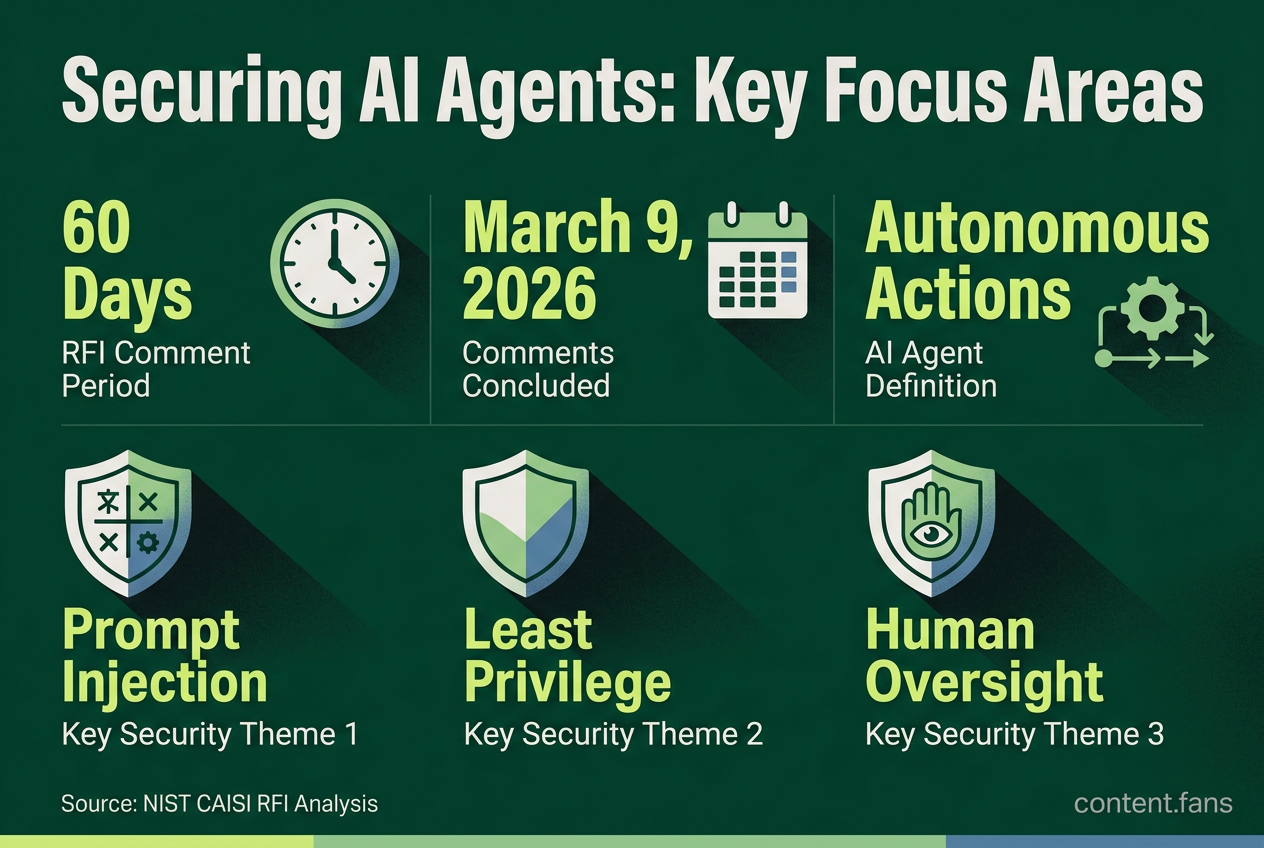
As NIST gathers industry input on AI agent security controls, a recent Request for Information (RFI) from its Center for AI Standards and Innovation (CAISI) is drawing significant attention. The RFI frames AI agents as systems that can "plan and take autonomous actions that impact real-world systems or environments," according to the NIST news release. Following a 60-day comment period that concluded on March 9, 2026, the varied submissions signal a growing consensus: autonomous AI agents demand more robust security controls than those applied to standard generative AI models.
Analysis of the public comments reveals several recurring security themes: mitigating prompt injection, enforcing least privilege, ensuring human oversight, adopting outcome-based metrics, and aligning with existing federal policies.
What the RFI asks
Industry feedback emphasized several key security areas for AI agents: preventing prompt injection, applying least-privilege access, maintaining human oversight for critical tasks, using measurable performance metrics, and harmonizing with federal policies. These themes suggest a move toward concrete, auditable controls for autonomous systems.
The document lists specific topics where NIST seeks evidence-based input, encouraging "concrete examples, best practices, case studies and actionable recommendations":
- Threat vectors such as direct or indirect prompt injection.
- Methods to constrain tool use and monitor agent permissions in production.
- Criteria for measuring robustness, detection speed and containment effectiveness.
- Case studies from deployers, security researchers and policy groups.
Who commented and why it matters
The docket includes submissions from a wide range of stakeholders, including policy institutes, technology trade groups, financial institutions, and independent security researchers, indicating broad cross-sector interest in establishing operational standards.
Notable stakeholders provided focused input on key areas:
- TechNet industry submission: Emphasized metrics such as time to detect anomalous behavior and containment success rates; urged open, consensus-driven standards
- Competitive Enterprise Institute (CEI): Focused on harmonization with antitrust and cybersecurity policy; cautioned against guidance that could deter collective vulnerability remediation
This diversity of input highlights a critical shift in the conversation, moving from abstract risk assessment to defining concrete operational requirements for AI agent security.
Emerging consensus on agent controls
A consensus emerged from the comments, focusing on antitrust-safe collaboration for AI and cybersecurity, and on updating federal guidance around cybersecurity information sharing. The comments emphasized the need for coordinated approaches to AI agent security that enable appropriate information sharing while maintaining competitive dynamics.
Link to future NIST work
NIST has confirmed that this feedback will directly "inform future work on voluntary guidelines and best practices related to AI agent security." These insights will likely be integrated into updates for the AI Risk Management Framework and its domain-specific profiles, including a forthcoming profile on Trustworthy AI in Critical Infrastructure that addresses agentic autonomy.
Although a specific timeline for a dedicated agent security publication has not been announced, stakeholders anticipate future guidance will blend controls from the AI RMF, the Cybersecurity Framework, and new identity and authorization models designed specifically for non-human actors.
What is NIST asking the public about AI agent security?
NIST's Center for AI Standards and Innovation (CAISI) issued Request for Information NIST-2025-0035 in January 2026 to collect community insight on securing systems that can plan and take autonomous actions that impact real-world environments. The docket focuses on three high-impact areas: (1) preventing system hijacking of agents, (2) constraining how far an agent can act without human review, and (3) monitoring the resources each agent can access during live deployments.
What themes dominated the public comments?
A significant number of stakeholder groups - including TechNet, CEI, and financial-services coalitions - filed comments before the March 9, 2026 deadline. Several themes recurred across many submissions:
- Distinct risk framing: commenters argued that agentic systems create risks beyond traditional AI because they can modify permissions, rotate keys, approve workflows, or touch production infrastructure.
- Prompt injection & tool abuse: multiple briefs urged NIST to treat robustness against prompt injection and policy compliance during tool use as measurable security goals.
- Least-privilege execution: industry urged adoption of zero-trust architectures and constrained sandbox environments for each agent.
- Human oversight for high-impact actions: respondents asked for controls that require human approval before agents can change credentials, network policies, or safety-critical systems.
- Outcome-based metrics: instead of abstract principles, commenters want time-to-detect anomaly and effectiveness of containment controls adopted as concrete benchmarks in any future guidance.
How will the input shape NIST's next deliverables?
NIST has already said the comments will inform voluntary guidelines and best practices and will feed directly into CAISI's ongoing evaluations of agent security. The agency may publish analysis of responses and incorporate findings into ongoing efforts including updates to the AI Risk Management Framework and related cybersecurity guidance. No binding regulations are planned, but federal procurement language often mirrors NIST voluntary guidance, so vendor controls adopted now may become de-facto standards.
Which other federal bodies are tackling AI agent security?
Beyond NIST, several agencies are active:
- CISA released a joint advisory with Five Eyes partners on secure adoption of agentic AI, stressing zero-trust identity management and least-privilege delegation.
- OMB has issued memoranda that classify many agentic deployments as "high-impact AI," triggering governance and procurement reviews.
- NIST NCCoE circulated a concept paper on software and AI agent identity/authorization, asking how non-human actors should receive, rotate, and revoke credentials at scale.
What practical steps should organizations take now?
Companies that currently operate - or plan to deploy - agentic systems can align with the emerging consensus without waiting for final documents:
1. Map each agent's action surface and apply least-privilege IAM policies.
2. Insert human confirmation gates for any action that can alter credentials, policy, or production infrastructure.
3. Log prompts, tool calls, and executed actions to an immutable audit trail; measure mean-time-to-detect policy violations.
4. Test agents against prompt-injection test harnesses and publish pass/fail metrics.
5. Adopt open, consensus-driven standards to avoid future fragmentation with federal procurement requirements.