
New data proves storytelling drives sales, raises loyalty
Serge Bulaev
Recent data from 2024 to 2026 suggests that storytelling may boost sales and customer loyalty. Research and industry examples indicate that clear, emotional stories can help brands increase their value, make customers more willing to pay higher prices, and even attract more investment. Leaders are now treating storytelling as an important business skill and are investing in story libraries, leader training, and consistent messaging. While not every company may see the same results, the evidence points to persuasive storytelling becoming an important factor in business success.

Recent industry observations suggest that storytelling drives sales, boosts loyalty, and attracts capital. No longer a soft skill, compelling narrative is increasingly viewed as a measurable financial advantage, with clear, emotionally resonant stories reportedly shifting business outcomes. Executives are treating narrative technique as a core capability, prioritizing brand and founder stories that connect data to human emotion.
Storytelling as a measurable economic lever
Strategic storytelling drives sales by connecting with customers on an emotional level, which increases brand equity and their willingness to pay higher prices. By framing data within a compelling narrative, businesses reduce cognitive friction for buyers, leading to improved revenue, customer loyalty, and overall market resilience.
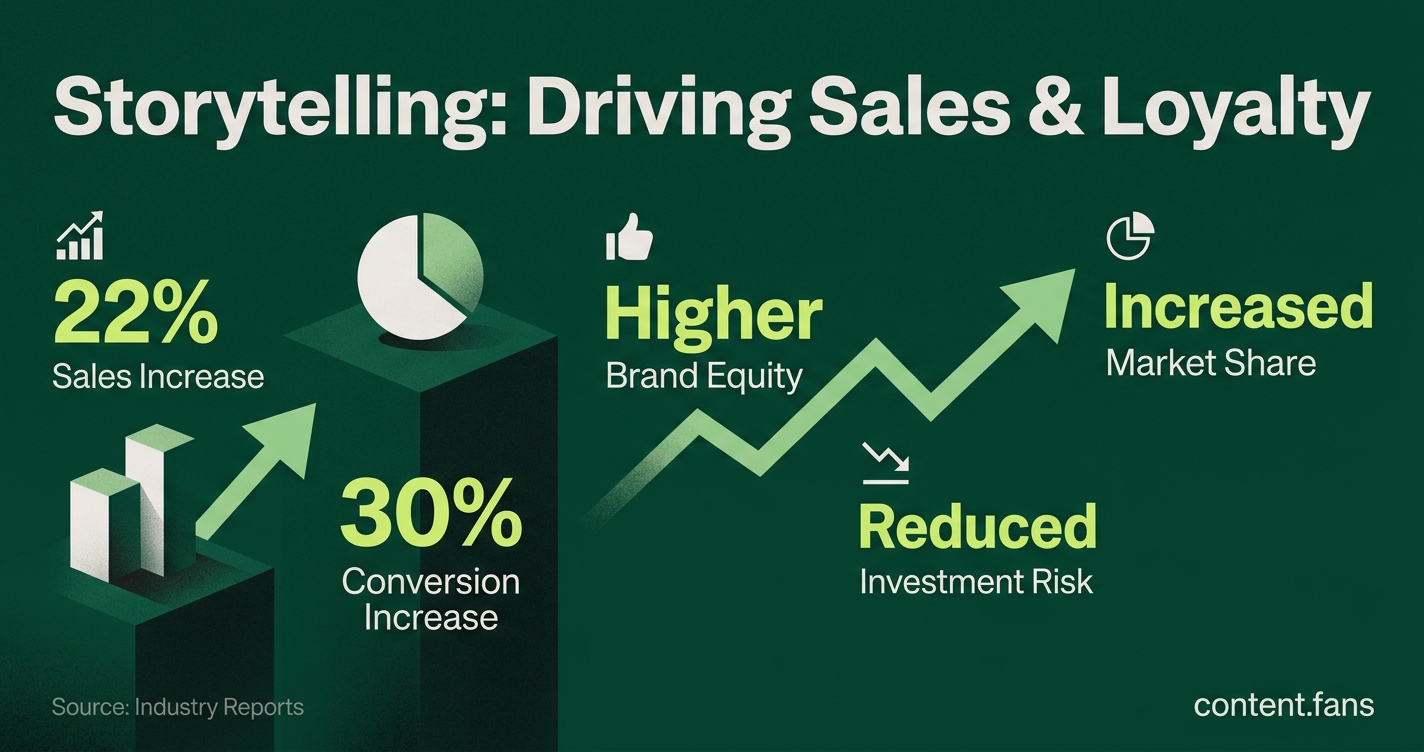
This correlation is supported by both academic and commercial findings. A 2024 MatheO thesis linked strong narratives to higher brand equity and consumer willingness to accept higher prices. However, publicly available secondary sources cite related but different figures, such as a 22% sales increase, a 23% conversion increase, or a 30% conversion increase; the exact claims are not verified from original sources.
Industry reports provide examples of storytelling impact:
- According to industry reports, the Liquid Death campaign generated significant earned media value and meaningful market share increases.
- Liquid Death remains independently owned and continues to build its brand through unique storytelling approaches.
- Industry observers note that narrative-led communication builds leadership confidence and encourages shareholders to focus beyond short-term volatility.
Leadership, capital, and investor decks
Leaders are increasingly using storytelling to translate strategy into action. A July 2024 Forbes Business Council article highlights how effective executives "embed story in strategy" to align their teams and influence stakeholders, outlining a four-part framework: Discover, Design, Develop, and Deliver.
This trend extends to investor relations. According to industry reports, founders who frame their data within a narrative have closed funding rounds more efficiently. Experts suggest storytelling reduces perceived investment risk by giving crucial context to performance metrics.
Practical priorities for budget allocation
Industry observations suggest executives are allocating budget resources toward key storytelling initiatives:
- Story Libraries: Centralized banks of authenticated customer and employee anecdotes for use in campaigns, internal communications, and earnings calls.
- Leadership Training: Workshops designed to fuse data analysis with classic narrative structures, enabling leaders to communicate more effectively.
- Message Consistency: A unified narrative arc deployed across all channels - from product pages to pitch decks - to ensure a single, coherent brand message for all audiences.
By implementing these practices, companies can convert brand resonance into tangible results like increased pricing power and accelerated fundraising. While replicating the success of viral campaigns is not guaranteed, the collective evidence from academia, industry analysis, and case studies suggests that persuasive storytelling has become a critical economic driver.
How does storytelling actually move sales numbers?
According to industry reports, emotionally-driven brand stories have raised sales significantly and lifted customer loyalty substantially in recent studies. When Liquid Death ran campaigns with strong narrative hooks, the business impact included meaningful market share growth. The mechanism is simple: stories reduce cognitive friction enough that price sensitivity drops and repeat purchases rise.
Why are investors and markets rewarding founders who master narrative?
In earnings calls tracked through recent periods, references to "storyteller" or "storytelling" have increased substantially. According to industry reports, repeated, consistent founder narratives build confidence faster than raw metrics alone. Warby Parker's early story about expensive glasses replacement costs helped turn a personal pain point into significant company valuation growth.
What is the most reliable formula for an investor-winning pitch story?
According to industry observations, high-performing decks follow four sequential beats:
1. Problem: a relatable pain that the market feels today
2. Shift: why the solution only works now
3. Proof: traction, retention, or revenue data packaged inside the narrative
4. Future: a believable scaling path repeated in every touchpoint
Industry reports suggest that startups adopting this sequence have closed funding rounds more efficiently after pivoting from data-only slides to story-first approaches.
How can leaders operationalize storytelling without bloating budgets?
According to industry observations, top-performing teams treat narrative as infrastructure:
- Story banks: repositories of real customer, employee, and partner moments
- 4Ds framework: Discover, Design, Develop, Deliver
- AI for structure, humans for emotion: use AI to draft outlines and humans to add authenticity and risk judgment
These methods reportedly require a small portion of marketing spend yet deliver outsized trust and retention gains.
What is the first, lowest-risk step for a company that has not invested in storytelling yet?
Rewrite one investor update or one product page using this micro-checklist:
- open with a one-sentence customer pain
- follow with a single metric that proves the pain is real
- close with a future-state vision that ties the metric back to purpose
According to industry reports, pilot tests show meaningful increases in email engagement rates after such rewrites. No new budget is required, only strategic reframing.