
Google in Talks with SpaceX for Orbital AI Data Centers by 2027
Serge Bulaev
Google is reportedly in talks with SpaceX about putting AI data centers in orbit by 2027, but no public filings have been made yet. Project Suncatcher is still an experiment, with the first test satellites planned for launch in early 2027. SpaceX might be the launch provider, but this has not been confirmed. These talks suggest Google may want to use space to help with the rising power needs of AI, taking advantage of more sunlight and less strain on Earth's power grids. The final plans and size of Project Suncatcher remain uncertain and could change depending on test results.
Recent reports indicate Google is in talks with SpaceX to develop orbital AI data centers as part of its 'Project Suncatcher,' with a potential 2027 launch for initial prototypes. While no public filings confirm the partnership, sources familiar with the matter told Reuters that discussions are underway. This move signals a significant effort to shift power-hungry AI workloads off Earth's strained power grids and into space.
Where the Talks Stand
Project Suncatcher is Google's exploratory initiative to run artificial intelligence data centers in orbit. The project aims to leverage near-constant solar power from space to meet the immense energy demands of AI computation, bypassing the growing limitations and bottlenecks of Earth's electrical grids.
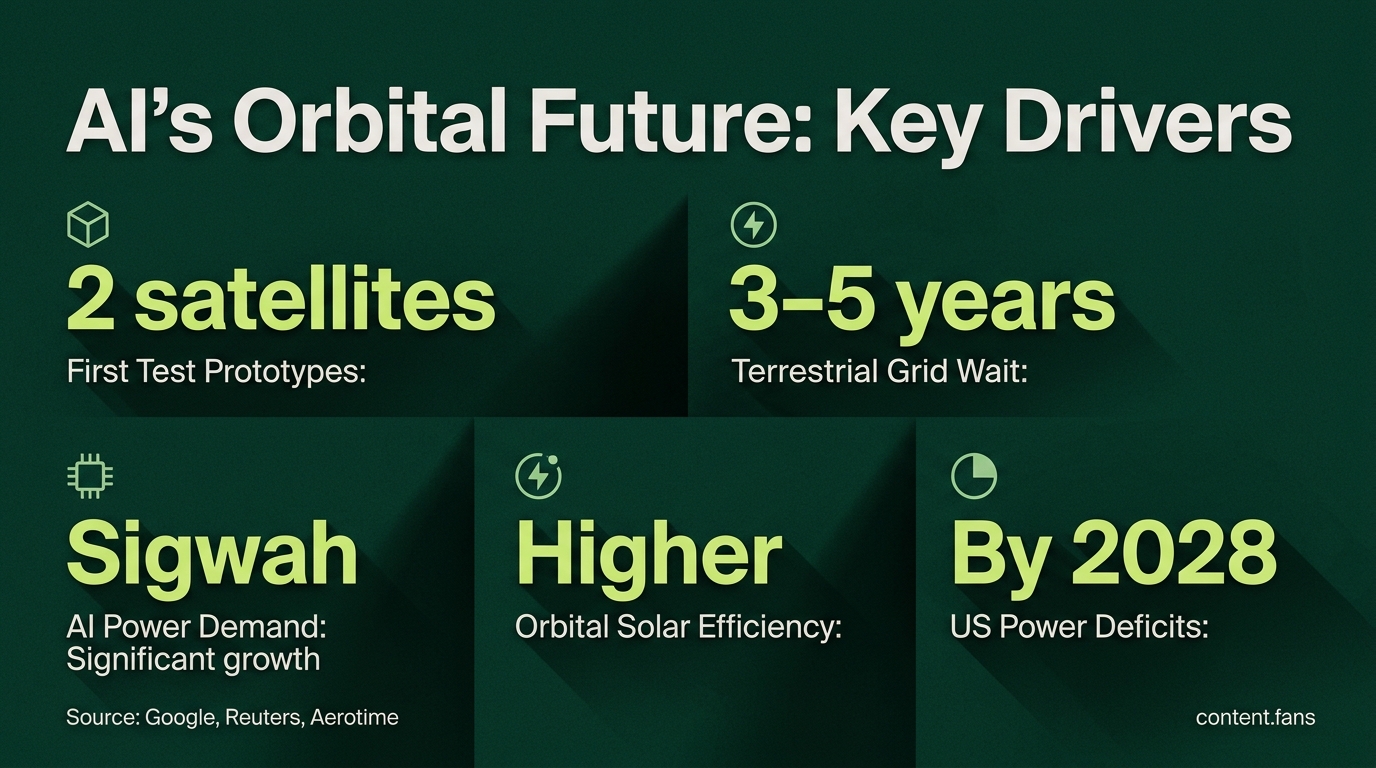
Google officially unveiled Project Suncatcher in November 2025 as a research initiative, not a full-scale deployment. According to an Aerotime article, SpaceX is just one of several launch providers being considered. Google's first test is planned to use two prototype satellites targeted for early 2027, underscoring the experimental nature of the effort. While reports suggest Google may hold an equity stake in SpaceX, neither company has confirmed if this influences launch negotiations.
Why Orbit Makes Sense for Power-Hungry AI
The primary advantage of space-based data centers is access to superior solar energy. Industry reports suggest orbital solar arrays can achieve significantly higher efficiency than typical terrestrial panels. By orbiting in near-continuous sunlight, they can operate at much higher capacity factors, potentially yielding substantially more energy annually per square meter than an identical panel on the ground. Google aims to use this energy directly for AI processing, avoiding the grid and infrastructure constraints that hamper ground-based facilities.
Ground Grid Bottlenecks Are Tightening
The push toward space is driven by intensifying constraints on Earth's power grids. Research suggests AI data centers will account for a significant portion of global electricity demand growth through 2030. According to industry reports, the U.S. could face substantial power deficits for data centers by 2028 due to lagging grid access, permitting delays, and transmission shortfalls.
Key challenges for terrestrial AI infrastructure include:
- Extreme Power Density: AI training racks commonly require substantial power, with newer systems demanding even more.
- Long Interconnection Queues: Wait times to connect to the grid can stretch three to five years in key U.S. regions.
- Emissions Concerns: Some operators are using on-site fossil fuel generators to bridge power gaps, undermining climate goals.
Faced with these hurdles, Google appears to be treating Project Suncatcher as an incremental solution. Company engineers quoted by Aerotime described the initial test as an "in-orbit learning mission" focused on solving challenges like thermal management and radiation shielding before attempting a larger deployment.
What Happens Next
The project's future depends on the performance of the prototype satellites. If the 2027 test is successful, reports suggest that Google has plans for larger constellations, although specifics remain unconfirmed. A successful partnership could leverage SpaceX's high launch cadence, which currently exceeds 90 flights per year, for rideshare opportunities. For now, industry sources point to the early-2027 test launch as a key milestone, with the project's ultimate scale and commercial viability still to be determined.
What exactly is "Project Suncatcher" and when could it fly?
Google has confirmed the existence of Project Suncatcher, framing it as a research effort to test whether large-scale AI chips can run on satellites.
- The first hardware demo is planned for early 2027 and will ride on two small prototype satellites.
- SpaceX is only one of several launch candidates; no contract has been signed and no Falcon 9 has been assigned to the mission yet.
Why put AI in orbit instead of building more Earth data centers?
The terrestrial grid is hitting physical limits.
- Industry reports warn that by 2028 the United States could face substantial power shortfalls for data centers even if chips are available.
- Orbital arrays avoid land, water, substation and permitting bottlenecks and can tap near-continuous sunlight, giving them significantly higher capacity factors compared to ground solar in many regions.
How much more energy can orbital solar panels harvest?
- Cell efficiency: Industry reports suggest commercial ground panels achieve certain efficiency levels, while multi-junction space cells can reach significantly higher performance.
- Total annual yield: because satellites in favorable low-Earth orbits skip night and weather, studies suggest an identical array can generate substantially more kilowatt-hours per year than its Earth twin.
Who owns what in the Google-SpaceX relationship?
Reports suggest Google may have business relationships with SpaceX, but the specific nature and extent of any equity stakes or board positions have not been reliably verified. These potential ties could ease technical dialogue but would not necessarily guarantee launch priority or pricing.
What still has to be proved before orbital data centers become real?
Project Suncatcher is only a technology demonstrator; a long list of unknowns remains:
- Can high-density AI racks be cooled inside a satellite?
- Will radiation-hardened TPUs deliver the same flops-per-watt as ground units?
- Is it cheaper to beam computed results down via lasercom than to ship electricity up a congested grid?
Until those questions are answered, orbital AI remains an experiment, not a scheduled service.