
Gartner: AI Spending Will Hit $2.5 Trillion By 2026
Serge Bulaev
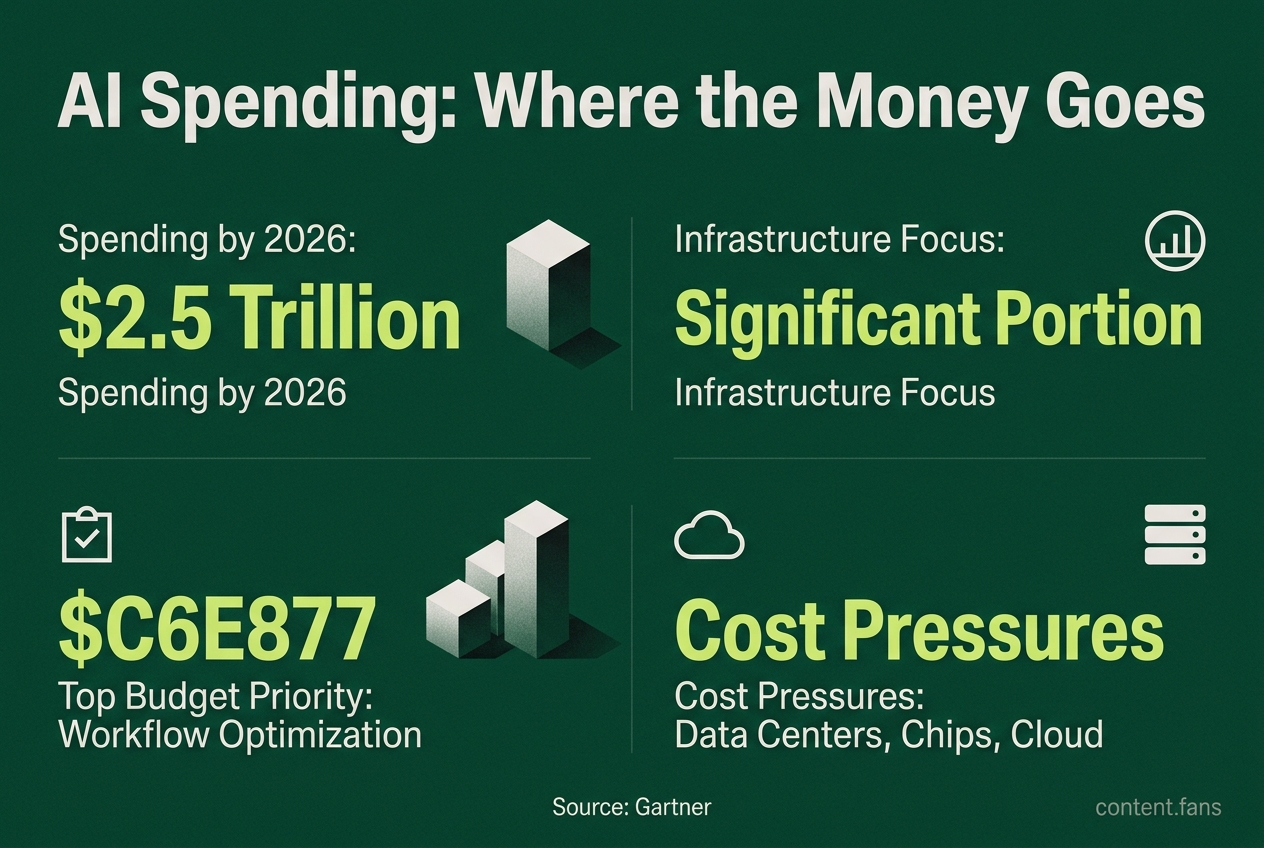
Gartner projects that worldwide AI spending may reach $2.5 trillion by 2026, with most of the money going toward infrastructure instead of software. Rising costs for data centers, chips, and cloud services appear to be putting pressure on company budgets, making cost control a top concern. Spending is also reportedly shifting to electricity, cooling systems, networking, and ongoing monitoring work. Experts suggest that managing these costs is becoming an important skill for companies, and those that can control budgets and use AI efficiently might gain an advantage. There may still be uncertainty about how these expenses will affect businesses, but cost management is likely to stay a key focus.

Worldwide AI spending is projected to grow substantially by 2026, according to industry analysts, with a significant portion of funds directed toward infrastructure, not software. As businesses enter the middle of the decade, they face a triple squeeze from rising data center construction prices, persistent AI chip shortages, and volatile cloud consumption fees, elevating cost management from a back-office task to a board-level strategic priority.
AI's Expanding Costs - pressure points for 2026
The surge in AI spending is driven by escalating infrastructure costs across multiple areas. This includes the high price of constructing next-generation data centers, persistent shortages of specialized chips and memory keeping hardware prices elevated, and the volatile, ever-increasing expense of consumption-based cloud services for training and inference.
According to industry reports, constructing next-generation AI data centers now costs significantly more than traditional hyperscale facilities. Key drivers include dense liquid cooling, redundant power, and high-speed networking, which add capital risk and tie up cash during delays.
Unlike data centers, which last for decades, AI silicon has a rapid turnover. Memory shortages for components like HBM and DRAM are expected to persist in the coming years, keeping hardware prices high. This means even if GPU prices decrease, overall system costs will likely remain elevated due to integration lead times.
Cloud costs are also escalating. Average monthly AI infrastructure spend is climbing substantially year over year. While vendors offer flexible consumption-based pricing, surging demand for AI inference often negates the cost benefits.
Where the money actually goes
A growing share of spend now lands outside classic compute:
- Electricity procurement and grid interconnection
- Advanced cooling systems, especially liquid loops
- High-bandwidth networking fabric
- Compliance, security and model governance tooling
- Ongoing retraining and monitoring labour
Reflecting this shift, industry reports indicate that a significant portion of surveyed leaders rank workflow optimization as their top AI budget priority. This signals a strategic move from experimental projects to operational scale, where costs for power and staffing are integral to every process.
Early playbooks for keeping budgets in check
Sources outline several tactics that organizations are already adopting:
- Route simple queries to smaller models and reserve premium accelerators for complex reasoning.
- Enforce token or time budgets at the gateway level to avoid runaway agents.
- Cache frequent prompts or semantic equivalents to cut duplicate inference.
- Split workloads across cloud, on-prem and edge based on latency, cost and privacy.
- Tag every request for real-time cost attribution and chargeback.
While these tactics don't eliminate capital pressure, they can significantly slow cost growth and expose hidden inefficiencies.
Competitive implications
The competitive landscape is being reshaped by these costs. With Morgan Stanley estimating substantial AI infrastructure investment in the coming years, pricing power is concentrated among a few cloud and chip suppliers. In response, startups are narrowing their focus and relying on partners, while enterprises are implementing stricter procurement rules that demand measurable ROI and robust governance.
Ultimately, managing AI's escalating costs is evolving into a core strategic capability. Companies that can master lifecycle budgeting, optimize workload placement, and improve model efficiency will not only protect their margins but also gain significant negotiating power in this capital-intensive era.
What is driving the substantial AI spending forecast for 2026?
Data center construction, specialized chips, and cloud consumption are the three largest line items.
- Next-gen AI facilities now cost significantly more than traditional hyperscale sites, according to industry reports.
- Memory shortages for GPUs and AI accelerators are expected to continue in the coming years, keeping hardware prices elevated.
- Average monthly AI cloud spend per organization is projected to increase substantially, and the curve is still steepening.
How are startups adapting to the new cost reality?
Vertical focus, lean architecture, and partner-heavy go-to-market have become survival rules.
- Many enterprises will raise AI budgets in 2026, with a significant portion of the new money earmarked for workflow optimization, not experiments; startups must show measurable ROI in weeks, not quarters.
- Rising maintenance and compliance costs push founders to reuse open-source pipelines and embed security-by-design instead of retrofitting later.
- Channel sales are accelerating: systems-integrator partnerships reduce the need for large professional-services teams and shorten procurement cycles.
What procurement changes should enterprise buyers expect?
Centralized, ROI-gated, governance-first purchasing is replacing scatter-shot pilots.
- Vendor short-lists now demand audit trails, bias-testing documentation, and per-use-case cost caps before a proof-of-concept can start.
- Multi-year, large-scale power contracts are being signed directly with utilities to lock in capacity for AI clusters, turning energy procurement into a board-level topic.
- Expect larger, longer deals with fewer suppliers; concentration risk is accepted in exchange for volume discounts and tighter SLA enforcement.
Which efficiency techniques deliver the fastest cost relief?
Model routing, token budgets, and hybrid cloud-edge placement are among the leading strategies being adopted.
- Route a significant portion of queries to small fine-tuned models and reserve frontier models for complex reasoning; early adopters report substantial token-cost savings within one quarter.
- Prompt-level caching and semantic deduplication cut repeat inference charges, especially in support-chat and FAQ use cases.
- Serverless containers for burst workloads plus reserved edge nodes for steady inference balance unit economics and latency without over-provisioning cloud GPUs.
Where will AI infrastructure capital flow next?
Power-dense, liquid-cooled sites in energy-rich regions are attracting the next wave of capital.
- Industry analysts note that silicon refresh cycles, not buildings, drive the biggest swing factors; a single accelerator generation flip can move spend substantially over five years.
- Morgan Stanley projects substantial cumulative AI infrastructure investment by 2028, with a significant portion still ahead, implying the coming years will remain capex-heavy before any plateau.
- Watch for vertically integrated players that bundle chip procurement, data-center real estate, and long-term renewable power agreements; these bundles are becoming the de-facto currency of large-scale AI negotiations.