
Ex-OpenAI Hardware Lead Warns of AI Hardware Boom, Supply Chain Strain
Serge Bulaev
Caitlin Kalinowski, a former hardware leader at Apple, Meta, and OpenAI, says we may be at the start of a big boom in AI hardware. She points out signs of growing demand for chips, sensors, and cooling in robots, edge devices, and data centers, but notes this is not yet certain. Experts warn that supply chains could get tighter and hardware prices might rise as more AI systems are built. Kalinowski suggests startups may have new chances to specialize in areas like sensor modules or memory tricks, though it is not guaranteed these will be huge markets.

Caitlin Kalinowski, a veteran hardware leader from Apple, Meta, and OpenAI, is sounding the alarm: an AI hardware boom is beginning, threatening significant supply chain strain. While she recently departed OpenAI, her high-profile product background gives her warning credibility as market indicators increasingly align with her perspective.
The core issue is a sharp, sustained rise in demand for compute, sensors, and cooling systems, driven by growth in robotics, edge devices, and data center construction. Kalinowski forecasts this not as a short-term spike but as a multi-year cycle, a possibility supported by publicly available data, though a definitive trend is not yet confirmed.
Robotics Creates Initial Demand Pull
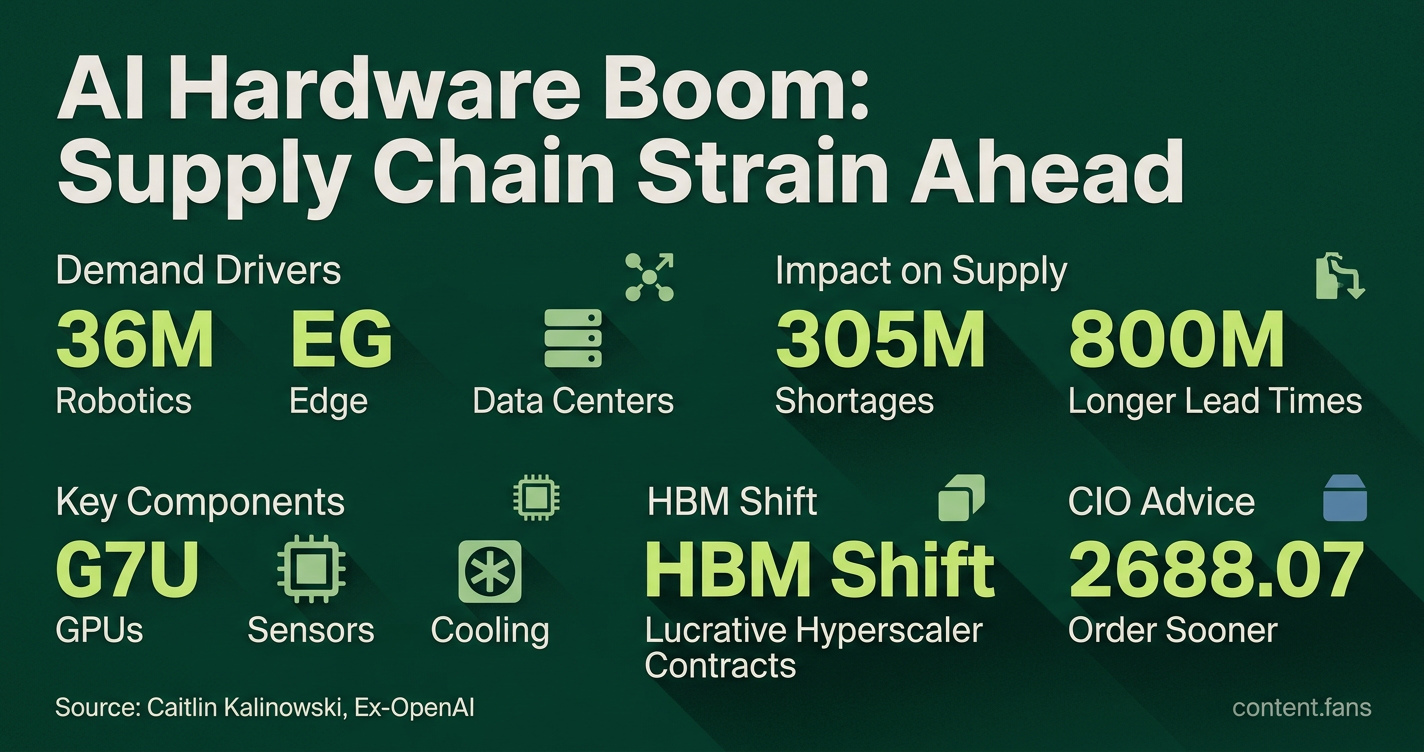
The AI hardware boom is driven by escalating demand for specialized components like GPUs, sensors, and cooling systems for robotics, edge computing, and data centers. This surge is creating a supply-demand imbalance, which experts predict will lead to component shortages, longer lead times, and increased prices.
A key driver is the proliferation of autonomous machines using agentic AI. According to industry reports, this represents a major industry shift in robotics development. These systems demand on-device inference, multi-modal sensors, and ruggedized power delivery. The necessity for millisecond-fast decisions in settings like warehouses forces compute locally, driving volume for embedded GPUs, low-power NPUs, and real-time networking components.
Edge Devices Exacerbate Supply Chain Strain
Kalinowski's warning also covers consumer and industrial edge hardware. As consumer devices integrate larger neural processing units, memory manufacturers are shifting production to high-bandwidth memory (HBM) to serve lucrative hyperscaler contracts. This pivot, sometimes called the "AI Tax," constrains the availability of standard DRAM and forces enterprises to secure inventory far in advance or adopt more flexible, modular hardware designs.
Industry analysts report that many enterprises are implementing various adjustments to manage supply constraints, including extended procurement timelines, diversified vendor relationships, and flexible deployment strategies to accommodate potential delivery delays.
Echoing this concern, Rajiv Ramaswami of Nutanix advises CIOs to order sooner, warning that hardware prices and lead times "could go up" as large-scale AI projects consume shared manufacturing capacity Nutanix supply chain analysis.
Specialized Data Centers Anchor Backend Demand
Supporting fleets of autonomous systems requires massive backend infrastructure for model training and management. The 2026 AI Index confirms continued growth in AI compute and deployment scale; it does not directly claim specific rack-density or liquid-cooling outcomes. Across industry analyses, advanced packaging and high-performance memory are consistently identified as the most significant bottlenecks, suggesting strong, sustained demand for their suppliers.
The Credibility Behind the Warning
Kalinowski's authority comes from her track record of shipping major hardware projects at Apple and Meta, along with her role in establishing OpenAI's robotics lab. While no longer at the company, her expertise remains relevant. She now advocates for "responsible physical AI" while continuing to analyze the same hardware challenges. Her ongoing insights on supply bottlenecks and new sensor technologies can be followed on X Caitlin Kalinowski.
Opportunities for Startups and Incumbents
Kalinowski suggests that this disruption creates opportunities for agile startups to fill niche roles that large OEMs may overlook. The market trends point toward specific openings:
- Edge Accelerators: Specialized chips optimized for low-latency control loops in robotics and industrial automation.
- Advanced Cooling: Novel thermal interfaces and solutions designed for high-density AI inference hardware.
- Sensor Modules: Compact, integrated sensor fusion modules tailored for the size and power constraints of mobile robots.
- Memory Optimization: Software or hardware techniques for memory pooling and compression to maximize the use of scarce HBM resources.
While there's no guarantee these niche markets will grow into billion-dollar industries, the consistent signals from robotics, enterprise procurement, and data center build-outs strongly support Kalinowski's "early boom" framework. Professionals monitoring component lead times will likely see the first concrete evidence of this trend in their upcoming procurement cycles.