
Every pivots to shared AI agents after personal assistants prove unreliable
Serge Bulaev
Every's personal AI assistants often failed at routine tasks and needed a lot of fixing, so the company is now moving to shared coworker agents with Plus One 2.0. This change may make things more reliable because shared agents are easier to manage and supervise as a team. Shared agents also let companies set stronger controls and review their actions together. Experts say that treating AI agents like regular software with careful monitoring could help solve many problems. It is still uncertain how well these shared agents will work with changing business needs and privacy limits.

After finding its personal AI assistants unreliable and difficult to maintain, Every is strategically pivoting to shared AI agents. This move from individual bots to supervised, team-based coworker agents reflects a broader industry trend toward prioritizing governance, reliability, and operational stability in enterprise AI deployments.
Why Every Abandoned Personal AI Agents
Every's internal deployment of its Plus One personal agents revealed critical flaws. Staff reported that agents frequently stalled on simple tasks, required constant prompt adjustments, and suffered from context loss. The maintenance burden became unsustainable, with engineers spending entire days debugging individual bots. This experience mirrors common failure points in enterprise agent pilots, including integration gaps and limited observability. Industry reports indicate that evaluation and observability remain significant blockers for business leaders implementing AI agents.
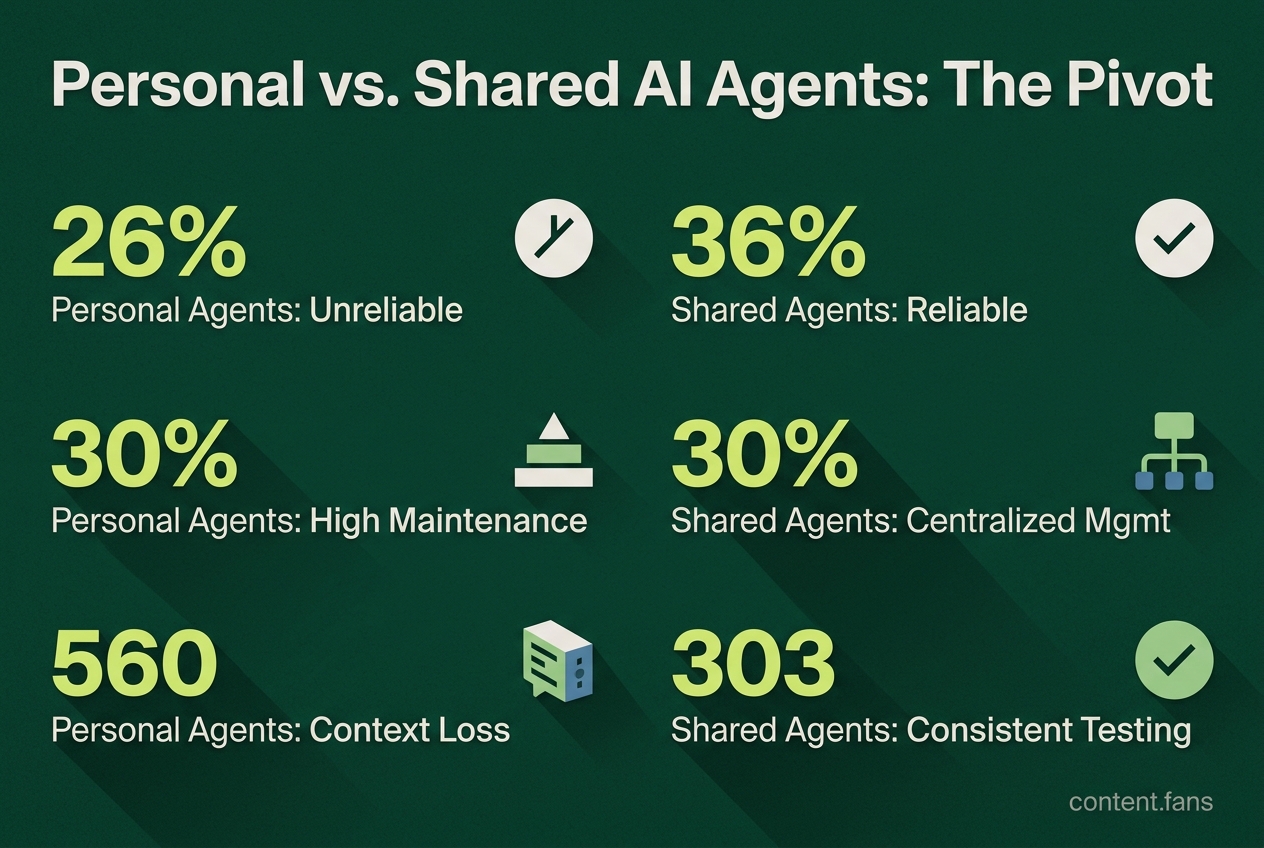
Every pivoted from personal to shared AI agents because individual bots proved unreliable, unstable, and created an unmanageable maintenance workload. The new shared 'coworker' model centralizes management, improves governance, and allows for consistent team-based supervision, directly addressing the core issues of the previous approach.
The Promise of Shared Coworker Agents
Shared coworker agents promise to solve the governance and maintenance crisis. According to a retrospective by Brandon Gell and Willie Williams, the fault was not the AI model but the premise of custom agents for every employee, which multiplied the surface area for errors. Industry experts agree, arguing the primary challenge is the surrounding "deployment infrastructure" Northflank, not model capabilities. With a shared model, multiple employees use the same interface, simplifying the implementation of single sign-on (SSO), audit trails, and standardized incident response protocols.
How Shared Agents Improve Reliability and Integration
A key advantage of shared agents is improved "operational fit" with existing company workflows. Instead of many fragile integrations, a single agent integrates with tools like email or spreadsheets and serves an entire team. This centralized approach simplifies upkeep and enables consistent testing. The model also supports human-in-the-loop oversight, a concept Dan Norris calls the shared coworker model, where employees can review an agent's work - like categorizing expenses - before final approval.
Key Lessons from Every's Pivot to Plus One 2.0
- Reliability Over Novelty: Engineers prioritized core stability by removing high-risk, low-value features.
- Centralized Observability: All logs, prompts, and tool calls are routed to a single dashboard for easier debugging and analysis.
- Scoped Privileges: Shared agents operate on a least-privilege basis, requiring human approval for sensitive actions.
- Incremental Rollout: Teams adopt new agents on a case-by-case basis, with continuous monitoring of performance metrics.
The Future of Enterprise AI Agents
Key questions remain as the industry matures:
- How can prompt versioning and management scale with evolving business rules?
- What is the optimal balance between an agent's memory retention and emerging privacy or token constraints?
These questions highlight a major trend for 2024-2026: enterprises are beginning to treat AI agents as production software requiring Site Reliability Engineering (SRE) principles. If Every's Plus One 2.0 succeeds, it will validate the shared coworker pattern as a more robust foundation for enterprise AI than the first-generation personal assistant model.