
Enterprise AI teams adopt shared agent catalogs to cut maintenance
Serge Bulaev
Enterprise AI teams in 2025 are advised to use a small catalog of shared 'coworker' agents instead of creating bots for each user, as this may make oversight easier. Shared agent catalogs centralize prompts, tools, and policies for everyone in a company, which reportedly helps reduce maintenance and improves control. Starting with simple, low-risk tasks appears to help organizations gain benefits while staying compliant. Shared catalogs may also make it faster to find and fix problems, and metrics for each agent can help teams track progress. However, shared catalogs do not remove every risk, so extra checks and monitoring are still needed.

Enterprise AI teams are increasingly building shared agent catalogs instead of per-user bots, as this approach centralizes oversight and scales more effectively than personalization. An agent management platform provides a "unified operational framework" by consolidating prompts, tools, and policies for all users (Sparkco). Organizations implementing shared catalog models report significant reductions in maintenance overhead.
Adopting a single catalog transforms daily operations for security, compliance, and product teams. Organizations typically find success by starting with high-impact, low-risk use cases like document processing to secure early wins under tight governance. Every agent in the catalog requires a designated owner, data scope, and service-level objectives (SLOs), as an agent with broad, ungated permissions poses significant security risks.
Why shared catalogs lighten maintenance
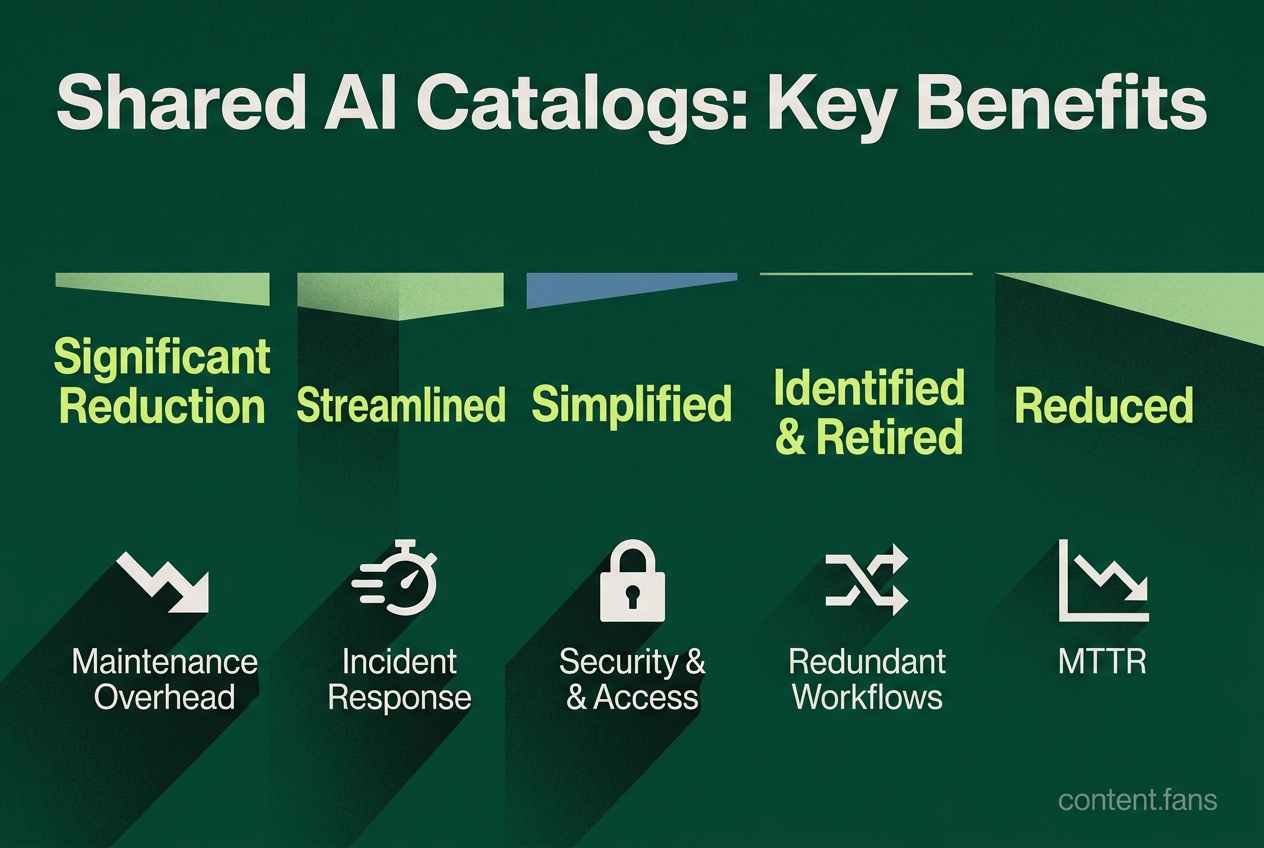
Shared agent catalogs reduce maintenance by providing a central registry for all AI agents, which helps platform teams identify and retire redundant workflows. This centralized model also simplifies security and access control, as updates to permissions or credentials propagate automatically to all agents using the platform layer.
The central visibility of a shared catalog makes it easy to spot duplicate or orphaned agents. By maintaining an inventory of "all models, prompts, tools and data flows," platform teams can quickly retire redundant workflows (Virtido). Embedding RBAC, encryption, and audit trails at the platform level also simplifies upgrades, as permission changes automatically propagate to every agent instance, reducing credential management overhead (JetRuby).
Shared catalogs also streamline incident response. When a workflow fails, operators can consult a single registry to identify the agent version and API involved. Industry reports suggest that teams without an agent inventory take significantly longer to isolate failures. This capability helps reduce mean time to recovery (MTTR) and creates a clear audit trail for compliance and regulatory purposes.
Measuring success inside the catalog
To gauge performance, SLOs should be structured across four key layers: resolution, quality, operations, and business impact. A standard catalog entry should define clear targets, such as:
- Effectiveness: Achieve meaningful resolution rates within defined timeframes.
- Safety: Maintain low hallucination rates through proper testing.
- Operations: Keep the cost per resolution below the target baseline.
- Business Impact: Ensure no decline in CSAT scores compared to a control group.
Linking these metrics directly to each agent's record allows teams to validate performance before expanding the agent's scope. All key performance indicators (KPIs) should roll up to a unified dashboard, a practice that applies to both shared and per-user agents and supports the continued use of hybrid models.
Shared catalog keyword reminder
The core recommendation remains consistent: build a small catalog of shared 'coworker' agents rather than per-user bots. This approach clarifies ownership and prevents configuration drift by sourcing governance data from a central platform instead of relying on individual, unmanaged assistants.
While shared catalogs significantly improve governance, they do not eliminate all risks. It is crucial to implement additional safeguards like runtime monitoring, human-in-the-loop (HITL) checkpoints, and strict approval gates for high-impact actions. Ultimately, the shared catalog is the foundational component that makes autonomous agents manageable for security, compliance, and engineering leaders.
Why are enterprises replacing per-user AI agents with shared catalogs?
Shared catalogs slash maintenance overhead by consolidating hundreds of duplicated, one-off agents into a single registry that is maintained once and reused everywhere.
- Significant reduction in duplicated agent builds is typical once a shared catalog replaces informal, per-user deployments.
- One central owner per reusable agent replaces dozens of separate code bases and prevents "shadow AI sprawl".
- Faster updates: a single prompt or integration change can be rolled out globally instead of touching each user's instance.
How do shared catalogs improve reliability and predictability?
Agents in a catalog pass the same certified test suite, are bound to explicit service-level objectives (SLOs), and inherit central observability, so behavior is consistent across teams.
- Production agents show improved autonomous resolution with shared standards versus ad-hoc deployments.
- High escalation accuracy is achievable when the same hand-off logic is reused, not reinvented.
- Low hallucination rates are realistic when test coverage and safety filters are built once and reused.
What information should every catalog entry record?
A useful entry is short but complete:
- Agent name and certified skills (e.g., "Invoice-Classification-L2")
- Owner and on-call contact
- SLO targets (e.g., resolution targets, cost per ticket thresholds)
- Latest test results + evaluation date
- Data sources and systems accessed
- Approval or governance stamp
Keeping these six fields current is enough to satisfy both IT maintenance tickets and compliance audits.
When should a team still choose per-user agents?
Per-user instances are justified only for highly personal or sensitive work:
- Executives' personal assistants
- Sales reps' private lead-capture notebooks
- Legal case-specific review agents where data must never cross clients
Even here, enterprises place the per-user agents on top of the shared control plane so security, logging, and access policies remain centralized.
How do you measure the success of a shared catalog?
Track four layered metrics that roll up to business value:
| Tier | Sample Metrics | Target |
|---|---|---|
| Effectiveness | Resolution rate, First-contact-resolution | Industry benchmarks |
| Safety | Hallucination rate, Policy violations | Minimal rates |
| Operational | Cost per task, Escalation rate | Cost reduction targets |
| Business | CSAT delta, ROI payback | CSAT maintained or improved |
Enterprises that achieve strong performance across these metrics report favorable ROI payback periods for customer-service catalogs and improved satisfaction scores compared with legacy per-user bots.