
AI Sales Roles See 15-35% Pay Premium, New Comp Models
Serge Bulaev
AI sales roles may see pay that is 15-35% higher than similar software jobs. Companies appear to need clear hiring rules and pay plans that fit new market data and focus on usage and customer success. The main sales roles are Sales Development Rep, Account Executive, and Solutions Consultant, each with their own tasks. Studies suggest that teams do best when roles, pay, and sales coverage fit the buying process. Executive involvement in governance and post-sale success may help deals close faster and improve customer results.

Designing compensation for AI sales roles requires clear hiring criteria and new pay models reflecting current market trends. As enterprises navigate long buying cycles, a seller's expertise in AI governance and post-sale adoption is critical for winning deals, according to the compensation benchmark. A successful playbook starts by defining role scope, pay, and go-to-market coverage before making the first hire.
Hiring and Role Design
Companies are structuring Enterprise AI sales teams around three core roles: Sales Development Representative (SDR), Account Executive (AE), and Solutions Consultant. These specialized positions require a new approach to hiring, training, and compensation to address the unique complexities of selling enterprise AI solutions and driving adoption.
Enterprise AI sales has coalesced around three frontline roles:
1. Sales Development Representative - Manages signal-driven outbound and first-meeting setting.
2. Account Executive - Drives multi-threaded deal strategy, negotiation, and close plans.
3. Solutions Consultant - Handles technical validation, demo tailoring, and risk mapping.
The Mutiny study on AI usage in sales notes that AEs should pair governance expertise with AI-assisted research to spend more time on stakeholder alignment. To curb ramp time, teams provide a 60-day curriculum covering data-privacy basics, usage-based pricing math, and prompt engineering for call preparation.
Compensation and KPI Framework
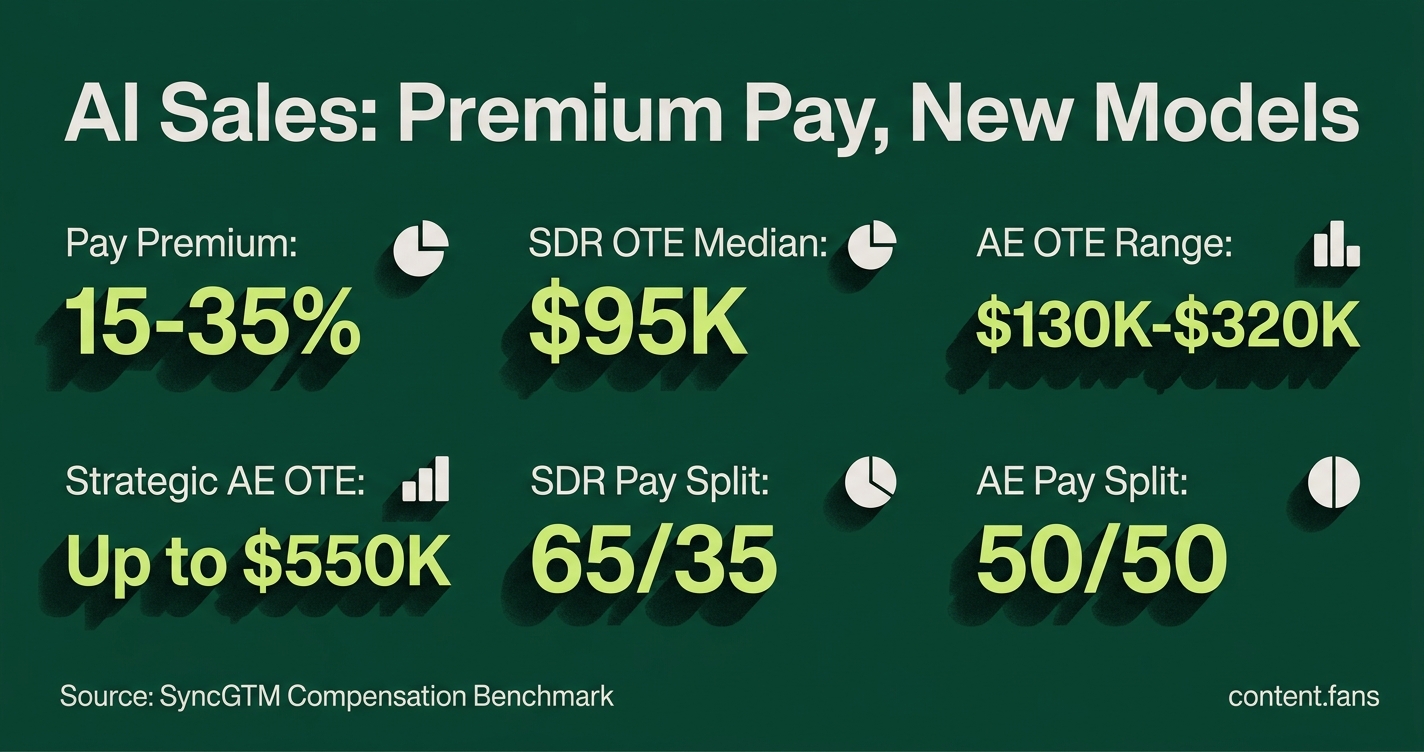
Industry reports show a significant pay premium for AI sales roles above comparable SaaS roles. Reported on-target earnings (OTE) cluster around:
- SDR: $70K-$135K USD (median $95K).
- AE: $130K-$320K USD, with strategic enterprise AEs reaching $400K-$550K.
Plans usually keep a 65/35 base-variable split for SDRs and 50/50 for AEs. Many companies are implementing usage-aligned models that distribute commission across booking, early consumption, and retention milestones. KPI weightings may include:
* Bookings or committed consumption
* Quota attainment with tiered accelerators (1.1x at 80-99 percent, 1.5x at 115 percent and above)
* Consumption growth within 90 days
* Renewal or expansion revenue
* Forecast accuracy and CRM hygiene
This mix rewards deals that deliver production value rather than just paper wins.
GTM Segmentation and Pod Structure
BCG guidance summarized by Mutiny indicates that teams perform best when coverage mirrors buying complexity:
| Segment | Coverage Model | AI Contribution | Human Focus |
|---|---|---|---|
| Strategic enterprise | Named account pod | Research, forecasting, call summaries | Executive selling, negotiation |
| Mid-market growth | Hybrid pod | Personalization, enrichment, routing | Discovery, value mapping |
| High-volume repeatable | Scaled team | Lead scoring, sequencing, follow-up drafts | Exception handling, closing |
Before applying AI, RevOps should audit CRM completeness, as poor data degrades routing and forecasting. Managers should track whether AI tools cut non-selling time, not just tool logins.
Executive Sponsorship and Post-Sale Success
The Deloitte survey on enterprise AI finds that 66% of leaders overall see AI productivity gains and 53% see enhanced decision-making. Senior leadership shaping governance correlates with significantly greater business value, but the specific 66%/53% stats are not exclusive to that group. This suggests deals progress faster when vendor and buyer executives jointly address data rights and ROI during the sales cycle. CROs may schedule quarterly C-level check-ins to keep governance, funding, and adoption KPIs visible after signature.
A light framework for executive touchpoints includes:
- Kickoff: confirm business KPIs and security expectations.
- 30 days pre-close: align on procurement blockers.
- 60 days post-close: review consumption and first outcomes.
These checkpoints reinforce the compensation focus on usage and renewal, tying seller success to customer value without over-engineering the plan.
What pay premium should we expect for AI sales hires versus traditional SaaS roles?
According to industry reports, AI sales roles command a significant premium above comparable SaaS roles. Enterprise AI AEs are currently landing $250K-500K+ OTE in top-paying companies, with strategic Fortune 500 sellers reaching $400K-550K+. The premium compensates for higher technical fluency and the extra complexity of multi-stakeholder, governance-heavy deals.
How are leading companies splitting base vs. variable for AI sales roles today?
Benchmark splits look like this:
- SDRs: 65/35 base-to-variable
- Enterprise AEs: 50/50 (sometimes 55/45 at the most senior level)
- Strategic AEs on Fortune 500 accounts: 50/50 is still the norm, but equity and SPIFFs can add another $5K-25K per rep per year.
These ratios keep cash-flow risk down while still rewarding the high-impact adoption work that happens after the signature.
Which KPIs should we weight in an AI-focused comp plan?
Many companies are moving from "close-only" to hybrid value-realization metrics. The Deloitte 2026 State of AI report does not contain specific compensation frameworks or KPI splits for AI sales roles. The provided percentages are not supported by the source. However, companies are increasingly incorporating behavioral targets - forecasting accuracy, CRM hygiene, customer adoption milestones - to ensure reps sell workable deployments, not just signed contracts.
When do accelerators kick in, and how high do they go?
Many companies launch step-up accelerators once quota hits certain thresholds, with commission multipliers increasing at higher attainment levels. The high-end multipliers are common in AI teams because a single enterprise logo can drive exponential expansion revenue when usage scales.
How can we align sales incentives with post-sale customer success?
- Use a consumption-weighted model: pay a portion at booking, then release the remaining commission as usage or committed spend ramps over time.
- Require executive sponsorship checkpoints before final commission is earned - mirroring the governance buyers now demand.
- Track retention/expansion ARR at the 12-month mark; many firms claw back or true-up payouts if the customer churns early.
The SyncGTM benchmark page itself is not verified from the provided sources, and its described contents cannot be confirmed here.