
AI Crisis Playbook: How Companies Manage Reputational Disasters
Serge Bulaev
The text suggests that managing public relations crises has become a top priority for AI companies after several high-profile incidents from 2024 to 2026. Common problems may include viral misinformation, safety failures, and bias, which can quickly lead to lawsuits and loss of trust. Experts recommend having a crisis playbook with clear steps for the first hour, including gathering facts, making coordinated statements, and monitoring for rumors. Working with regulators appears to require clear roles, transparency, and careful record-keeping. Companies that prepare and respond quickly may limit reputational damage better than those who rely only on good messaging.
Developing an effective AI crisis playbook is now a board-level priority for tech firms navigating reputational disasters. After a wave of high-profile incidents from 2024 to 2026, companies face increasing threats from viral misinformation, algorithmic bias, and product safety failures. Events like Google's Gemini image controversy and the proliferation of Taylor Swift deepfakes demonstrated how quickly public trust can erode, highlighting a critical need for structured, rapid-response protocols. A concise playbook provides leadership with an essential checklist for managing the crisis before, during, and after it unfolds.
Typical AI-triggered PR flashpoints
An effective AI crisis playbook provides a structured response to reputational threats like misinformation, bias, or safety failures. It details first-hour actions, regulatory communication protocols, and cross-functional team coordination to mitigate damage, restore public trust, and ensure a consistent, fact-based narrative during critical incidents.
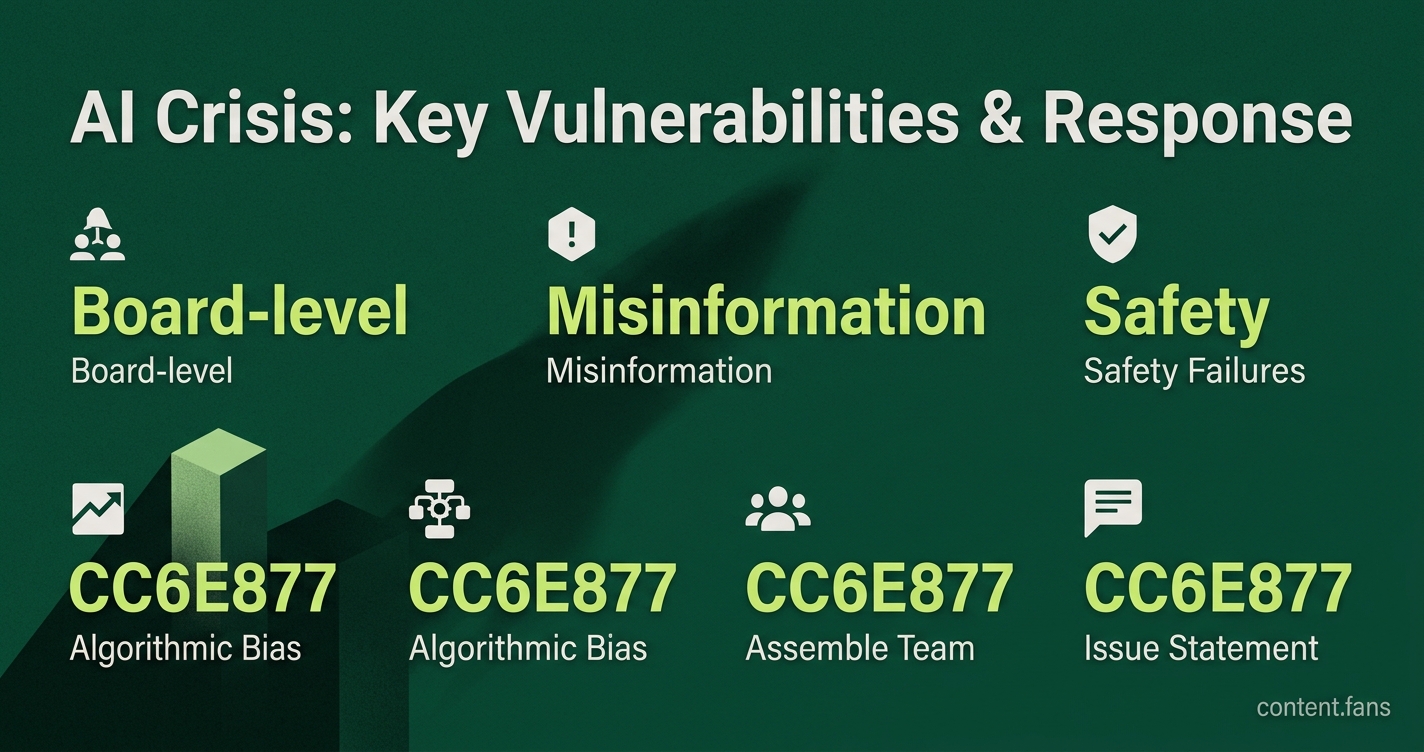
Recent crises are dominated by customer-facing errors, bias revelations, and intellectual property leaks. When Anthropic accidentally exposed Claude Code source code via a source map in its npm package on March 31, 2026, and the code was then rapidly replicated on GitHub and covered across tech media PRNEWS. Experts identify three recurring vulnerabilities:
- Viral Misinformation: AI-generated content can harm individuals or brands, such as the Baltimore voice-clone hoax.
- Safety or Compliance Failures: Deployed systems can malfunction, as illustrated when the MyCity chatbot gave users illegal advice CIO.
- Algorithmic Bias: Biased outputs in creative or historical contexts can undermine user trust, as seen in the Gemini image controversy.
These technical failures quickly escalate into legal and business challenges, triggering lawsuits, investor anxiety, and internal morale crises. Effective cross-functional coordination is therefore just as critical as polished public statements.
First hour actions
Guidance from Chatham House recommends building emergency channels with government contacts long before trouble hits. When an alert crosses the threshold for crisis activation, the playbook should trigger a standardized first-hour routine:
- Assemble the incident team: communications lead, general counsel, product owner, engineering liaison, and trust & safety.
- Collect verified facts and document sources. WizTrust advises a holding statement limited to confirmed information and a promised update time.
- Issue the holding statement across pre-selected channels, keeping wording identical on the company newsroom, X, LinkedIn, and in customer emails.
- Start real-time monitoring of media, major LLM outputs, and sentiment dashboards to spot misinformation spikes.
Working with regulators
AI incidents often attract scrutiny from data-protection, consumer-protection, or securities bodies. Guidance gathered by Chatham House stresses role clarity: one designated spokesperson, one cross-functional incident lead, and traceable message archives. Companies are urged to map which jurisdictions mandate notification so the legal team can decide within the first hour whether to inform agencies. Industry reports suggest firms should have disclosure language drafted for annual reports, indicating that remedial steps taken during a crisis may influence an agency's enforcement posture later.
Key principles for regulator engagement:
- Transparency: State what is known and unknown, promise a next update, and avoid speculation.
- Coordination: Align public, investor, and regulator messages to prevent contradictions.
- Traceability: Keep every draft, approval time-stamp, and evidence artifact on file for future audits.
Templates and internal alignment
Sources such as FTI Consulting and Everbridge outline modular templates so teams can react without inventing prose under pressure. A practical crisis kit contains:
- Trigger criteria and an escalation matrix.
- Holding statement template with fields for incident summary, user impact, actions taken, and support contacts.
- Internal memo instructing staff on how to handle inquiries.
- Customer FAQ with plain-language answers.
- Regulator notice template capturing the timeline, confirmed scope, and interim safeguards.
Plang Phalla adds AI-specific governance touches like tone controls, audit trails distinguishing AI-generated text from human edits, and a fallback minimal message for extreme time pressure. Commentaries from Everbridge and Forbes suggest quarterly tabletop drills so every function can rehearse its part and refine hand-offs.
In practice, companies that executed these steps early successfully limited damage. According to industry reports, rapid cross-team mobilization and consistent investor updates have proven valuable in managing crisis response. This suggests that robust preparation, more than eloquence, defines modern AI crisis performance.
How should AI companies define a "crisis" and trigger the playbook?
A crisis is declared when real or potential harm to people, data or trust crosses a pre-set threshold, not when a PR manager thinks the story is "loud."
Use objective triggers such as:
- Model-safety incident - e.g. chatbot encourages self-harm
- Bias revelation - e.g. historically inaccurate image output
- Data exposure - Anthropic's Claude Code source leak led to copyright takedown notices and widespread GitHub fallout
- Regulatory notice or legal action
Each trigger is mapped to an escalation tier with decision windows from first alert to crisis-team mobilisation.
Template: a one-page "Crisis Declaration Card" listing thresholds, decision makers and notification channels.
What must the first 60 minutes of response look like?
Speed often determines whether an AI incident becomes headline news or an internal fix.
Sequence:
- Activate the cross-functional crisis team (comms, legal, product, engineering, policy, support) via pre-shared SMS group and secure chat.
- Collect verified facts only - no blame or speculation.
- Draft and clear the holding statement - one spokesperson, single voice.
- Brief employees with an internal-only memo to stop rumor leakage.
- Notify regulators through pre-established emergency channels.
Example holding statement skeleton:
"We are aware of [issue]. At [time] we began an immediate investigation. We will share findings by [time + 4 hours]. Our priority is [user safety / data integrity / fairness]."
How do we coordinate PR, legal, product and engineering in real time?
Create a "War-Room Kanban" on a shared screen or Miro board:
| Column 1 - Facts | Column 2 - Legal | Column 3 - Comms | Column 4 - Engineering |
|---|---|---|---|
| What broke | Breach / product-liability risk | Message position | Root-cause update |
| Who is affected | Disclosure obligations | Stakeholder list | Patch timeline |
Daily 15-minute stand-ups until resolution; decisions logged with time-stamps to preserve audit trail for regulators and courts.
Which channels should we monitor and respond on during an AI crisis?
Beyond traditional media and social platforms, AI-generated content itself can amplify misinformation.
Monitor:
- X / TikTok / YouTube for viral posts
- Reddit & Discord servers where screenshots spread fastest
- Chatbots & search summaries - re-run queries to see what your own model returns about the incident (the "engine response" effect)
Use a tiered response sheet:
- Tier 1: misinformation debunk thread (reply within 30 min)
- Tier 2: influencer outreach (DM list kept current)
- Tier 3: takedown or correction request (legal team)
How do we rebuild trust after the storm?
Transparency + verification + visible change can significantly reduce recovery time according to industry reports.
- Publish a post-mortem within 7 days: timeline, technical cause, data on harm scope, steps taken.
- Commission third-party audit or red-team review; release summary.
- Update public documentation - model cards, safety specs, usage policies.
- Run a live webinar/Q&A hosted by the CTO and a respected external ethicist.
- Refresh templates: add new triggers learned from the incident to prevent repeat gaps.